Announcements

10 Year Anniverary & New Releases Winners: Carrie Fancett Pagels' Butterfly Cottage - Melanie B, Dogwood Plantation - Patty H R, Janet Grunst's winner is Connie S., Denise Weimer's Winner is Kay M., Naomi Musch's winner is Chappy Debbie, Angela Couch - Kathleen Maher, Pegg Thomas Beverly D. M. & Gracie Y., Christy Distler - Kailey B., Shannon McNear - Marilyn R.
Showing posts with label 17th Century. Show all posts

Friday, January 10, 2020

COLONIAL WILLIAMSBURG ~ Its establishment, decline, and restoration


Establishment:
Jamestown, the first capital of the Virginia colony was established in 1607. It remained there until 1699 when the Virginia Assembly relocated the capital inland to Middle Plantation. The town was later named Williamsburg after England's King, William III.

The rationale was to get away from Jamestown’s swampy conditions which fostered contaminated water, disease, poor living conditions, and flooding. Williamsburg, a mere seven miles inland is located on a peninsula between the James River and the York River, was at a higher elevation than Jamestown.

The Capital
Williamsburg quickly grew to be a center of economic, social, and political life in Virginia, the largest and most populated British colonies in America. 
At one end of its main street, named after his Highness William Duke of Gloucester, was the Capital. At the other end of DOG Street was the
William & Mary
College of William and Mary established in 1693.
 
The Royal Governor’s Palace was situated halfway between the two. 
Businesses, churches, a courthouse, magazine, and homes were constructed within the approximate 300 acres. In 1773, the nation's first mental health facility opened in Williamsburg. Large estates or plantations as well as smallholdings developed throughout the area.
The Royal Governor's Palace

Decline:
There were several reasons for Williamsburg’s decline in the latter part of the eighteenth century. In 1780, the capital of Virginia moved from Williamsburg to Richmond, a more central location in the Commonwealth. While some Tidewater residents were resistant to the move, Governor Thomas Jefferson was a strong advocate. The war with Britain was still underway and the enemy was shifting its focus to the southern colonies.  Williamsburg’s proximity to the Chesapeake Bay placed it dangerously close were there to be a naval or military invasion. Another factor was navigable rivers were the primary means of transportation. The James River flows right through Richmond. The Virginia Gazette, a primary publication also moved to Richmond. Williamsburg returned to be a rural quiet college town.

Restoration:
Dr. William A. R. Goodwin served as rector of Bruton Parish Church twice.
Bruton Parish
reconstructed in 1715 remains an active parish
First in 1903 when he led a campaign on the restoration of the church. After serving at a church in Ney York he returned to Williamsburg in 1923. Fascinated by Williamsburg’s historic past, and concerned by its modernization, he feared the town’s distinctive past and charm might be lost. Returning the town to its former glory would require immense financial resources. He first approached Henry Ford about the project to no avail. When he shared his vision to John D. Rockefeller, Jr he got the promise of financing required. Rockefeller authorized the hiring of an architect and the acquisition of key properties. 

Such a massive restoration was unprecedented. Records were searched to reproduce the former structures with accuracy. Thomas Jefferson’s architectural drawings for the Governor’s Palace aided in its rebuilding from 1930-1934. The town was being reconstructed and restored with the aid of historians, archeologists, and craftsmen of every sort.

The undertaking to develop the world’s largest living history museum that began in 1927 and continues to this day. Walking through the structures and streets of Colonial Williamsburg one can meet and chat with skilled artisans and interpreters all attired in eighteenth-century clothing. 
Shields Tavern
Dining at one of the period eateries is a treat. Visitors see a variety of accurately depicted conveyances, as well as animals that would have been a part of the community.
Coming to Williamsburg is like returning to the eighteenth century, filled with many learning and fun experiences--no doubt why so many people return.
Rush Hour in Colonial Williamsburg


Friday, September 13, 2019

Commemorating 400 Years of the First Representative Assembly in the New World


The Virginia Company of London, a joint-stock company, was created by King James to establish a colony in North America. The settlement of Jamestown was founded in 1607. The King and the Virginia Company of London chartered Burgesses (representatives in a given area) to oversee the colony.

Four hundred years ago, 22 Burgesses representing each of Virginia’s eleven major settlements met in the church at Jamestown, Virginia from July 30-August 4, 1619. They were the first Virginia General Assembly. Democracy in the Western Hemisphere was born along the banks of the James River on July 30, 1619.

On July 30, 2019, there were two events to commemorate the 400th anniversary. 
One occurred early in the morning, at the reconstructed Historic Jamestowne Church, where the Governor and a small group of officials, and some descendants of the first families met. 

Later the President of the United States was joined by former Governors, some Virginia legislators, a former clerk of the British House of Commons at the Jamestown Settlement for a joint session of the General Assembly.

1619 was a pivotal year for Virginia, the first permanent English colony in North America.
~ In addition to being the birthplace of the first Representative Assembly in the New World, Virginia welcomed the arrival of the first enslaved West Central Africans to English North America later that same summer.
~ By November English women were brought to Jamestown to establish families.
~ In December of 1619, the English ship Margaret landed at Berkeley Hundred, and celebrated the first Thanksgiving, over two years before the Pilgrims arrived aboard the Mayflower.
~ New laws passed that same year authorized Virginia’s colonists to initiate various industries, which established the basis for America’s free enterprise system.

Friday, July 13, 2018

NORTH AMERICA’S OLDEST ANGLICAN CHURCH BUILDING

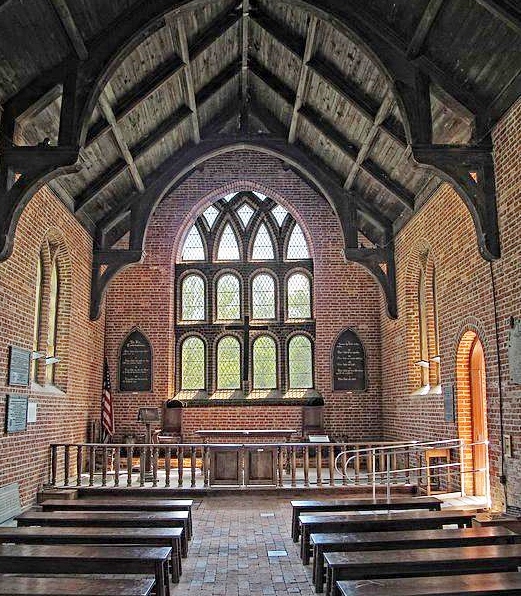
St. Luke’s Church, near Smithfield in Isle of Wight County, Virginia claims to be the oldest surviving church in Virginia still standing in the United States. According to local lore, the structure was built in 1632, however, much evidence suggests a date of 1682.

The church, a single-room brick structure with a twenty-foot-square tower began as an Anglican Church. When the Anglican Church
disbanded in America after the Revolutionary War and services were halted and not held again until 1821 when it became an Episcopal Church.

This church, also known as Old Brick Church is a gothic style, Flemish-bond brickwork building with buttresses, stepped gables, medieval,
timber trussed roof, and the original brick traceried windows. The building has undergone two renovations in its 336-year history. These restorations combine several architectural styles. The original clear diamond-paned, leaded glass windows were replaced with Tiffany-style, stained glass windows in the 19th century.

The primary entrance is through the tower archway. As one walks down the nave toward the chancel, there is some box seating in front for the gentry, with pews located behind. The current pews are more modern than the high-back pews that would have been there in colonial times.

Around 1652, Joseph Bridger, a young English royalist established Whitemarsh, the largest estate south of the James River and the second largest home in 17th-century Virginia. He was the principal financier of the St. Luke’s and some of his remains are prominently interred in the chancel of the church. 

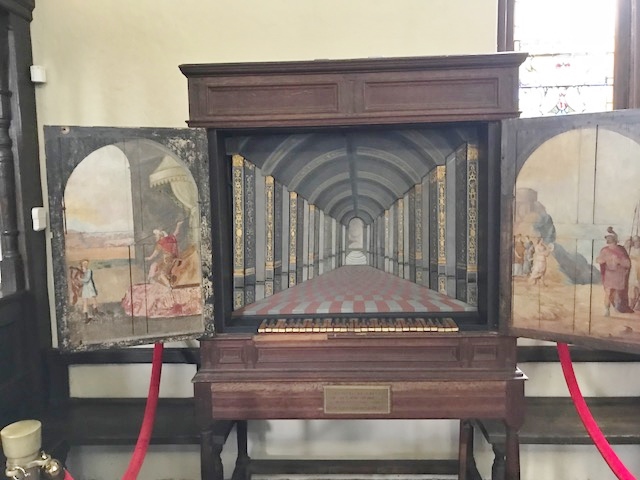
A rare 1630 English Chamber Organ, once owned by a family of Hunstanton Hall, Norfolk, England for over 300 years sits in the side of the chancel and is in playing order. It has a paneled oak case and painted front wooden pipes. The inside of the folding doors are painted with Biblical characters.

St. Luke’s, still an open cemetery, has gravestones from every era. A beautiful statue of St. Luke is situated where it can be easily seen by visitors.

St. Luke's was designated a National Historic Landmark October of 1966 and was listed on the National Register of Historic Places. In 1957 the site was designated a National Shrine at the time of the 350th anniversary of Jamestown.    

Visitors to St. Luke’s, 14477 Benns Church Blvd, Smithfield, VA 23430 can have guided tours seven days a week between February and December.

The Site is also available for private rentals including weddings, funerals, baptisms, and other special events.


If you are near Smithfield, Virginia, it’s well worth a visit.

Tuesday, September 12, 2017

This Month in Colonial History: September


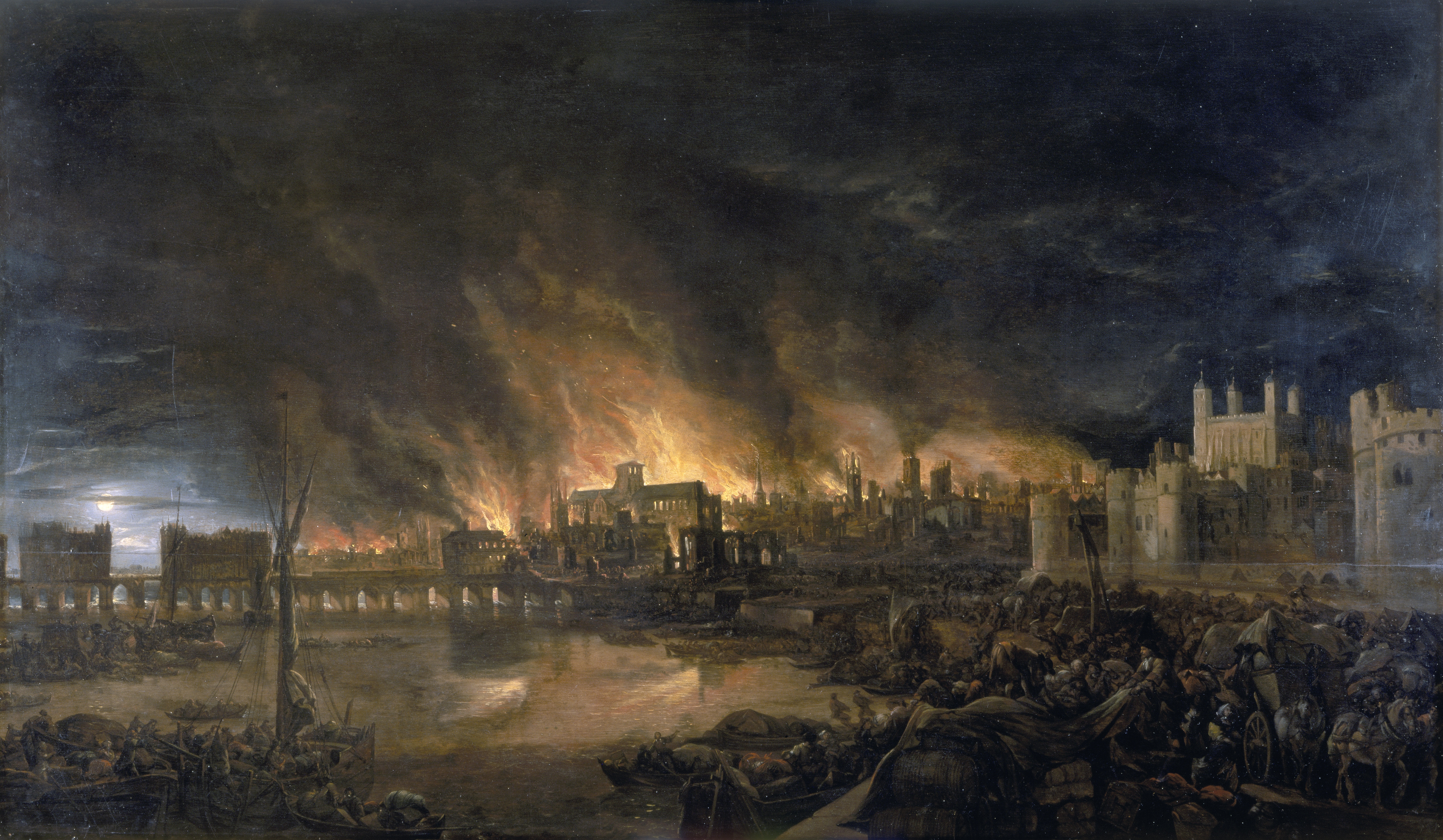
The Great Fire of London, unknown painter
1:  The death of King Louis XIV of France (the “Sun King”), who had ruled since age 5 and succeeded by his 5-year-old great-grandson, Louis XV.

2:  The Great Fire of London is started. More than 13,000 houses destroyed over 3 days, but supposedly only 6 lives lost. (1666)

2:  “The British ended their use of the Julian calendar, switching instead to the Gregorian calendar, resulting in a major adjustment as Wednesday, September 2, was followed by Thursday, September 14. The correction resulted in rioting by people who felt cheated and demanded the missing eleven days back.” (1752)

2:  The U.S. Treasury is established. (1789)

3:  The Treaty of Paris is signed, formally ending the American Revolution, by John Adams, Ben Franklin, and John Jay. (1783)

4:  Navigator Henry Hudson discovers the island of Manhattan. (1609)

4:  El Pueblo de la Reina de Los Angeles, or the Town of the Queen of the Angels, is founded by the Spanish governor of California, later to be known simply as Los Angeles. (1781)

5:  Russian Czar Peter the Great imposes a tax on beards. (1698)

5:  The First Continental Congress assembled in Philadelphia. Every colony represented except for Georgia. (1774)

6:  The Mayflower sets sail from Plymouth, England, after many trials and a few false starts, and still more unthinkable trials to come. Still, as leader William Bradford wrote, they “commited them selves to the will of God, and resolved to proseede” to the New World. (1620)

Marquis de Lafayette
6:  The birth of Marquis de Lafayette (1757-1834) in Chavaniac, France.

7:  The birth of Queen Elizabeth I (1533-1603) in Greenwich Palace, daughter of Henry VIII and Anne Boleyn.

8:  First Catholic settlement in America founded at St. Augustine, Florida, by Spaniard Don Pedro Menendez de Aviles. (1565)

9:  The United Colonies becomes the United States. (1776)

13:  New York City becomes the capitol of the United States. (1788)

14:  Composer George Frederick Handel finishes Messiah after 23 straight days of work. (1741)

14:  Napoleon enters a burning Moscow at the beginning of his disastrous Russian campaign. Fewer than 20,000 men of his original 500,000 survive. (1812)

14:  Francis Scott-Key composes the lyrics to “The Star Spangled Banner.” (1814)

15:  The birth of James Fenimore Cooper (1789-1851) in Burlington, New Jersey.

16:  “Mexico's break from Spain began in the town of Dolores Hidalgo as Father Miguel Hidalgo y Costilla rang his church's bells and exhorted local Indians to ‘recover from the hated Spaniards the land stolen from your forefathers...’” (1810)

16:  “A detachment of Marines under Major Daniel Carmick from the Naval Station at New Orleans, together with an Army detachment, destroyed a pirate stronghold at Barataria, on the Island of Grande Terre, near New Orleans.” (1814)

17:  The U.S. Constitution is unanimously approved by delegates from 12 states. (1787)

18:  Chile declared its independence from Spain after 269 years as a colony. (1810)

22:  Nathan Hale executed for spying. “I only regret that I have but one life to lose for my country.” (1776)

22:  Birth of Michael Faraday (1791-1867), discoverer of electromagnetic induction (moving a magnet through a coil of wire produces a current). Thus electric generators are developed.

25:  Sighting of the Pacific Ocean by Spanish explorer Vasco Nunez de Balboa, after crossing the Isthmus of Panama. (1513)

25:  Publication of the first American newspaper. “A single edition of Publick Occurrences Both Foreign and Domestick appeared in Boston, Massachusetts. However, British authorities considered the newspaper offensive and ordered its immediate suppression.” (1690)

25:  Ratification of the Bill of Rights. (1789)

26:  Birth of Johnny Appleseed, as John Chapman (1774-1845) in Leominster, Massachusetts.

26:  The U.S. Postal Service was founded. (1789)
Sam Adams, 1772, by Copley

27:  Birth of Samuel Adams (1722-1803) in Boston, Massachusetts.

28:  Duke William of Normandy begins the conquest of England at Pevensey, Sussex. (1066) Relevant to the colonial era because, well, Britain. :-)

28: Discovery of California by Portuguese navigator Juan Rodriguez Cabrillo upon his arrival at San Diego Bay. (1542)

29:  U.S. Army created by Congress, with just 1,000 enlisted men and officers. (1789)

  My thanks to The History Place, Holiday Insights, Marine Corps University, Smithsonian Magazine, and Wikipedia. :)

Monday, August 14, 2017

This Month in Colonial History: August

May I present the August edition of interesting and notable happenings during the colonial and early Federal eras ...

1:  Francis Scott Key (1779-1843), composer of “The Star Spangled Banner,” is born.

1:  The first U.S. Census is completed. There are four million people in the U.S. in 1790.

1:  Slavery is abolished in Jamaica, where it had been introduced by the Spanish in 1509. (1838)

2:  Most of the 55 members of the Continental Congress sign the Declaration of Independence, in Philadelphia. (1776)
1490 map by Bartolomeo and Christopher Columbus
3:  “Christopher Columbus sets sail from Palos, Spain, with three ships, Nina, Pinta and Santa Maria. Seeking a westerly route to the Far East, he instead landed on October 12th in the Bahamas, thinking it was an outlying Japanese island.” (1492)

4:  Dom Perignon invents champagne. (1693)

5:  First British colony in North America claimed by Sir Humphrey Gilbert, in the St. John’s harbor area of Newfoundland.

5:  Birth of John Eliot (1604-1690), "Apostle to the Indians." The first Bible printed in America was his translation of the Bible into a native language.

6-10:  The Constitutional Convention’s Great Debate. Outcomes included the establishment of a four-year term of office for the President, granting Congress the right to regulate foreign trade and interstate commerce, and the appointment of a committee to prepare a final draft of the Constitution. (1787)

7:  President Washington creates the Order of the Purple Heart. (1782)

7:  Through an Act of Congress, the Federal Government takes over the creation and maintenance of the nations' lighthouses. (1789)

8:  The Daughters of the American Revolution organization is created. (1890)

10:  The village of Chicago is incorporated. (1833)

12:  Metacom, leader of the Pokanokets, a tribe within the Wampanoag Indian Federation, is assassinated, resulting in the end of a two-year uprising known now as “King Philip's War.” (1676)

16:  The Battle of Bennington in Vermont ... local militiamen and Massachusetts troops wipe out a detachment of 800 German-Hessians sent by British General Burgoyne to seize horses. (1777)

16:  The Battle of Camden in South Carolina ... major defeat for Continentals under General Gates by troops of British General Charles Cornwallis, resulting in 900 Americans killed and 1,000 captured. (1780)

17:  Birth of American frontiersman Davy Crockett (1786-1836) in Hawkins County, Tennessee. Died at the Alamo.

18:  Birth of Meriwether Lewis (1774-1809) near Charlottesville, Virginia.

24:  St. Bartholomew’s Day Massacre in Paris and throughout France. Thousands of Protestant Huguenots died at the hands of Catholics. (1572)

24-25:  The Battle of Bladensburg, in defense of Washington, D.C. The Capitol, White House, and many other buildings, public and private, are burned by the British in retaliation for the American burning of York (Toronto). Participants in the defense of D.C. include a 100-man detachment from the Marines. (1814)

28:  Birth of Johann Wolfgang von Goethe (1749-1832) in Frankfurt am Main, Germany, author of the dramatic poem Faust, completed in 1831.

28:  Birth of the first American-born Roman Catholic saint, Elizabeth Ann Seton (1774-1821; born as Elizabeth Ann Bayley) in New York. Founder of the first American Catholic religious order, the Sisters of Charity of St. Joseph, and the an elementary school in Baltimore, marking the beginning of the parochial school system in the U.S in 1809.

29:  Birth of John Locke (1632-1704) in Wrington, England. Son of Puritans, this physician, philosopher, and essayist would deeply influence the Whig cause of England and all of Western thought.

29:  Sinking of the British battleship Royal George, resulting in the drowning of 900 men. (1792)

29:  Birth of physician and author Oliver Wendell Holmes (1809-1894) in Cambridge, Massachusetts.

30:  Birth of author Mary Shelley (1797-1851) in London.

31:  Beginning of Shays' Rebellion in Massachusetts, by ex-Revolutionary War Captain Daniel Shays leading an armed mob, to prevent the Northampton Court from holding a session to try and imprison debtors, mostly poor ex-soldier farmers. (1786)

As always, my thanks to The History Place, Holiday Insights, and Marine Corps University. And Wikipedia. :)

Friday, January 27, 2017

INDENTURED SERVANTS IN COLONIAL AMERICA

In my guest post for Colonial Quills, Coming To America, September 16, 2011, I delved into the subject of immigrants coming to the colonies as indentured servants.

Indentured Servants were emigrants who signed contracts, or “indentures,” committing themselves to work for a fixed number of years, usually four to
seven, in payment for their passage. The captain would transport the indentured servants to the American colonies, and sell their legal papers to colonists; farmers, planters, and shopkeepers, thereby providing them a labor force.

That post examined some of the reasons people left their homeland to start a new life in the young colonies. It also detailed some of the challenges they endured to cross the Atlantic and what they experienced upon arrival.

Indentured servitude was a subject that has interested me for a long time and was the basis for the story I wrote, A Heart Set Free, a tale of an indentured servant who travels from Scotland to the Virginia colony in 1770.

The research I did for the story was fascinating. Since my character, Heather Douglas emigrated from Scotland; I primarily studied the people signing indentures from the British Isles.

Poverty and unemployment were rampant in early seventeenth century Britain, which prompted many to seek a better life in the colonies. Poor crop years in the eighteenth century also brought people from there and northern Europe to the colonies.

The Enclosure Acts, a series of Parliamentary Acts in England passed between 1750 and 1860, and the high cost of rents caused many from England and Scotland to emigrate. Impoverished Ireland also caused many to emigrate for what they hoped would be a better life.

The ages of men and women who indentured themselves varied in ages from the teens through those in their sixties. They came from rural areas and cities throughout England, Scotland and even Ireland.

Most indentured servants were laborers and often uneducated. As the slave
trade became more common, particularly in the south, many indentured servants learned trades. They did wool spinning, tailoring, hat making, retailing, baking, brewing, butchering, leather processing and smithing of all sorts, and the construction trades also apprenticed bondservants in carpentry, joinery, masonry, plastering, wheel-righting, and shipbuilding.

It was not uncommon for bondservants to prosper once their term of service was over.

I was surprised to learn that as many as 48% of European immigrants to all 13 colonies before 1775 were indentured. The onset of the American Revolution reduced the entry of indentured servants significantly.


If your ancestors came from Western Europe before the Revolution, It is likely that some may have been indentured.

Friday, January 20, 2017

Abolitionism in Colonial America

by Tamera Lynn Kraft

Most people think abolitionism didn't really come to be until the early 1800, but abolitionist views in America started almost as early as slavery in America.


The first Africans that came to America, according to some historians, were sold to Jamestown colonists in 1619 as indentured servants although some say there were already Africans there. The twenty men had been stolen from a Portuguese slave ship and were allowed land and freedom when there period of service was done, but by the 1630s, some colonists were keeping African servants for life. John Punch, in 1640, was the first documented indentured for life servant. In 1662, the law recognized slavery and instituted statutes that any children born would follow the status of their mother making it so children could be born slaves.

The first dispute against this practice was that Christians could not own their brothers in Christ. If a slave was baptized in the faith, he had to be freed. In 1667, the General Assembly outlawed freedom by baptism. By 1705, an array of slave codes were enacted, and half of the labor force in Virginia. In the 1620s, the Dutch West India Company introduced slavery to New England, and be 1700, slavery was established as an institution there as well.


Even though slavery was being established in the colonies, there was a movement growing to end the practice. Throughout the 17th century, many evangelicals and Quakers came out against slavery.  As early as 1688, four Quakers in Germantown signed a protest against the practice of slavery and made their case that the practice was not Christian and against Biblical precepts. In the 1730s and 1740s, during the Great Awakening, preachers decried owning slaves as sin.

During the American Revolution, Moravian and Quaker preachers convinced over a thousand slave owners to free their slaves. The newly formed states debated whether to allow slavery to continue. It was finally decided to outlaw the slave trade within twenty years and allow each state to decide for itself. The economy in the South was also encouraging freedom for slaves. Planters were shifting from labor-intensive tobacco to mixed-crop cultivation and needed fewer workers.


After the American Revolution, northern states gradually outlawed slavery. In 1808, the United States criminalized the slave trade and outlawed any new slaves being brought to America. If it hadn't been for Eli Whitney's cotton gin patent in 1794, slavery may have only been a footnote in history. The cotton gin overnight made the practice of slavery profitable. We'll never know if the invention had been delayed twenty years, if that would have ended slavery. Either way, it didn't end abolitionism. The abolitionist movement that started in Colonial times would continue to grow until a war forced the end of slavery in the United States.


Tamera Lynn Kraft has always loved adventures and writes Christian historical fiction set in America because there are so many adventures in American history. She has received 2nd place in the NOCW contest, 3rd place TARA writer’s contest, and was a finalist in the Frasier Writing Contest. Her novellas Resurrection of Hope and A Christmas Promise are available on Amazon and at Barnes and Noble.