Announcements

10 Year Anniverary & New Releases Winners: Carrie Fancett Pagels' Butterfly Cottage - Melanie B, Dogwood Plantation - Patty H R, Janet Grunst's winner is Connie S., Denise Weimer's Winner is Kay M., Naomi Musch's winner is Chappy Debbie, Angela Couch - Kathleen Maher, Pegg Thomas Beverly D. M. & Gracie Y., Christy Distler - Kailey B., Shannon McNear - Marilyn R.
Showing posts with label North American explorers. Show all posts

Friday, November 6, 2020

In Search of Riches - the Trade that Shaped the Colonies (and New Fiction!)

It began with gold, silver, and...fur!

From the early days of Europe's exploration and conquest in the New World, there was expectation of awaiting riches for those willing to search out and plunder them. Precious metals like gold and silver discovered in the Aztec and Incan empires fed that notion, so when Jacque Cartier headed up the St. Lawrence River between 1534 and 1542, he anticipated finding similar treasure. Of course he hoped to uncover a water route to Asia too, where there was wealth to be had in silk and spices, but in the end, he discovered none of those things. 

Jacques Cartier

He did, however, find another valuable item. He found furs being trades among the native tribes in vast quantities. Back in Europe, certain fur-bearing animals like the beaver had gone nearly extinct, yet the demand for fur coats, collars, and hats was on the rise. 

Beaver Fur Top Hat

Often when we think of the Colonial period of American history, we think only life within the bounds of those first thirteen colonies and the obvious birth pains that brought about Colonial independence. But without the fur trade that was pressing exploration further into the continent, many of those birth pains might not have existed for many more generations.

Early on, the British were content to control the land east of the Appalatians, and France remained to the north, while Spain was more concerned with the Gulf Coast. But as the desire grew back in Europe for more fur, those countries began to expand their horizons beyond their small settlements and to push against one another. This is just the beginning of the fur trade story that led to the final settling of North America.

The era of the fur trade is one that resonates deeply with me, and it's part of the reason I wrote Mist O'er the Voyageur, my 2019 Selah Award finalist and 2-time Book-of-the-Year nominee. Now I have cause to celebrate that I've signed a contract for the sequel that will be published in a little over a year. Song for the Hunter will continue the story begun in Mist O'er the Voyageur, and it will further explore the people and practice of the fur trade in the Lake Superior region in 1807.

In the months ahead, as I work on edits and rewrites for my publisher, I'll also share more history of the fur trade that helped shape Colonial America and beyond, and I'll cover some aspects that I didn't during the writing and production of Mist O'er the Voyageur.

Stay tuned...

And while I have you here, please share my further joy as I celebrate my post-WWII farm girl romance THE LOVE COWARD that releases TODAY.


I wish you a full heart and many reasons to be grateful this Thanksgiving season.
Naomi
https://naomimusch.com/


Friday, March 6, 2020

Étienne Brulé, Lake Superior's First European Visitor

Being a Midwesterner, when I think of the Colonial era, I almost always consider what was going on in other parts of the continent west, north, or south of the Alleghenies during that time. Colonization was pushing into those regions also, as the race was on between European countries to settle our massive continent and wrest it from anyone here before them.

About the time the Pilgrims were landing on Plymouth Rock, French explorer Étienne Brulé was already visiting Lake Superior's Apostle Islands just off the north shore of present day Wisconsin. He was the first European explorer to venture beyond the St. Lawrence River into Canada. 


Brulé was born not far from Paris, France, but it is believed he came to the American continent in the company of Samuel de Champlain in 1608, ahead of other well-known explorers. In Champlain's writings, he referred to Brulé as "my lad" and remarked on his ambition and abilities. Because of Brulé's desire to see what laid beyond the Richelieu River and Lake Champlain and to know about the Algonquin people, Champlain sent him off to seek a route that would carry them westward to the great lake they'd heard about. So Brulé became a true pathfinder. He mastered Huron language and culture. When next he met with Champlain, Champlain noted how Brulé had taken on the manner of dress of his Indian allies, and that Brulé gave a good report of his time spent among them. When Champlain "discovered" Lake Huron, he met his young interpreter already there and gave him permission to continue on further south, as was his desire.

Over the next couple of years, Brulé continued his travels among the native peoples deep in the interior. He remarked on the many powerful and warlike nations (the Iroquois, of whom he was at one time captured by and tortured, then saved by his own wits). He made his way as far as the junction of lakes Erie and Ontario and then to the Susquehanna River. He was the first to explore Pennsylvania. 


Brulé was eventually denounced by a friar for his immoral life-style among the Indians and was further discredited for not being on the up-and-up with France, playing a two-sided game of working for the administration under Champlain but also for the fur merchants who opposed him.  


In 1629, after Champlain gave up his colony (Quebec) to England's Kirke brothers, he wanted Brulé to return to France with the company, but Brulé, along with a fellow interpreter Nicolas Marsolet, claimed they'd be hung if they returned, so they remained behind. 


Later on, while the colony was still under English rule, the young and adventurous Étienne Brulé was killed by the Hurons he knew so well. Word reached Champlain in 1633.


It's hard to imagine these explorers and their native allies covering such vast amounts of rough country and becoming so well adjusted to the life styles they took on. I love thinking about those days, the grandeur they first laid eyes on, and trying to coax from my visions of that time something akin to what it must have been like, don't you?


Naomi Musch

https://naomimusch.com/

Friday, March 1, 2019

The Coureur Des Bois -- Rebel Adventurers of the Colonial Frontier

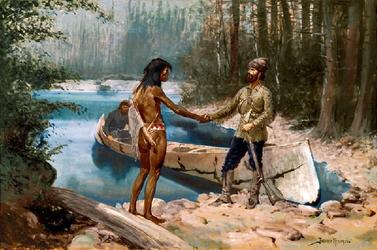
When we think of the explorers who opened up our vast continent, we tend to think of the great frontiersmen like Daniel Boone or overland adventurers like Lewis and Clark. But there was another type of explorer who, while less famous individually, collectively made untold inroads into the North American continent. They were the many intrepid Frenchman or Scots called simply, the Coureurs Des Bois.

Picture

Their English counterparts on Hudson Bay would have been called "woods-runners", and to the Anglo-Dutch of Albany they'd have been known as "bush-lopers". What was common between all of them was that they were drawn into the independent fur trade by the lure of adventure, freedom, and money.

A coureur des bois in the painting, La Vérendrye at the Lake of the Woods, circa 1900-1930 by Arthur H. Hider (1870-1952)

Note: The name Coureurs Des Bois is occasionally interchanged with that of the voyageurs, but while some coureurs des bois may have been enlisted as voyageurs, in fact, the coureurs des bois predated the influx of the voyaguers who were the canoe travelers hired to work for the big fur companies like the North West Company, the Hudson's Bay Company, the XY Company, or the American Fur Company.

While licensed fur traders had the blessing of the government and the fur companies, the coureurs des bois were unlicensed to trade, though trade they did. That's right. They were the rebels of the forest.

The French King, in an attempt to regulate trade, had created laws which forbade anyone to go into Indian country to trade except those of the monopoly company. Licenses were granted, but only to a select few. The government preferred the native population to bring their furs directly to French merchants. But as population increased, more and more young men looked to the fur trade for their living, and with only minimal licenses being issued, that meant they had no choice but to work independently. Young men began deserting their assigned seignories (farms) in New France and escaped to the wilderness, drawn by the prospect of fortune as well as the lure of an unstructured life in the Indian villages. It has been estimated that, by the end of the seventeenth century, possibly as may as one-third of able-bodied men had chosen the life of the coureur des bois, choosing to break the law and escape to the wilderness to trade for furs themselves. Once they had a taste of the free-roving, adventurous life of the coureur des bois, they seldom returned to the colonies or their farms, even though the punishment, if caught, would be severe.

These independent traders thought that operating outside government regulation a risk worth taking and a life worth living. They genuinely enjoyed the camaraderie of the First Nations people with whom they often settled and raised families, and they became fluent negotiators and adept guides.

You might think that since the coureurs des bois did their work illicitly, colonists would refuse to trade with them. However, not only did the colonists trade with them, when times were tough, colonists often took part in the trade and became coureurs des bois themselves.

You may recall in my article last month, I wrote of the explorer Du Luth, who belatedly recalled that'd he'd gone on his adventure without the proper license, and made a hurried attempt to remedy the situation by claiming all the land he explored for the King of France. There were some other famous explorers who began as coureur des bois as well. Here are several of the most notable:

  • Radisson and Groseilliers were brothers and coureurs des bois credited with establishing the Hudson Bay Company.
  • Étienne Brulé was the first European to see the Great Lakes.
  • Jean Nicolet explored the region around Green Bay and established peace with the Indians there.


etienne_brule
Etienne Brulé
The coureur des bois were itinerant bush-rangers, whose explorations and inroads into the continent paved the way for many to follow.

Imagining the adventure~
Naomi Musch

https://naomimusch.com/