Announcements

10 Year Anniverary & New Releases Winners: Carrie Fancett Pagels' Butterfly Cottage - Melanie B, Dogwood Plantation - Patty H R, Janet Grunst's winner is Connie S., Denise Weimer's Winner is Kay M., Naomi Musch's winner is Chappy Debbie, Angela Couch - Kathleen Maher, Pegg Thomas Beverly D. M. & Gracie Y., Christy Distler - Kailey B., Shannon McNear - Marilyn R.
Showing posts with label voyageurs. Show all posts

Friday, March 1, 2019

The Coureur Des Bois -- Rebel Adventurers of the Colonial Frontier

When we think of the explorers who opened up our vast continent, we tend to think of the great frontiersmen like Daniel Boone or overland adventurers like Lewis and Clark. But there was another type of explorer who, while less famous individually, collectively made untold inroads into the North American continent. They were the many intrepid Frenchman or Scots called simply, the Coureurs Des Bois.

Picture

Their English counterparts on Hudson Bay would have been called "woods-runners", and to the Anglo-Dutch of Albany they'd have been known as "bush-lopers". What was common between all of them was that they were drawn into the independent fur trade by the lure of adventure, freedom, and money.

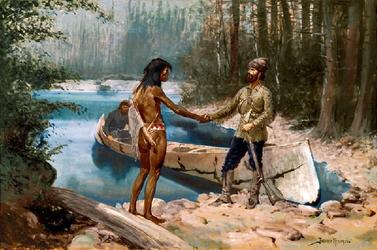
A coureur des bois in the painting, La Vérendrye at the Lake of the Woods, circa 1900-1930 by Arthur H. Hider (1870-1952)

Note: The name Coureurs Des Bois is occasionally interchanged with that of the voyageurs, but while some coureurs des bois may have been enlisted as voyageurs, in fact, the coureurs des bois predated the influx of the voyaguers who were the canoe travelers hired to work for the big fur companies like the North West Company, the Hudson's Bay Company, the XY Company, or the American Fur Company.

While licensed fur traders had the blessing of the government and the fur companies, the coureurs des bois were unlicensed to trade, though trade they did. That's right. They were the rebels of the forest.

The French King, in an attempt to regulate trade, had created laws which forbade anyone to go into Indian country to trade except those of the monopoly company. Licenses were granted, but only to a select few. The government preferred the native population to bring their furs directly to French merchants. But as population increased, more and more young men looked to the fur trade for their living, and with only minimal licenses being issued, that meant they had no choice but to work independently. Young men began deserting their assigned seignories (farms) in New France and escaped to the wilderness, drawn by the prospect of fortune as well as the lure of an unstructured life in the Indian villages. It has been estimated that, by the end of the seventeenth century, possibly as may as one-third of able-bodied men had chosen the life of the coureur des bois, choosing to break the law and escape to the wilderness to trade for furs themselves. Once they had a taste of the free-roving, adventurous life of the coureur des bois, they seldom returned to the colonies or their farms, even though the punishment, if caught, would be severe.

These independent traders thought that operating outside government regulation a risk worth taking and a life worth living. They genuinely enjoyed the camaraderie of the First Nations people with whom they often settled and raised families, and they became fluent negotiators and adept guides.

You might think that since the coureurs des bois did their work illicitly, colonists would refuse to trade with them. However, not only did the colonists trade with them, when times were tough, colonists often took part in the trade and became coureurs des bois themselves.

You may recall in my article last month, I wrote of the explorer Du Luth, who belatedly recalled that'd he'd gone on his adventure without the proper license, and made a hurried attempt to remedy the situation by claiming all the land he explored for the King of France. There were some other famous explorers who began as coureur des bois as well. Here are several of the most notable:

  • Radisson and Groseilliers were brothers and coureurs des bois credited with establishing the Hudson Bay Company.
  • Étienne Brulé was the first European to see the Great Lakes.
  • Jean Nicolet explored the region around Green Bay and established peace with the Indians there.


etienne_brule
Etienne Brulé
The coureur des bois were itinerant bush-rangers, whose explorations and inroads into the continent paved the way for many to follow.

Imagining the adventure~
Naomi Musch

https://naomimusch.com/

Friday, November 2, 2018

Historical Artwork that Inspired Story

Like many writers, when I begin to plot and plan a novel, one of my favorite activities is to collect photo inspiration for the story. Sometimes this comes after the story is written, but often there are items, places, and people that have inspired settings or characters in the book, and I like to have an image of them.

One of those inspirations for my new release Mist O'er the Voyageur was the fascinating artwork of several artists of history.


  • Frances Anne Hopkins 
Mrs. Hopkins lived from 1838-1919. She was the wife of a fur trader - the Hudson's Bay Company (HBC) official Edward Hopkins. One of her early paintings, Canoes in a Fog, Lake Superior, was selected by the Royal Academy for exhibition in London while she was a young wife and mother in Montreal in 1869. That painting helped to inspire the title for my book Mist O'er the Voyageur:


One of her most famous paintings also fed my imagination, and I am fortunate to have a print of this 1889 classic called Shooting the Rapids:

Mrs. Hopkins lived a very interesting life, and if you'd like to learn more about her, I recommend reading this post: http://www.hbcheritage.ca/people/women/frances-anne-hopkins

  • Arthur Heming 
Mr. Heming was  both a novelist and a painter from Canada who didn't merely dream up his visual depictions in his tales or paintings, but he also spent a great deal of time in the wilderness and was able to depict the harsh life, danger, and skills of the voyageurs from personal experiences. His work entitled Canadian Express shows the challenges the voyageurs faced as the freight haulers to and from the wilderness forts:


This one depicts the voyageurs taking a rest, referred to as "a pipe" and is aptly titled Taking a Pipe:


  • Michael Gnatek
  • Paul Calle


Michael Gnatek passed away in 2006, but not before accumulating a fabulous gallery of historical military art from various periods. I love his painting of a mountain man wearing a Hudson's Bay blanket capote. His work reminds me of another contemporary artist, Paul Calle, whose paintings are so details, right down to the weathered facial lines in mountain men and trappers. I am blessed to have two of Paul Calle's prints on my living room walls.  Do to copyright, I won't post the images, but I hope you'll check out the links:


The two Paul Calle prints on my wall. Here they are on Pinterest:

THROUGH THE TALL GRASS by Paul Calle
END OF A LONG DAY by Paul Calle

  • Margaret Killarney
Another contemporary artist, Margaret Killarney, another oil artist from Ontario, draws you into her paintings of the northern Lake Superior shoreline the way a stained-glass window beckons you into glorious prisms of light. Her work has even been featured on the cover of Lake Superior Magazine. Check out the beautiful imagery on her site:


  • Original Photographs of the Past by Various Historical Photographers
Though I can't share the actual photos which belong to the Minnesota Historical Society, please take a look at this piece written by Paul Peter Buffalo, as he chronicles his historical heritage along with a number of photos depicting native individuals and families (mostly Chippewa) along with their lodgings, handiwork, and lifestyle from long ago:

WINTER WOOD AND WIIGWAAMS by Paul Peter Buffalo


These are just a few of the artists that contributed imagery to my imagination as I penned Mist O'er the Voyageur. I must also say that when I first saw the cover for Mist, I let out a squeal of glee. I cannot overlook the talent of graphic artists who can compose the work of photographers and other artists into such beautiful book covers able also to capture our literary imaginations.


I hope you enjoyed taking in  some of this fabulous artwork. If you'd like to see more, follow my Pinterest board: Amazing Art, and also the boards for my individual book titles. Hmm...why not just follow them all? ;)

Here's to every artist out there!
Naomi

Friday, October 5, 2018

Fur Trade History Comes Alive at the Lester River Rendezvous! (Enter a Rafflecopter Giveaway!)

Rats! I missed the firing of the cannon. Three times! Every time the reenactors prepared to fire the cannon last weekend at the annual Lester River Rendezvous, I was engrossed in some other amazing learning experience and didn't get to watch. I sure heard it though! I had been anticipating the rendezvous most of the summer, not unlike the northerners of a bygone era.

For nearly a century, primarily in the 1700s and early 1800s, trappers, traders, Native Americans, Métis, Frenchmen and Scots, British and American -- among them the flamboyant voyageurs -- arrived from points scattered throughout the wilderness for the yearly festivities called the rendezvous. Rendezvous took place at important forts all throughout the Great Lakes region. At these locations, men who'd lived a rugged existence in the wilderness harvesting furs, company clerks, or bourgeois company men arriving from the east, came together to engage in the exchange of pelts for goods. In the process a fortune was made for the North West, XY, and Hudson's Bay companies. But the rendezvous was also a time when all these wilderness folk enjoyed revelry, feasting, gaming, and occasionally brawling. The event would last for several weeks in summer, then just as quickly when it ended, everyone would disperse. The hunters and trappers returned to the forest and native villages, the clerks to their posts, the voyageurs to winter in the Upper Country or back to Montreal with canoes mounded with bales of pelts, eager to satisfy the European hunger for fur.

This last week I attended a re-enactment of one of those events just north of Duluth, Minnesota on the Lester River where it twists and tumbles over rocks and down the hill. There it spills into magnificent Lake Superior. I couldn't absorb the experience any more eagerly! Here are some highlights.


This fellow went by the rendezvous name of Jacques LeChristian. I asked him right off if he was a bourgeois trader, and his eyes brightened. "Why, yes I am!" he said. Later in the day I purchased a CD of voyageur legends told by my new friend Monsieur LeChristian.

The  Lester River Rendezvous is set up mostly as an educational village open for two days to school groups, and then one day for the general public. Thousands of visitors enjoy free entrance onto the site where they can partake in food and music, and most excitingly, a visit to the Voyageurs' Village.

Here I am on the river, experiencing the excitement of the rendezvous which has so much to do with the time and setting my new novel Mist O'er the Voyageur coming out next Wednesday.                                                                                                         
             
I enjoyed a number of demonstrations of how people used to live during those times while I strolled through Voyageur Village at the rendezvous. In future posts, I'll give some of the "how to" details I learned for everything from rendering bear fat to starting a fire with char cloth and flint.


The lady above was of Métis heritage. I enjoyed hearing her talk about her ancestors and the vital role of the Métis in the fur trade and voyageur era. She also sewed all these beautiful costumes!


This lady was busy tanning hides. She described various processes to do it, depending on the type of finished product. Here, she is softening a rabbit hide. She also had a large number of other interesting items on display including this box of glass beads. Beads were a popular trade item during for many years.


The lady in the photograph above is making sour dough cinnamon rolls. Not so unusual in itself. However; she's also teaching about the process of making and keeping sour dough, and she's baking them over the fire in a "Dutch oven". More on that in a future post!


This red-hatted fellow was so engaging! He had the children and adults enraptured as he demonstrated the method used to build fires back in a time when matchsticks hadn't been invented. He had to take special precautions with that beard! 


Above we have the tinsmith selling his wares, and below is the blacksmith. I wish I could have invested in the beautiful ax or some of the gorgeous knives he created. I settled for a lovely little robe hook for $2. Now that's an affordable souvenir!


Talk about a pot of soup! This big kettle was called the chaudier by the French voyageurs. Brigitte Marchal, the heroine in my tale, becomes very familiar with that piece of equipment! (I could use one of these for family gatherings.)


Though this was not a real birch bark canoe (this one was "disguised" as a real canoe so that the kids could get inside and learn to paddle) I had to get a picture standing next to the North West Company emblem.

Have you attended any rendezvous re-enactments? Next on my schedule are the Forts Folle Avione Rendezvous on the Yellow River in Northwest Wisconsin, and the Great Grand Portage Rendezvous in Grand Portage, Northeastern Minnesota. Living History provides a learning environment of discovery and engagement in a way that reading a history book can't provide. Whatever part of history you're curious about, from the French and Indian wars, to the Civil War, to visiting an historical speakeasy -- it's a vivid way to dig deeper into history that you don't want to miss!

Now it's time for a drawing!
With my novel, Mist O'er the Voyageur coming out in less than a week, I'm celebrating with 3 chances to win an e-book and the opportunity to win the Grand Prize Drawing at month's end. Use the Rafflecopter below to enter. (The book is also available for pre-order until it releases.)

Catch you again in the pages of history~
Naomi Musch

a Rafflecopter giveaway

Friday, September 7, 2018

Meet the Métis


Hi there! I’m Naomi Musch, a new member of the Colonial Quills blog team. I can’t tell you how thrilled I am to be here. I write in a variety of time periods, but the American colonial period is where my heart beats strongest, especially when that story is set on the frontier. In light of that, I have a new book coming out next month titled Mist O’er the Voyageur. In it, the heroine, Brigitte Marchal, is a Métis girl from Montreal who sets out traveling west by voyageurs brigade into the Lake Superior wilderness where dangers, mysteries, and romance await. With her in mind, I’d like to introduce you to the Métis.

WHO ARE THE MÉTIS?

The Métis are an aboriginal people group who emerged during the North American fur trade that took off in the 1700s when French and, sometimes, Scottish freemen (those without a company contract, also referred to as coureur des bois) began to travel into the unsettled interior of the continent via the Great Lakes waterways in search of better furs. Many of these men, who learned the practices and habits of the Native people, soon established families with First Nations tribes around the lakes. As they began to intermarry, they grew into a distinct people with their own established culture, history, territory, and language known as Michif.

Woodcut of a French Coureur des Bois
by Arthur Heming
From their beginnings, it wasn’t long until the Métis no longer saw themselves as extensions of either their maternal (First Nations) or paternal (French/Scottish) ancestry, but rather as a separate, distinguished nation. The Métis were some of the first settlers of Winnipeg, Canada, though they were eventually forced from their lands during the War of 1812 and for many years strove with Canada for their home lands and rights. The Métis have spread throughout the upper Midwest and Northwest since, making their settlements along the waterways around the Great Lakes, Ontario, and in other areas known as the historic Northwest including parts of the northern United States. Historically, many of the Métis remained involved in the fur trade as trappers, traders, and were often employed as voyageurs on the Great Lakes.

There have been many notable people among the Métis, from activists and politicians, to frontiersmen, authors, film-makers, and poets -- even body-builders and hockey players! The Métis were responsible for breaking the fur trade monopoly held by the Hudson’s Bay Company, who had been behind a lot of their early troubles. One Métis man, Louis Riel, became known as the father of Manitoba.
Louis Riel


In Mist O’er the Voyageur, my heroine Brigitte Marchal is born of this unique Métis heritage. She was born to an Ojibwe mother and a French fur-trader father. After the age of six, when her mother passed away, she was taken to Montreal to be raised by her French aunt and uncle and educated by the Sisters of Notre Dame. During her adventure paddling with the voyageurs into the western regions of Lake Superior to find her father, Brigitte has ample opportunity to meet other Métis people and learn more about her heritage and traditions along the way – as well as discovering some long-kept secrets.


Join me again next month, when I share some interesting bits about the Great Lakes Voyageurs and what it was like when they all gathered for the annual fur trade Rendezous.

NaomiMusch.com