Announcements

10 Year Anniverary & New Releases Winners: Carrie Fancett Pagels' Butterfly Cottage - Melanie B, Dogwood Plantation - Patty H R, Janet Grunst's winner is Connie S., Denise Weimer's Winner is Kay M., Naomi Musch's winner is Chappy Debbie, Angela Couch - Kathleen Maher, Pegg Thomas Beverly D. M. & Gracie Y., Christy Distler - Kailey B., Shannon McNear - Marilyn R.
Showing posts with label Mayflower. Show all posts

Wednesday, December 9, 2015

Colonial American Medicine

by Elaine Marie Cooper


Mary placed his hand back on his chest and remembered how those wounds from the thorny bushes had prompted her to bring the slippery elm to soothe his abrasions.
She made a paste out of the crushed bark and water and then spread it over his hands. He smiled.
“You have a soft touch, miss.”
“’Tis the slippery elm that is soft, sir. ‘Tis an old Indian medicinal.”
                               Excerpt from Road to Deer Run


When our ancestors came over on the Mayflower in 1620, it wasn’t just the founding of the first successful white colony in the United States. The date also signified the beginning of Colonial American medicine.


Onboard the Mayflower was a surgeon named Giles Heale who returned to England after accompanying the passengers to the new world. But William Bradford wrote that Dr. Samuel Fuller was surgeon and physician to the Pilgrims. While the group brought many of their traditional cures from Europe, the Native Americans taught the Colonials many new cures such as mashed cranberries to use as a poultice for wounds.

One of the well-documented uses of Colonial medicine took place when Edward Winslow brought medicinals to the dying Indian sachem, Massasoit. Winslow’s detailed journal describes arriving at the bedside of the Indian chief who had not swallowed anything for days. Seeing that Massasoit’s tongue was swollen and “furred,” Winslow scraped off the “corruption” and managed to get the chief to swallow a “confection of many comfortable conserves.” The tribe noticed an immediate improvement in his condition. Encouraged by this turn of events, Winslow searched for medicinal herbs and managed to find only strawberry leaves and sassafras root, which he boiled and strained. Massasoit swallowed the herbal drink and continued to recover.

Winslow wrote, “we, with admiration, blessed God for giving His blessings to such raw and ignorant means, making no doubt of his recovery, himself and all of them acknowledging us the instruments of His preservation.”

Indeed, it was often God that the colonists turned to for healing of their maladies but gleaning the herbs of the land became a supplement to their prayers.

Most women learned the uses of numerous medicinals to help their families recover from illness. Hyssop for respiratory ailments, yarrow to stop bleeding, slippery elm for wounds and stomach distress, mint for headaches—the list is long and each herb often had multiple uses.

While these plants were often beneficial, excessive use could prove dangerous, even deadly.

Multiple herbs and treatment, including bleeding, were described in a small book called “Every Man his own Doctor” or “The Poor Planter’s Physician.” It was written anonymously by a practitioner in Virginia in order to help the poor survive their illnesses. It was quite popular in the colonies, especially for those without access to a physician.

Medicinals in Colonial America are fascinating to study, especially since many are still used in homeopathic teas and other preparations. Colonial medicine lives on.


Elaine Marie Cooper is the author of Road to Deer Run, which releases December 10th. Her previous releases include the award winning Fields of the Fatherless and Bethany's Calendar. She will have three more Colonial era releases in 2016. 

Wednesday, October 22, 2014

The Screw that Saved America


The year was 1620. The crowd of passengers crammed into the small vessel numbered 101. Among them were adventurers, seekers of fortune...and a group of Separatists who wanted a fresh start in a new land where they could worship as they saw fit. 

We've all heard the story of the Mayflower. But I confess that for many years it was just a tale trotted out at the end of November, and I had always been far more interested in making paper-bag Indian vests and coloring my cornucopia than in some of the finer details of the Pilgrims' journey. Of course, that was before I became a history nerd, so it's only to be expected that now, as I'm reading those old stories to my kids in our homeschool curriculum, they're the ones coloring happily away while I pause in my reading to go, "Wow, I never knew that! Just think of it..."

Just think of it. This collection of Separatists who called themselves Pilgrims were starting an entirely new life in a new, unfamiliar world. They had to bring with them anything they might need for the first year

Food.
Seeds for planting.
Cloth.
Books.
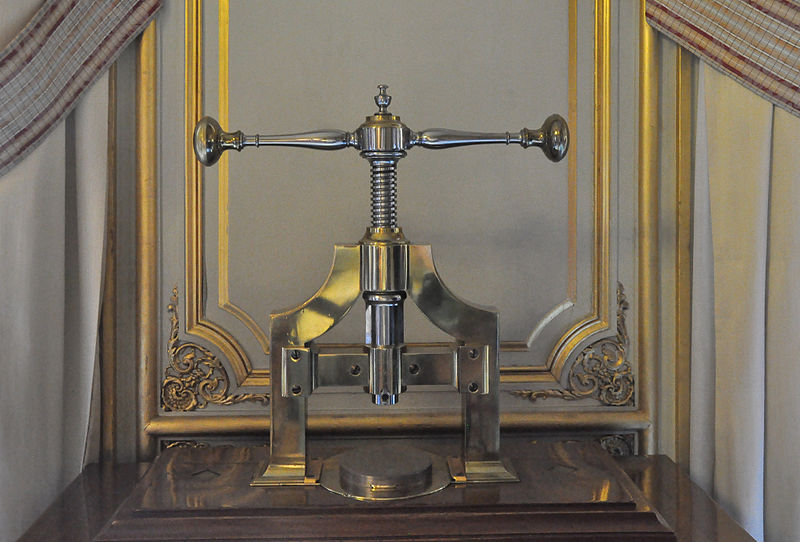
A printing press.
A fishing boat, to set up a trade.
Candles.
Lamps and oil.
Blankets.
Furniture.

The Pilgrims saw God in every aspect of their lives, every event that took place. They trusted Him to deliver them to their new home in His way. But I imagine as the storms rocked the small Mayflower, as they had to batten the hatches and huddle together in a space the size of a volleyball court yet again, a few of them probably wondered if they'd made the right choice.
Mayflower in Plymouth Harbor by William Halsall, 1882

But this storm was worse than the ones that had come before. This storm howled and raged. The Mayflower was tossed through the waves. Boards groaned. Wind ripped. Small children whimpered and hid their faces in their mothers' skirts.

Hushed assurances turned to panic when the Mayflower rolled to her side. They would go down, surely. The lanterns swung. The hull moaned. Then boom!

A sailor rushed belowdeck. "Watch out, everyone!" he called to the frightened mass of people. "The crossbeam that supports the main mass has cracked! It could give way at any moment!"

Everyone hurried to help. All the men tried to hold that crucial timber into place. But this was beyond what mere arms could do. Brewster and Bradford, leaders of the Pilgrims, looked to the wide-eyed captain.

"We must pray," Bradford said.

They did. And the idea came instantly to Brewster. "The printing press! We must find it!"

Now, as an author, I'm all for words saving the day. But in this case, it wasn't what the press could produce that saved the Mayflower, the Pilgrims, and hence America as we know it. It was the press itself.

The people scrambled to the hold where they'd stored all their furniture and larger items, and soon enough a shout came out that they had found the press. Brewster hurried to it and took off the enormous screw that was the press, the thing that applied pressure to put ink on page. This giant screw was then hauled into place on the cracked beam.

"Slowly," Brewster cautioned. "Carefully."

And it worked. The screw pushed the beam back into place--and held it there. The Mayflower survived the storm, and at that point she was closer to the New World than the old. They pressed onward. Forward.

To a land that would soon become home to so many.

I'm not sure when Brewster could reclaim his screw press, but you can be sure he did--the Pilgrims put high stock in education and the written word. A mere 16 years later, they founded Harvard College. And helped forge a nation that would never forget them.

~*~


Roseana M. White pens her novels beneath her Betsy Ross flag, with her Jane Austen action figure watching over her. When not writing fiction, she’s homeschooling her two small children, editing and designing, and pretending her house will clean itself. Roseanna is the author of 9 historical novels and novellas, ranging from biblical fiction to American-set romances to her new British series. Spies and war and mayhem always seem to make their way into her novels…to offset her real life, which is blessedly boring. You can learn more about her and her stories at www.RoseannaMWhite.com.

Wednesday, March 13, 2013

Coffee in the Colonies


“What if I brewed up some Bohea…in your coffeepot? Are you brave enough to try?”
Anna smirked. “I am desperate enough to try.”
                             Excerpt from Fields of the Fatherless (soon to be released)


Betsy and her sister-in-law, Anna, took a huge risk brewing up the Chinese black tea called Bohea (bu-ee). It was strictly forbidden in the colony of Massachusetts in 1775—so much so that neighborhood comitteemen were assignd to monitor private households to ensure that only coffee or herbal teas were served.

Anyone caught drinking the banned brew of tea taxed by England would be deemed a Tory. But drinking coffee was akin to declaring independence for America. Coffee was the preferred drink of the patriotic cause although many still desired the black or green tea that they had been accustomed to. Some, like Anna, used black tea like Bohea for headaches, so it was a real sacrifice to make the change. And some just liked the milder taste of tea.

But preferences aside, the popularity of coffee in America soared after the Boston Tea Party.

In fact, the party itself was planned and the details plotted out in a coffee house called The Green Dragon. It was in December of 1773 that over one hundred enraged patriots tossed cases of tea overboard from three ships into the murky Boston harbor. The tea boycott had begun.

But while coffee was suddenly in high demand, it had actually arrived in the colonies in the late 17th century, at the same time as tea.

 Coffee originated in the Arab countries but live plants were transported to greenhouses in Holland in 1616. From there, the Dutch began to grow this popular bean in India and Java (now called Indonesia). Within a few years, the Dutch were the main suppliers of coffee to Europe.

The Holland connection brings up another interesting tidbit from my research. A mortar and pestle for “braying” coffee beans into powder was brought over on the Mayflower in 1620 by passengers William and Susanna White. The emigrants onboard the Mayflower had resided in Holland for a time before leaving for the New World. Thus, the first coffee may have arrived with the first colonists arriving at Plymouth, although there was no record of the beans actually carried as cargo onboard.

English coffeepot, Staffordshire transferware


According to Dennis Picard, historian at Storrowton Village Museum in West Springfield, Massachusetts, “coffee was shipped and purchased green, and the homeowner had to roast each batch either in a spider (a frying pan with legs) or a metal drum shaped roaster.” It was then ground with a mortar and pestle.

Crank coffee grinders began to be used in homes in the early part of the 19th century.

The first literary reference to coffee consumption in North America is from 1668, when coffee houses were established in New York, Philadelphia, Boston and other cities. Often these coffee houses also served other beverages, such as tea, ale and cider.

A mention of coffee and tea is found in Shirley Glubock’s Home and Child Life in Colonial Days:

“In 1670, a Boston woman was licensed to sell coffee and chocolate, and soon coffee houses were established there. Some did not know how to cook coffee any more than tea, but boiled the whole coffee beans in water, ate them, and drank the liquid; and naturally this was not very good either to eat or drink.
At the time of the Stamp Act, when patriotic Americans threw the tea into Boston Harbor, Americans were just as great tea drinkers as the English. Coffee-drinking, first acquired in the Revolution, has also descended from generation to generation, and we now drink more coffee than tea. This is one of the differences in our daily life caused by the Revolution.”

Brittania ware Coffeepot


Just one of the many differences, indeed.

My favorite excerpt about coffee and the American Revolution was an incident recorded by Abigail Adams in 1778, and quoted in Revolutionary Mothers by Carol Berkin:

“An eminent, wealthy, stingy merchant (also a bachelor) had a hogshead of coffee in his store, which he refused to sell…under six shillings per pound. A number of females, some say a hundred, some say more, assembled with a cart and trunks, marched down to the Warehouse and demanded the keys which he refused to deliver. Upon which one of them seized him by his neck and tossed him into the cart. Upon his finding no quarter, he delivered the keys when they tipped up the cart and discharged him; then opened the Warehouse, hoisted out the coffee themselves, put it into the trunks and drove off…a large concourse of men stood amazed silent spectators.”

I suppose the moral of that tale is, never stand between a woman and her coffee—especially during a Revolution!


 (Coffeepot photos courtesy of Storrowton Village Museum, West Springfield, Massachusetts)


Wednesday, September 12, 2012

Monument to the Forefathers in Plymouth, MA

Posted by Elaine Marie Cooper


My ears perked up when my husband beckoned me into the family room: “Hon, come watch the Kirk Cameron movie, ‘Monumental.’ He’s talking about the Pilgrims.”

What? I had heard about the movie but knew nothing about it except its title. Quickly drawn into watching this documentary about the beginnings of our country, I was especially surprised when Mr. Cameron visited a huge edifice. It was a monument to honor these enterprising heroes who traveled thousands of miles to obtain the freedom to worship God without having to bow to the king of England.

 I was stunned.

Even though I have visited Plymouth to see the landmarks like the Plimouth Plantation and the replica of the Mayflower, I knew nothing about this 81-foot tall monument set on the summit of a hill. And it turns out that I am not alone. Most visitors to Plymouth are surprised to find out about this amazing architectural creation. It used to be readily visible, yet tree growth over the years has all but obscured its presence. It now stands in the middle of a housing development. According to visitors that have actually seen it, viewing this granite monument is a breath-taking experience.


The National Monument to the Forefathers is the largest, freestanding granite monument in the world. But if its size is not impressive enough, the design itself is awe-inspiring and speaks to the faith-filled beginnings of this nation of America. In fact, the central figure of this statue is the 36-foot-tall woman named “Faith.” Her feet stand on Plymouth Rock and her finger points upward toward heaven.

Surrounding Faith are four figures: Education (with Wisdom on one side and Youth led by Experience on the other), Law (attended by Justice and Mercy), Morality (between a Prophet and an Evangelist holding the Ten Commandments in one hand and the scroll of Revelation in the other), and Liberty (with Peace flourishing and Tyranny overthrown). Just the description takes your breath away!

There are bas relief images surrounding the base of the monument depicting the Pilgrims’ history. They include images of the travelers leaving Delft Harbor in the Netherlands, the signing of the Mayflower Compact, the landing at Plymouth Rock, and the treaty with Massasoit, Sachem of the Wampanoags.

 This incredible memorial was birthed through the efforts of the Pilgrim Society in 1820—just 44 years after the signing of the Declaration of Independence. Its purpose was to be a tribute to the “memory of the virtues, the enterprise, and the unparalleled sufferings of their ancestors.”

 The National Monument to the Forefathers was designed by artist and architect Hammatt Billings from Milton, MA. The creative Mr. Billings designed other monuments as well, some beautiful Victorian mansions, and even the illustration for the cover of the Old Farmer’s Almanac.


 The cornerstone for the Plymouth monument was laid in 1859. The $150,000 needed to fund the endeavor were provided by the Federal Government, the Commonwealth of Massachusetts, the State of Connecticut, and 11,000 individuals. One of those individuals was then President Abraham Lincoln. There is an archived copy of the receipt for his donation of ten dollars.

The construction for the project was put on hold soon after the laying of the cornerstone, due to the onset of the Civil War. Unfortunately, Billings, who died in 1874, never saw the final memorial since it was not completed until 1889.

 According to Paula Fisher, Director of Marketing and Group Services at the Plymouth County Convention and Visitors Bureau, there are believed to be about three million Mayflower descendants in America today (including Paula and myself). But whether descended by blood or by belief in the desire to worship freely, we can all celebrate the memory of the Pilgrims and the stance they took for religious liberty. The National Monument to the Forefathers is a stunning symbol of that declaration.

The next time I visit Plymouth, it will be at the top of my “must-see” list.

The 400th Anniversary of the landing of the Pilgrims is right around the corner in 2020! It should be quite a celebration.


(Photos courtesy of Plymouth County Convention and Visitors Bureau)