Announcements

10 Year Anniverary & New Releases Winners: Carrie Fancett Pagels' Butterfly Cottage - Melanie B, Dogwood Plantation - Patty H R, Janet Grunst's winner is Connie S., Denise Weimer's Winner is Kay M., Naomi Musch's winner is Chappy Debbie, Angela Couch - Kathleen Maher, Pegg Thomas Beverly D. M. & Gracie Y., Christy Distler - Kailey B., Shannon McNear - Marilyn R.
Showing posts with label printing press. Show all posts

Wednesday, October 22, 2014

The Screw that Saved America


The year was 1620. The crowd of passengers crammed into the small vessel numbered 101. Among them were adventurers, seekers of fortune...and a group of Separatists who wanted a fresh start in a new land where they could worship as they saw fit. 

We've all heard the story of the Mayflower. But I confess that for many years it was just a tale trotted out at the end of November, and I had always been far more interested in making paper-bag Indian vests and coloring my cornucopia than in some of the finer details of the Pilgrims' journey. Of course, that was before I became a history nerd, so it's only to be expected that now, as I'm reading those old stories to my kids in our homeschool curriculum, they're the ones coloring happily away while I pause in my reading to go, "Wow, I never knew that! Just think of it..."

Just think of it. This collection of Separatists who called themselves Pilgrims were starting an entirely new life in a new, unfamiliar world. They had to bring with them anything they might need for the first year

Food.
Seeds for planting.
Cloth.
Books.
A printing press.
A fishing boat, to set up a trade.
Candles.
Lamps and oil.
Blankets.
Furniture.

The Pilgrims saw God in every aspect of their lives, every event that took place. They trusted Him to deliver them to their new home in His way. But I imagine as the storms rocked the small Mayflower, as they had to batten the hatches and huddle together in a space the size of a volleyball court yet again, a few of them probably wondered if they'd made the right choice.
Mayflower in Plymouth Harbor by William Halsall, 1882

But this storm was worse than the ones that had come before. This storm howled and raged. The Mayflower was tossed through the waves. Boards groaned. Wind ripped. Small children whimpered and hid their faces in their mothers' skirts.

Hushed assurances turned to panic when the Mayflower rolled to her side. They would go down, surely. The lanterns swung. The hull moaned. Then boom!

A sailor rushed belowdeck. "Watch out, everyone!" he called to the frightened mass of people. "The crossbeam that supports the main mass has cracked! It could give way at any moment!"

Everyone hurried to help. All the men tried to hold that crucial timber into place. But this was beyond what mere arms could do. Brewster and Bradford, leaders of the Pilgrims, looked to the wide-eyed captain.

"We must pray," Bradford said.

They did. And the idea came instantly to Brewster. "The printing press! We must find it!"

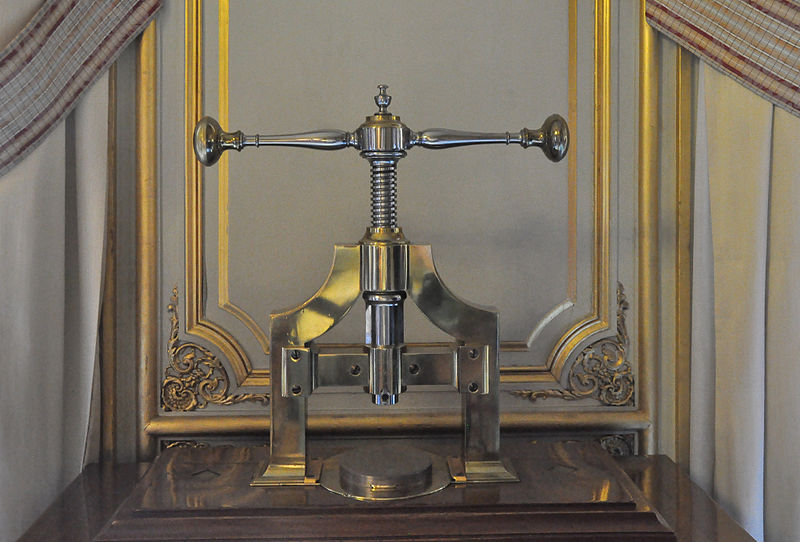
Now, as an author, I'm all for words saving the day. But in this case, it wasn't what the press could produce that saved the Mayflower, the Pilgrims, and hence America as we know it. It was the press itself.

The people scrambled to the hold where they'd stored all their furniture and larger items, and soon enough a shout came out that they had found the press. Brewster hurried to it and took off the enormous screw that was the press, the thing that applied pressure to put ink on page. This giant screw was then hauled into place on the cracked beam.

"Slowly," Brewster cautioned. "Carefully."

And it worked. The screw pushed the beam back into place--and held it there. The Mayflower survived the storm, and at that point she was closer to the New World than the old. They pressed onward. Forward.

To a land that would soon become home to so many.

I'm not sure when Brewster could reclaim his screw press, but you can be sure he did--the Pilgrims put high stock in education and the written word. A mere 16 years later, they founded Harvard College. And helped forge a nation that would never forget them.

~*~


Roseana M. White pens her novels beneath her Betsy Ross flag, with her Jane Austen action figure watching over her. When not writing fiction, she’s homeschooling her two small children, editing and designing, and pretending her house will clean itself. Roseanna is the author of 9 historical novels and novellas, ranging from biblical fiction to American-set romances to her new British series. Spies and war and mayhem always seem to make their way into her novels…to offset her real life, which is blessedly boring. You can learn more about her and her stories at www.RoseannaMWhite.com.

Wednesday, October 16, 2013

The 18th Century Printing Press by Amber Perry

18th century printing press

Oh, the glories of modern technology. Information is everywhere, and we can access it as easy as turning on our phones!

Well, back in the 18th century they did not enjoy such luxuries. To produce books, newspapers and other such means of education and information, the work was long, tedious and often backbreaking. On a recent visit to Colonial Williamsburg I took particular interest in the printing press. I am truly amazed at what people did day-in and day-out to make sure that the people of the colonies were well informed.

This was no cake walk! Typically a print shop would employ two to three men, but if it was small, the work could be done with one person--it just would take a very long time. The "compositor" gathered the type and arranged it in composing sticks and then into galleys, the "beater" would spread the ink--a mixture of varnish and lampblack--over the galleys, and the "pressman" would pull the lever once the carriage (the place where the galleys were secured) was ready to go. A lot more work than just sitting at a computer, huh?

Still want to know more? Or perhaps you think you could do this "easy" job, huh? OK! Let me show you what it takes to print only ONE page using 18th century technology, and when we're through, tell me if you still want to take up this all-important trade!


Step 1: Gather your letters

Ever wonder where we get the terms "upper case" and "lower case"?
Well, in the top case are the capital letters and in the lower are, well, the
lower letters. *grin* Once you have the letters you need, you can fill your composing sticks.
Remember to put all the letters in backwards so you can read it correctly when the print is done. 


Step Two: Fill the composing sticks and set them in the galleys. 
This job often took hours. A printer's day was not easy and often lasted up to 14 hours or more.

So, you've filled all the composing sticks and placed them securely in the galleys. Good work!

Step Three: Get your paper. 
Now, the paper a printer used had to be damp--not dry--to allow the ink to adhere properly. So, the printer had to wet all the paper before he used it. It needed to be just damp, not dripping, so he would wet the papers in a large vat of water, take out the stack and let it sit, until the papers reached the right dampness. Just another step in the process that seems insignificant, but is very important.

Hold your paper carefully. Since it's wet, it is more likely to tear--and we don't want to waste.
 Next, secure it in place.


Step Four: Cover the galleys in ink.
As stated, there were different types of inks used, but the ink of choice was typically varnish and lampblack.
Inkballs were used to adhere the ink to the galleys--this was the "beater's" job.


Make sure when you apply the ink, to cover all the letters evenly.


Step Five: Move the carriage under the platen and pull on the lever.
What's a platen? Oh, that's the thingy that goes up and down and presses the paper to the ink-covered galley. *wink*

Close the paper over the galleys, then move it under the platen and pull!! You will
need a strong upper body to do this all day long.


Step Six: Remove the paper
Wow! Finally, a printed page. Now, you get to do this over and over again until your newspaper is finished . . . 14 hours later. *yikes*

You should be very proud of yourself!


But, your work is not yet done. The paper--not to mention the ink--is still damp and needs to dry so it won't smear.

Step Seven: Hang the paper over the ropes near the ceiling (make sure the fire is roaring nicely during cooler months) and wait until its dry to remove it.

These are the ropes for you to hang your finished product on. Just make sure
that the fire in your fireplace is roaring nicely. That will help the drying go faster.


So, what do you think? Would this have been your trade-of-choice? Personally, I would have loved it! (And yes, woman were known to work in print shops, though not as a general rule. In case you were wondering . . .)

I hope you have enjoyed your tour of the 18th century printing press. Thank you for joining me!

What did you think? If printing isn't your forte, what trade would you have chosen?