Announcements

10 Year Anniverary & New Releases Winners: Carrie Fancett Pagels' Butterfly Cottage - Melanie B, Dogwood Plantation - Patty H R, Janet Grunst's winner is Connie S., Denise Weimer's Winner is Kay M., Naomi Musch's winner is Chappy Debbie, Angela Couch - Kathleen Maher, Pegg Thomas Beverly D. M. & Gracie Y., Christy Distler - Kailey B., Shannon McNear - Marilyn R.
Showing posts with label Storrowton Village Museum. Show all posts

Wednesday, February 17, 2016

Hardy and Historical False Indigo Plants

False Indigo is the tall plant on the left

On a visit to Storrowton Village Museum in Massachusetts a few years ago, I found a lovely surprise in their Colonial American garden: False Indigo, also called Baptisia or wild indigo. The reason I was pleasantly surprised was due to the fact I had this plant in my home garden in the Midwest and it was one of my favorites.


I learned a few things about False Indigo from the Museum Director at Storrowton, Dennis Picard. The plant with thick stems, long spikes of leaves and pea-like blooms were used by the early native Americans and the colonists as a blue dye. The plant is native to North America and, though the dye was a pale comparison to the rich blue of Indigofera plants from the tropics, it served its purpose to provide color for the colonist’s textiles. And it was certainly more accessible.

Since blue was a favorite hue for clothing, cultivation of the Baptisia in the colonies was encouraged by the English government in the 1700’s. Native Americans used the plant as an ingredient in their medicines but this was perhaps not the best purpose since most of the plant is mildly poisonous.  Perhaps that is why False Indigo is deer resistant.

While the blue flowers of the plant might lead some to assume the pigment is derived from the flowers, it was actually extracted from the leaves, specifically the leaves of the Baptisia tinctoris, that bears yellow flowers rather than blue.


Although it was a very functional plant for the early colonists, it’s the beauty of the perennial itself that captures my heart every spring. It weaves its thick stalk out of the moist soil and unfolds its leaves slowly. Soon the buds appear and the lovely blue color thrills me every time.

The amazing transformation in fall is startling as the flowers dry into long pods that turn a dark black. Many cut these pod stems for use in flower arranging. I just leave them to decorate my English garden.


When I first planted my False Indigo, the area was quite sunny. Now the maple tree nearby has spread it’s growing branches to provide a bit too much shade, causing the plant to shy away from growing too tall. I’d like to transplant it to a sunnier locale, but they say these beauties dislike being moved.

Perhaps I’ll just need to borrow a few seeds from the pods and plant them far away from the maple. And once again, watch this Colonial American beauty shine its beautiful foliage and blue flowers, and remind me anew of its history in Early America.


Elaine Marie Cooper is the author of Road to Deer Run (Book 1, Deer Run Saga), Fields of the Fatherless and Bethany's Calendar. Her upcoming releases in 2016 include Promise of Deer Run (Book 2) in June, Saratoga Letters in October, and Legacy of Deer Run (Book 3) in December. You can find her on her website at http://www.elainemariecooper.com 


Wednesday, September 11, 2013

Colonial Cradles


Hush! my dear, lie still and slumber,
Holy angels guard thy bed!
Heavenly blessings without number
Gently falling on thy head.

Sleep, my babe; thy food and raiment,
House and home, thy friends provide;
All without thy care or payment:
All thy wants are well supplied.

— From “A Cradle Hymn” by Isaac Watts (1674 – 1748)

The first time I saw a colonial cradle, I was visiting the home of Nathaniel Hawthorne in Concord, Massachusetts.
 
Nathaniel Hawthorne Home, Concord, MA
I was just a young girl and I can still see the rich, dark wood, so smoothly crafted with loving care. I remember imagining the children of the household that were rocked to sleep within the comforting confines. Seeing that cradle brought to life tender traces of the love and care of the people who had lived there. I cherished that memory long into adulthood, when I named my own son “Nathaniel.” And I still eagerly drink in the images of antique cradles wherever I see them.

Peregrine White's Wicker Cradle

The first cradle in America came over on the Mayflower in 1620. It was the Dutch wicker bed that soothed the first child born to the Pilgrims in the New World: Peregrine White. The young boy was birthed onboard the wooden vessel as it docked in Cape Cod Bay. It can still be seen at the Pilgrim Hall Museum in Plymouth, Massachusetts.

Most of the cradles made in the colonies were wrought from wood and the designs ranged from plain, solid boards, to engraved embellishments along the panels, to spindled sides similar to modern crib designs.

Author Eric Sloan in American Yesterday wrote, “At one time or another, cradles have been attached to butter churns, turnspits, dog mills, and even windmill gears to give them automatic movement, but the simple rocker cradle remained in the American household for over two centuries before its disappearance.”

A rather unique cradle, thought to have multiple uses for nursing mothers, twins or invalids, was the “adult cradle.” These wooden cradles were about the size of a single bed, but built closer to the floor.

According to Jack Larkin in The Reshaping of Everyday Life: 1790 – 1840, not every infant slept in a cradle in Early America. “…it was common, noted the physician and reformer William Alcott in 1830, for an American mother to ‘sleep with her infant on her arm,’ and children often shared the parental bed until they were weaned.”

Cradle from Storrowton Village Museum

But whether some infants shared their parents’ bed or not, the cradle seemed to be the predominant shelter for little ones while they slept.

Shirley Glubock in Home and Child Life in Colonial Days writes:

“Nothing could be prettier than the old cradles that have survived successive years of use with many generations of babies….In these cradles the colonial baby slept, warmly wrapped in a homespun blanket or pressed quilt.”


How much better thou’rt attended
Than the Son of God could be,
When from heaven he descended
And became a child like thee!

Soft and easy is thy cradle:
Coarse and hard thy Savior lay
When His birthplace was a stable
And His softest bed was hay.

— From “A Cradle Hymn” by Isaac Watts (1674 – 1748)


Wednesday, March 13, 2013

Coffee in the Colonies


“What if I brewed up some Bohea…in your coffeepot? Are you brave enough to try?”
Anna smirked. “I am desperate enough to try.”
                             Excerpt from Fields of the Fatherless (soon to be released)


Betsy and her sister-in-law, Anna, took a huge risk brewing up the Chinese black tea called Bohea (bu-ee). It was strictly forbidden in the colony of Massachusetts in 1775—so much so that neighborhood comitteemen were assignd to monitor private households to ensure that only coffee or herbal teas were served.

Anyone caught drinking the banned brew of tea taxed by England would be deemed a Tory. But drinking coffee was akin to declaring independence for America. Coffee was the preferred drink of the patriotic cause although many still desired the black or green tea that they had been accustomed to. Some, like Anna, used black tea like Bohea for headaches, so it was a real sacrifice to make the change. And some just liked the milder taste of tea.

But preferences aside, the popularity of coffee in America soared after the Boston Tea Party.

In fact, the party itself was planned and the details plotted out in a coffee house called The Green Dragon. It was in December of 1773 that over one hundred enraged patriots tossed cases of tea overboard from three ships into the murky Boston harbor. The tea boycott had begun.

But while coffee was suddenly in high demand, it had actually arrived in the colonies in the late 17th century, at the same time as tea.

 Coffee originated in the Arab countries but live plants were transported to greenhouses in Holland in 1616. From there, the Dutch began to grow this popular bean in India and Java (now called Indonesia). Within a few years, the Dutch were the main suppliers of coffee to Europe.

The Holland connection brings up another interesting tidbit from my research. A mortar and pestle for “braying” coffee beans into powder was brought over on the Mayflower in 1620 by passengers William and Susanna White. The emigrants onboard the Mayflower had resided in Holland for a time before leaving for the New World. Thus, the first coffee may have arrived with the first colonists arriving at Plymouth, although there was no record of the beans actually carried as cargo onboard.

English coffeepot, Staffordshire transferware


According to Dennis Picard, historian at Storrowton Village Museum in West Springfield, Massachusetts, “coffee was shipped and purchased green, and the homeowner had to roast each batch either in a spider (a frying pan with legs) or a metal drum shaped roaster.” It was then ground with a mortar and pestle.

Crank coffee grinders began to be used in homes in the early part of the 19th century.

The first literary reference to coffee consumption in North America is from 1668, when coffee houses were established in New York, Philadelphia, Boston and other cities. Often these coffee houses also served other beverages, such as tea, ale and cider.

A mention of coffee and tea is found in Shirley Glubock’s Home and Child Life in Colonial Days:

“In 1670, a Boston woman was licensed to sell coffee and chocolate, and soon coffee houses were established there. Some did not know how to cook coffee any more than tea, but boiled the whole coffee beans in water, ate them, and drank the liquid; and naturally this was not very good either to eat or drink.
At the time of the Stamp Act, when patriotic Americans threw the tea into Boston Harbor, Americans were just as great tea drinkers as the English. Coffee-drinking, first acquired in the Revolution, has also descended from generation to generation, and we now drink more coffee than tea. This is one of the differences in our daily life caused by the Revolution.”

Brittania ware Coffeepot


Just one of the many differences, indeed.

My favorite excerpt about coffee and the American Revolution was an incident recorded by Abigail Adams in 1778, and quoted in Revolutionary Mothers by Carol Berkin:

“An eminent, wealthy, stingy merchant (also a bachelor) had a hogshead of coffee in his store, which he refused to sell…under six shillings per pound. A number of females, some say a hundred, some say more, assembled with a cart and trunks, marched down to the Warehouse and demanded the keys which he refused to deliver. Upon which one of them seized him by his neck and tossed him into the cart. Upon his finding no quarter, he delivered the keys when they tipped up the cart and discharged him; then opened the Warehouse, hoisted out the coffee themselves, put it into the trunks and drove off…a large concourse of men stood amazed silent spectators.”

I suppose the moral of that tale is, never stand between a woman and her coffee—especially during a Revolution!


 (Coffeepot photos courtesy of Storrowton Village Museum, West Springfield, Massachusetts)


Wednesday, October 10, 2012

Colonial Cats and Mice

Posted by Elaine Marie Cooper

There is a Colonial American proverb: “You will always be lucky if you know how to make friends with strange cats.”

Perhaps it was a popular saying because that friendship could help quell the numerous mice the colonists were forced to contend with. Not only did the scavengers threaten the colonials’ meager supply of food, the rodents even ate any supply of candles. The tallow (animal fat) that was used to make this precious commodity was apparently appreciated by the little creatures—much to the house owners’ consternation.


To shield the candles from destruction, the colonists built special wooden boxes and set them on the wall to keep their source of light safe from the hungry creatures.

But an early American household also kept that ultimate mice killer—a cat.

Until I visited Storrowton Village Museum in West Springfield, Massachusetts last fall, I was unaware that some colonial homes had openings to the outdoors for their cats to go in and out. I actually thought that cat doors were a 20th century invention. It certainly made more sense in the 18th century since they likely did not tolerate cat boxes in the house.


If you look closely at this 18th century home, which is situated at the museum in West Springfield, you will see the cat door in the lower right near the door.

A close-up will reveal it even more clearly.


Ah, the life of a happy colonial cat. Since we have no photos of a colonial kitty, my own feline, Julius, has graciously offered to model.


Julius has no such luxury to come and go as he pleases. His outdoor ventures to my front porch are closely monitored by humans. He is an indoor, city cat—but a great mouser indoors. With the cooler, fall weather descending, I am grateful for his hunting skills since the little rodents are notorious for finding the tiniest entrance into a home.

Mice were not indigenous to America. They were stowaways on board ships from Europe. As uninvited guests, they quickly made their home quite comfortably in the New World. Along with these little varmints on the boats were other pests: gray rats, black flies and (gulp) cockroaches.

The only reference to mice being in any way useful was in a volume called Taxation in Colonial America by Alvin Robushka: “Specific export duties were imposed on skins of beaver, raccoon, mink, otter, bear, wolf, muskrat, mice, and deer…”

Shiver. Mice skins? They actually skinned them and used them for something? 

 I don’t even want to think about it. But there must have been a lot of mice…

This author has opted to include no photos of rodents. :)

Wednesday, April 11, 2012

"Nighty-night, Sleep Tight"

“Nighty-night, sleep tight.” Why, just last night, I said those very words to my triplet grandchildren.

 It seemed as natural as saying “I love you.”

 All these years of hearing it and saying it to my progeny, and I never wondered about its origin.

 There are a few masters of the English language that claim that “tight” in colonial days meant “soundly,” as in “sleep well.” But many lean towards the explanation that sleeping tight was a reference to the rope sling beneath one’s mattress during colonial times. If the ropes were not “tight,” that sagging night’s sleep would be a bit less restful!
While I would not deign to describe myself as a language expert, Noah Webster was quite adept at English usage. In his 1828 dictionary, not one definition of “tight” refers to soundly or well; but it does define “tight” as “Hardy; this is the taught of seamen applied to a rope stretched.” So let us assume that a good, sound night’s rest meant having the ropes under the mattress stretched well.

These suspended straps were occasionally made from leather, but rope appeared to be more commonly used.

 Ropes ran along the edges of the bed and were either wrapped around pegs or slung through holes in the wood frame. How did Colonial Americans tighten those sagging strands? They used a rope wrench or “key,” which was a wood tool used to grab and twist the rope.
It usually took men or strong boys to do this labor-intensive job. They would twist the handles of this large key, which stretched and pulled the twine into submission. It sometimes required two workers—but it was worth it to get a good night’s sleep.

 Colonial comfort for the wee hours of the night then involved a mattress of sorts. These were usually made from rough ticking material or linen, then stuffed with a variety of fillers, from straw to wool to horsehair. But feather-filled beds, with their softness and warmth, were the best of all.

 An interesting video from a BBC program called “Tales of the Green Valley” shows the stuffing of an old mattress. Fun stuff! (Excuse the pun)

 http://www.youtube.com/watch?v=JfLgnBwhBwI&feature=youtu.be&t=13m33s

 Many bedrooms in Colonial America were not heated, so warmth became a decidedly important issue.
From "Home and Child Life in Colonial Days" by Shirley Glubok it reads:

  “President John Adams so dreaded the bleak New England winter and the ill-warmed houses that he longed to sleep like a dormouse every year, from autumn to spring. In the Southern colonies, during the fewer cold days of the winter months, the temperature was not so low, but the houses were more open and lightly built than in the North. They were without cellars and had fewer fireplaces; hence the discomfort from the cold was as great. 


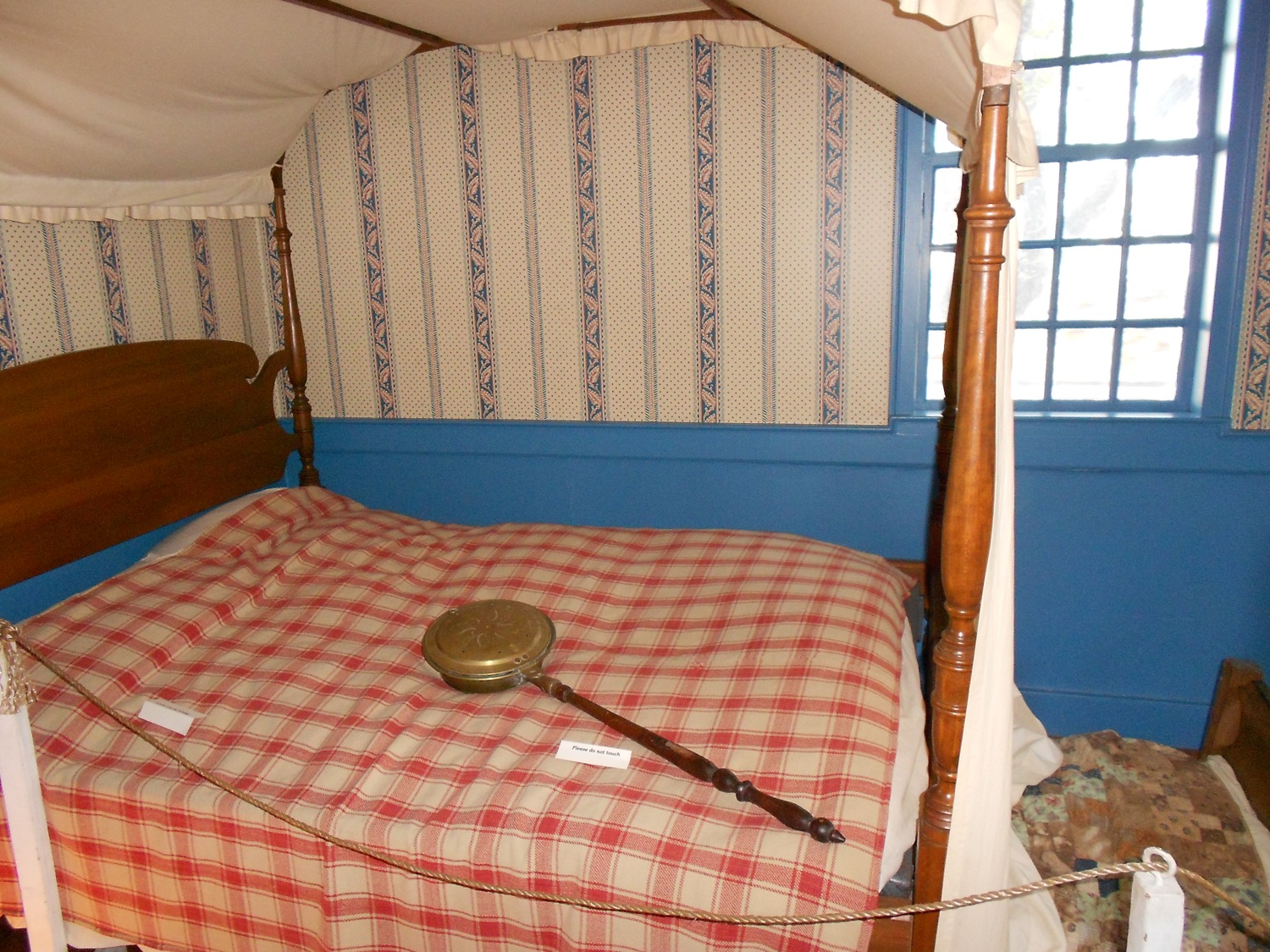
 The first chilling entrance into the ice-cold bed of a winter bedroom was sometimes mitigated by heating the inner sheets with a warming pan. This usually hung by the side of the kitchen fireplace, and when used was filled with hot coals, thrust within the bed, and constantly and rapidly moved back and forth to keep from scorching the bed linen. 


 The warming pan was a circular metal pan about a foot in diameter, four or five inches deep, with a long wooden handle and a perforated metal cover, usually of copper or brass, which was kept highly polished and formed, as it hung on the wall, one of the cheerful kitchen discs to reflect light of the glowing fire.”

Colonial American homes were often cozy—that is, quite small. Beds took up considerable space. One solution was the “press bed,” which stood on its end during the day, and was pulled down for sleeping at night. Quite clever!
Rope beds were used from around 1600 until the late 1800’s when coil spring mattresses became popular.

 My favorite story of Colonial beds comes from my 97-year-old mother, who recently recalled visiting our ancestors’ farm in Massachusetts when she was very young. She remembered two things from her visit: It was the first time she had ever tasted blueberries, and it was the first time she had ever slept on a feather-filled mattress. She said it enveloped her with a softness unlike any other. It was such a sweet memory for her—and a sweet conversation for me to treasure as I watch her reminiscences begin to fade into history.