Announcements

10 Year Anniverary & New Releases Winners: Carrie Fancett Pagels' Butterfly Cottage - Melanie B, Dogwood Plantation - Patty H R, Janet Grunst's winner is Connie S., Denise Weimer's Winner is Kay M., Naomi Musch's winner is Chappy Debbie, Angela Couch - Kathleen Maher, Pegg Thomas Beverly D. M. & Gracie Y., Christy Distler - Kailey B., Shannon McNear - Marilyn R.
Showing posts with label Joseph Brant. Show all posts

Wednesday, September 20, 2017

The Draper Manuscripts

Earlier this month I attended the 35th Fair at New Boston, a huge reenactment held at George Rogers State Park in Springfield, Ohio. A couple of my friends invited me to come, and boy, was I impressed! It looked and felt just like being in a real colonial camp, and in spite of the drizzly day, we had a wonderful time!

One of the suttlers’ tents I stopped by to check out period-correct wares was “Squire Boone’s” establishment, and my eyes were immediately drawn to a display of volume 3 of the Draper Manuscripts. Squire Boone had just acquired the last few copies still available, the only one issued in a new printing in recent years and was selling them for a price I couldn’t resist. This volume covers the Revolution and early Federal periods, just what I need for my American Patriot Series.

In case you didn’t know, the Draper Manuscripts are the holy grail of 18th and early 19th century frontier research, and full volumes can be expensive and hard to find. The alternative is to go to the Wisconsin Historical Society, where they’re held, or to a library that has them in microfilm form. Here’s a basic rundown on this amazing research goldmine.

Lyman Copeland Draper

Lyman Copeland Draper was born September 4, 1815 in Lockport, New York, and died August 26, 1891. He lived much of his life in Madison, Wisconsin, where he became a librarian and historian, serving as the first corresponding secretary for the state’s Historical Society from 1854 to 1886 and as superintendent of public instruction from 1858 to 1860.

When Draper was a boy, the tales his grandfathers told of their exploits during the Revolution and his father’s experiences in the War of 1812 naturally aroused his interest in the history of those times. By the 1830s he was corresponding with settlers who had moved into what his contemporaries called the Trans-Allegheny West—the area west of the Allegheny Mountains—during the second half of the 18th century. This region includes the Ohio River Valley and parts of the Mississippi River Valley as well as the western Carolinas and Virginia and portions of Georgia and Alabama.

Intending to document the Indian Wars in Ohio territory and write a series of biographies of the settlers, Draper traveled extensively throughout the region to develop a better sense of it. In all, he published 10 volumes of historical notes for the Wisconsin Historical Society and also a volume on the Battle of King’s Mountain (1780) that featured many of the settlers he corresponded with.

The Draper Manuscript Collection

Daniel Boone by Chester Harding, 1820
Draper never finished his biographies, but his manuscript collection provides the largest single first-hand account of the settlement of the Trans-Allegheny region. It includes a welter of materials, from Draper’s research notes, to correspondence, interview notes, extracts from newspapers and other published sources, muster rolls, transcripts of official documents, and much more. Organized into 491 volumes, the materials are divided into 50 series of various lengths by geographic area, subject, and individuals. These cover primarily events in the Trans-Allegheny region between the French and Indian War and the War of 1812—roughly from 1755 to 1815.

The collection contains voluminous military records, including Revolutionary War pension applicant information; descriptions of actions in the West during the Revolution; the War of 1812; Native American conflicts; and western exploration, such as the Lewis and Clark Expedition. Original documents of the Revolutionary period comprise only a small part, however. The works and papers of a number of notable early Americans are also included, among them Joseph Brant, Daniel Boone, George Rogers Clark, John Donelson, James Robertson, and Simon Kenton.

Joseph Brant by Gilbert Stuart, 1786
Draper bequeathed his manuscript collection to the Wisconsin Historical Society. The archives are free and open to the public, and the original materials are available to researchers. Major research libraries around the United States also have microfilm of portions of the collection. You’ll find a list of these libraries on the Wisconsin Historical Society website.

All in all, this amazing collection is an invaluable resource for writer like me who focus on the early American frontier. Needless to say, I’m thrilled to own a little piece of it!

Is there a historical period, event, or person you’re particularly drawn to? Or do you own something related to a particular period in history that has a special meaning for you? If so, please share with our readers!
~~~
J. M. Hochstetler is the daughter of Mennonite farmers and a lifelong student of history. She is also an author, editor, and publisher. Her American Patriot Series is the only comprehensive historical fiction series on the American Revolution. Northkill, Book 1 of the Northkill Amish Series coauthored with Bob Hostetler, won Foreword Magazine’s 2014 INDYFAB Book of the Year Bronze Award for historical fiction. Book 2, The Return, releases April 1, 2017. One Holy Night, a contemporary retelling of the Christmas story, was the Christian Small Publishers 2009 Book of the Year.


Wednesday, May 30, 2012

Lori Benton - Researching the Iroquois

Flag of the Iroquois Confederacy
Occasionally I write a blog post dealing with a subject I've researched for my 18th century-set novels. I like to do this for the benefit of other writers, or anyone interested in that particular subject, coming along behind me on this research path. I imagine them stumbling upon the post like an unexpected cache of provisions. I hope they'll prove useful to the knowledge-hungry traveler.

Today I'd like to share my bibliography of titles collected while researching the history of the Iroquois Confederacy, or The Six Nations, particularly the Mohawk and Oneida nations.

The Six Nations are a confederacy of Iroquoian-speaking peoples that once occupied the the western portions of the state of New York from the Hudson River to the Finger Lakes region.

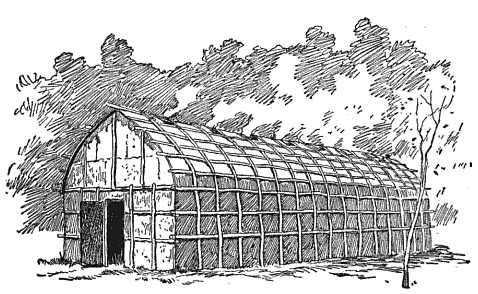
Traditional Iroquois longhouse
At a certain period of their history, their primary dwelling was the longhouse. The Iroquois thought of their land symbolically as a giant longhouse running east to west across their territory.


Guarding the eastern door of The Great Longhouse were the Mohawk. Next came the Oneida and (after 1722) the Tuscarora. In the center of the Longhouse, as Keepers of the Central Fire, were the Onondaga. Then came the Cayuga and lastly the Seneca guarding the western door.

Sometime before European contact, arguably around the year 1450, these tribes united under the Great Law of Peace to form the Haudenosaunee, or The People of the Longhouse.

Due to war, disease, settlement, and broken treaties, the 18th century and the early 19th saw the removal of these tribes from most of their traditional land. Many were resettled in Canada. Some in Wisconsin, some in Oklahoma. Some still live in New York.

As part of the research for my debut novel I studied the history of the the Mohawk, or Kanyen'kehake, nation. Their name translates to People of the Flint.

Joseph Brant, Mohawk chief
Much of this research centered around Joseph Brant, or Thayendenegea, who was educated in an eastern school, rose to prominence among the Mohawk partly due to the influence of Sir William Johnson, Superintendent of Indian Affairs for the northern colonies (and husband of Joseph's sister Molly), and became a war chief for his people who fought with the British during the Revolutionary War.

Titles I found helpful in my research:

~ The Ordeal of the Longhouse: The Peoples of the Iroquois League in the Era of European Colonization by Daniel K. Richter
~ Joseph Brant 1740-1807, Man of Two Worlds by Isabel Thompson Kelsay
~ Turtles, Wolves, and Bears, A Mohawk Family History by Barbara J. Sivertsen
~ Kanyen'keha Tewatati (Let’s Speak Mohawk) and One Thousand Useful Mohawk Words by David Kanatawakhon Maracle
~ The Iroquois by Evelyn Wolfson
~ Joseph Brant, Mohawk Chief by Jonathan Bolton and Claire Wilson
~ Realm of the Iroquois by The Editors of Time-Life Books
~ The Iroquois in the American Revolution by Barbara Graymont
~ The Tribes of the Iroquois Confederacy by Michael Johnson


The second eastern-most tribe after the Mohawk were the Oneida, or Onyota’a:ká:. Their name is translated as People of the Standing Stone.

Though no nation of the League was unanimously pro-British or pro-Patriot during the Revolutionary War, most of the nations fought on the side of the British--except for the Oneida Nation, who sided with the colonists.

This was due in large part to the influence of New Englander and Patriot Samuel Kirkland, a Protestant missionary who had lived and ministered among them since the mid 1760s. While not all Oneidas welcomed Kirkland and the Gospel he preached, many considered him a friend to their people. Kirkland lived among them and shared their hardships, alleviating them as best he could through pleas for aid from wealthy seaboard acquaintances and missionary societies. Through him the Oneida people formed stronger links with the colonials than did the other Iroquois nations. Some Oneida warriors served during the Revolutionary War as scouts. Some fought with the colonial militia at the Battle of Oriskany, near Fort Stanwix in western New York.

Finding resources for Oneida-related subjects has proven harder than for those pertaining to the Mohawk. For the benefit of anyone else researching along this same path, here's what I've found thus far:

~ The People of the Standing Stone, The Oneida Nation from the Revolution through the Era of Removal, by Karim M. Tiro.
~ The Oneida Indian  Experience, Two Perspectives, Edited by Jack Campisi and Laurence M. Hauptman.
~ Forgotten Allies, The Oneida Indians and the American Revolution, by Joseph T. Glatthaar and James Kirby Martin.
~ The Divided Ground, Indians, Settlers, and the Northern Borderland of The American Revolution, by Alan Taylor
~ Life of Samuel Kirkland, missionary to the Indians, by Samuel Kirkland Lothrop (can be found online as an ebook through Google).
~ Oneida Iroquois Folklore, Myth, And History, New York Oral Narrative from the Notes of H.E. Allen and Others, by Anthony Wonderley 


Do you have any titles or other resources to add? Please mention them in the comment section.