Announcements

10 Year Anniverary & New Releases Winners: Carrie Fancett Pagels' Butterfly Cottage - Melanie B, Dogwood Plantation - Patty H R, Janet Grunst's winner is Connie S., Denise Weimer's Winner is Kay M., Naomi Musch's winner is Chappy Debbie, Angela Couch - Kathleen Maher, Pegg Thomas Beverly D. M. & Gracie Y., Christy Distler - Kailey B., Shannon McNear - Marilyn R.
Showing posts with label Duluth MN. Show all posts

Friday, February 1, 2019

The Lovelorn Explorer Who Broadened France's Empire in North America

Love can change the world. We know that's true of God's love, but we all like to think the same is true of affairs of the heart. Here in the month when love is most celebrated, we can certainly say that love--of at least the heartbroken variety--did indeed change the colonial world in the late 1670s.


Studying North America in the 1600s is to learn of the great explorers and the claiming of land for European empires, as well as the founding of colonies across the landscape. One such explorer was Daniel Greysolon Sieur du Lhut (or in the Quebec archival rendering: Daniel de Gresolon du Luth and Americanized as Daniel Greysolon Duluth). In late June, 1679, he planted a banner for France, "His Majesty's Arms" on the location of present day Duluth Minnesota, at the very head of Lake Superior, "in the great village of the Nadouecioux (Sioux), called Izatys, where never had a Frenchman been..." That was what Duluth penned in a letter to the French Minister of Marine, to quell allegations made against him that he had deserted Montreal to engage in the fur trade without the proper licensing to do so. He was not quite accurate in his proclamation that no other Frenchman had been in this part of the world. Groseilliers and Radison had arrived in Sioux country some years prior. However, I digress.

Let's back up.

Duluth was born in Saint-Germaine-en-Laye near Paris in or around 1654. At that time, Saint Germaine was something of a resort area for the French court. Duluth's own family had some noble lineage along with a degree of wealth from his mother's side which qualified him as a "gentleman". Being among the "petit noblesse" (similar to being a gentleman of lower lineage in England) he decided to join the army.  

Now fast-forward a little bit.

Duluth served as a "Gendarme de la Guard du roi", military guardsmen who were only recruited from among the nobility. He boasted about this appointment for years to come, even though he eventually found the slow advancement and days spent around a somewhat effeminate court life unsatisfactory for a young man of his energetic and ambitious nature. Rather, life in New France sounded exciting. He resigned from his position with the Guard and soon made his way to Montreal where friends and family, as well as his previous commission, gave him ready entry into Montreal society. In those esteemed circles he met the old Boucher family, who had several daughters, one in particular who caught his eye and then his heart.

Within a year or two, however, Duluth had to return to France to settle some family matters. While he was there, he became caught up in the Franco-Dutch war and took part in the bloody battle of Seneffe, serving as a squire to the young Marquis de Lassay. 

Finally, at war's end, he returned again to Canada and leased a small home. His amore for Madamoiselle Boucher had not lessened during his time away, and a year or two later he built a much more elegant and somewhat palatial estate on the shores of the majestic St. Lawrence River. He no doubt hoped to bring his lady-love to his expansive, well-appointed home as his bride. In the meantime, he also developed aspirations to trade in the growing fur market.

Meanwhile, the Bouchers had risen to even higher prominence in Montreal society. With their advancement in social circles, the young lady in question, for whom Duluth had long pined, disapproved of his plans to enter trade. The couple's differing opinions rose to surface in quarrels again and again, apparently heatedly at times. Caught in this stalemate, it eventually became clear to Duluth that he had lost at love, so the two parted company. Duluth then did what any lovelorn, heart-broken individual might do. He got out of there. 

Being still a man in his twenties, the call of the Far West beckoned. Duluth quickly sold his fine home and invested his money in everything he would need to venture west, from canoes to trade goods. He also worked at cultivating friendly relations with the natives, and as a result, they offered him three slaves as guides for his journey. With his guides and eight Frenchman, including his brother Claude, the brigade embarked westward, and the rest, as they say, is history.
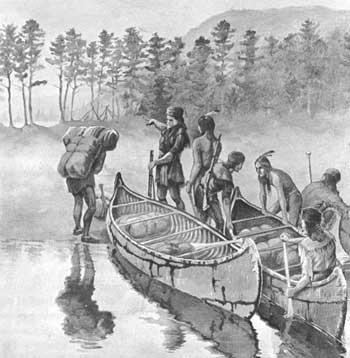


Duluth spent the following winter at the Falls of Saint Mary's (the Sault), an important village set neatly on the Saint Mary River connecting lakes Superior and Huron. During that time, Duluth's head probably cleared some after his heartbreak, for he seemed to recall that he'd departed Montreal without a proper license to trade from Governor Frontenac. In an attempt to set things right, he wrote the afformentioned letter, assuring the French Minister of his loyalties to France and of his intent to open up the west in such a way meant to expand the King's interests. He pointed out his purpose to bring peace between the Sioux and Ojibwe, and to secure the natives' trade away from the English by currying their favor so that they might promise to bring all their pelts to Montreal and Quebec.

It seems that Duluth all along did intend to reach the mouth of the St. Louis River at the head of Lake Superior, and once he did, he crossed what was called the "Little Portage" and planted His Majesty's colors, laying all claim to the region south and west of Lake Superior for France. 


Duluth went on to meet with the Indians, spreading feasts, summoning councils, and doing all in his power to show good will and establish firm relations. He ventured deep into the northern forests and down the rivers to the south all the way to the Mississippi. Far and above his own interests in fur trading, he was patriotic. Many more adventures came his way, although it appears he never again sought to take a French wife. He died in in Montreal in 1720 with his valet LaRoche in attendance to the end.

My belief is that once burned was all it took for monsieur Duluth to give up matrimonial notions. He had more illustrious endeavors to attend to for his true mistress--France. That's my theory, and I'm sticking to it. I'll share a bit more about Daniel Greysolon Sieur du Lhut next month, when I write about the infamous scourge of fur traders known as the courier du bois

Until then, here's to love and adventure.
Naomi Musch

Stone marker near the site where Daniel Greysolon Sieur du Luth landed and planted the French flag
in present Canal Park, Duluth, Minnesota.


Friday, October 5, 2018

Fur Trade History Comes Alive at the Lester River Rendezvous! (Enter a Rafflecopter Giveaway!)

Rats! I missed the firing of the cannon. Three times! Every time the reenactors prepared to fire the cannon last weekend at the annual Lester River Rendezvous, I was engrossed in some other amazing learning experience and didn't get to watch. I sure heard it though! I had been anticipating the rendezvous most of the summer, not unlike the northerners of a bygone era.

For nearly a century, primarily in the 1700s and early 1800s, trappers, traders, Native Americans, Métis, Frenchmen and Scots, British and American -- among them the flamboyant voyageurs -- arrived from points scattered throughout the wilderness for the yearly festivities called the rendezvous. Rendezvous took place at important forts all throughout the Great Lakes region. At these locations, men who'd lived a rugged existence in the wilderness harvesting furs, company clerks, or bourgeois company men arriving from the east, came together to engage in the exchange of pelts for goods. In the process a fortune was made for the North West, XY, and Hudson's Bay companies. But the rendezvous was also a time when all these wilderness folk enjoyed revelry, feasting, gaming, and occasionally brawling. The event would last for several weeks in summer, then just as quickly when it ended, everyone would disperse. The hunters and trappers returned to the forest and native villages, the clerks to their posts, the voyageurs to winter in the Upper Country or back to Montreal with canoes mounded with bales of pelts, eager to satisfy the European hunger for fur.

This last week I attended a re-enactment of one of those events just north of Duluth, Minnesota on the Lester River where it twists and tumbles over rocks and down the hill. There it spills into magnificent Lake Superior. I couldn't absorb the experience any more eagerly! Here are some highlights.


This fellow went by the rendezvous name of Jacques LeChristian. I asked him right off if he was a bourgeois trader, and his eyes brightened. "Why, yes I am!" he said. Later in the day I purchased a CD of voyageur legends told by my new friend Monsieur LeChristian.

The  Lester River Rendezvous is set up mostly as an educational village open for two days to school groups, and then one day for the general public. Thousands of visitors enjoy free entrance onto the site where they can partake in food and music, and most excitingly, a visit to the Voyageurs' Village.

Here I am on the river, experiencing the excitement of the rendezvous which has so much to do with the time and setting my new novel Mist O'er the Voyageur coming out next Wednesday.                                                                                                         
             
I enjoyed a number of demonstrations of how people used to live during those times while I strolled through Voyageur Village at the rendezvous. In future posts, I'll give some of the "how to" details I learned for everything from rendering bear fat to starting a fire with char cloth and flint.


The lady above was of Métis heritage. I enjoyed hearing her talk about her ancestors and the vital role of the Métis in the fur trade and voyageur era. She also sewed all these beautiful costumes!


This lady was busy tanning hides. She described various processes to do it, depending on the type of finished product. Here, she is softening a rabbit hide. She also had a large number of other interesting items on display including this box of glass beads. Beads were a popular trade item during for many years.


The lady in the photograph above is making sour dough cinnamon rolls. Not so unusual in itself. However; she's also teaching about the process of making and keeping sour dough, and she's baking them over the fire in a "Dutch oven". More on that in a future post!


This red-hatted fellow was so engaging! He had the children and adults enraptured as he demonstrated the method used to build fires back in a time when matchsticks hadn't been invented. He had to take special precautions with that beard! 


Above we have the tinsmith selling his wares, and below is the blacksmith. I wish I could have invested in the beautiful ax or some of the gorgeous knives he created. I settled for a lovely little robe hook for $2. Now that's an affordable souvenir!


Talk about a pot of soup! This big kettle was called the chaudier by the French voyageurs. Brigitte Marchal, the heroine in my tale, becomes very familiar with that piece of equipment! (I could use one of these for family gatherings.)


Though this was not a real birch bark canoe (this one was "disguised" as a real canoe so that the kids could get inside and learn to paddle) I had to get a picture standing next to the North West Company emblem.

Have you attended any rendezvous re-enactments? Next on my schedule are the Forts Folle Avione Rendezvous on the Yellow River in Northwest Wisconsin, and the Great Grand Portage Rendezvous in Grand Portage, Northeastern Minnesota. Living History provides a learning environment of discovery and engagement in a way that reading a history book can't provide. Whatever part of history you're curious about, from the French and Indian wars, to the Civil War, to visiting an historical speakeasy -- it's a vivid way to dig deeper into history that you don't want to miss!

Now it's time for a drawing!
With my novel, Mist O'er the Voyageur coming out in less than a week, I'm celebrating with 3 chances to win an e-book and the opportunity to win the Grand Prize Drawing at month's end. Use the Rafflecopter below to enter. (The book is also available for pre-order until it releases.)

Catch you again in the pages of history~
Naomi Musch

a Rafflecopter giveaway