Announcements

10 Year Anniverary & New Releases Winners: Carrie Fancett Pagels' Butterfly Cottage - Melanie B, Dogwood Plantation - Patty H R, Janet Grunst's winner is Connie S., Denise Weimer's Winner is Kay M., Naomi Musch's winner is Chappy Debbie, Angela Couch - Kathleen Maher, Pegg Thomas Beverly D. M. & Gracie Y., Christy Distler - Kailey B., Shannon McNear - Marilyn R.
Showing posts with label frontier landscapes. Show all posts

Monday, October 14, 2019

The Wonders of the Colonial Frontier: Wildlife

Back in August, I wrote about the South Carolina wilderness as it appeared to early European settlers, and promised I'd discuss the different types of wildlife that populated this frontier. Years ago, at Charles Towne Landing, a state park in Charleston, South Carolina, site of the earliest permanent settlement in the area, visitors could walk through an area called the Animal Forest and see examples of such wildlife. I've no idea to what degree the park maintains this area--so much else there has changed, though the park website still advertises it as an attraction--but our family has never forgotten our visits. Panthers, wolves, elk, bison, black bears, wild turkeys, and otters shared space with alligators, foxes, raccoons, and other critters who remain when others moved west or were hunted into scarcity.

John Henry Logan describes great herds of elk and bison across the Carolinas in the early 1700's, and explorers across Cumberland Gap into Kentucky attest to the richness of game in that area as well. When I researched for my Daughters of the Mayflower title The Cumberland Bride, I was under the impression that the elk and bison had mostly disappeared by 1800, but later research revealed this was not so.

One noteworthy source that I haven't covered before is the letters of Sarah McClendon, a settler to western Kentucky, near the Ohio River and a little south of what would become Henderson, about 1794. I ran across this woman's letters, a rather rambly reminisce of her early married life and late husband for the benefit of their three sons, while researching for my upcoming book The Blue Cloak, and found a fascinating trove of all sorts of tidbits, despite misspellings. Sarah recounts how the region they settled was frequented by large herds of elk and bison, and she mentions the curiosity of flocks of parrots, sometimes referred to as the Carolina parakeet.
Carolina Parakeet, stuffed and mounted at the Field Museum

Interestingly, Wikipedia had this to say about the bird:

The Carolina parakeet had the northern-most range of any known parrot. It was found from southern New England and New York and Wisconsin to Kentucky, Tennessee and the Gulf of Mexico. It has also had a wide distribution west of the Mississippi River, as far west as eastern Colorado. Its range was described by early explorers thus: the 43rd parallel as the northern limit, the 26th as the most southern, the 73rd and 106th meridians as the eastern and western boundaries respectively, the range included all or portions of at least 28 states.[Note 6] Its habitats were old-growth wetland forests along rivers and in swamps especially in the Mississippi-Missouri drainage basin with large hollow trees including cypress and sycamore to use as roosting and nesting sites. 
I may have geeked a little at that last line, imagining flocks of the exotic bird flitting through the Congaree National Park, my feature last month!

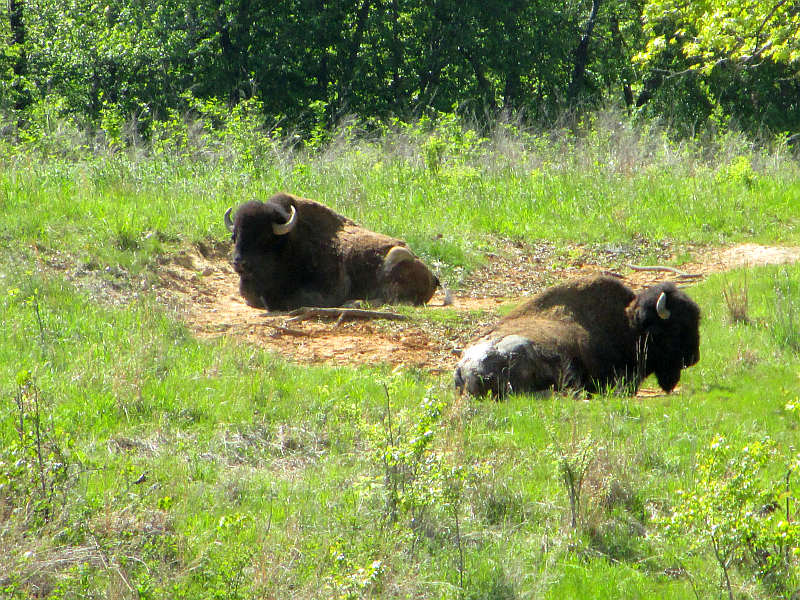
Additional note: it should not surprise me when I find various resources for giving people a taste of what our land was like during earlier days--and two such relevant places are the Elk & Bison Prairie, and Blackfish Bison Ranch, both in Kentucky. I haven't visited either place, but they look interesting! (The photo at the top of my post is borrowed from the former site.)

Friday, September 27, 2019

Wonders of the Colonial Frontier: Congaree National Park

What did the colonial frontier look like?

Last month I quoted from the writings of John Henry Logan, describing what the South Carolina backcountry looked like when European settlers first arrived. Just a few weeks later, my son and daughter-in-law (then expecting baby #3 any day!) granted me a walk through Congaree National Park near Columbia, SC, as a Sunday-after-church attempt to "walk the baby out." (It didn't work. Baby girl delayed her appearance for 5 more days, but then arrived in one of THE sweetest births I've ever had the privilege to witness!)

Ahem. Excuse my Grammie sidetrack. I did spend most of the walk geeking out over what is billed as South Carolina's last remaining old-growth forest.

I took a ton of photos, but it was nearly impossible to capture just how tall and massive some of these trees are ...


The forest is comprised of beech, cypress, tupelo, oak, loblolly pine (where the famed "heart pine" came from), and so many others. The tupelos were noteworthy because the moss growing thickly on the lower trunks marks where the high-water line is during seasonal floods.


Also, remember my reference last month to canebrakes, and how the plant was a type of bamboo? WRONG. It's related to sugarcane ... bamboo is actually an invasive species not native to the American southeast. Can you imagine these, growing 20-30 feet high, as Logan described?


... wetlands, full of cypress and tupelo ...


... a very short video clip with my daughter Corrie reading about the largest loblolly pine ...


... the palmetto, for which South Carolina is named ...


... remember Logan's description of peavines, as high as a horse's withers? I spied ONE. A small one. But I was delighted to recognize it!


What's a visit to the forest without creepy-crawlies? I'd never seen a millipede this huge ...


And we were excited to see this luna moth ....

 Look close at the ruggedness of that forest floor--those are cypress knees, everywhere! Can you imagine walking or riding a horse through this? Definitely not terribly passable by wagon ...

And last but maybe not least, a quick clip of me surveying my surroundings. (Sound up ... )


Monday, August 12, 2019

Wonders of the Colonial Frontier: the Landscape of South Carolina

Early explorers of America found a wonderland whose description almost defies belief for those of us used to the tamed, populated landscapes of the eastern seaboard. A particular gem of reference exists in A History of the Upper Country of South Carolina by John Henry Logan, published in 1859. He writes,


The Great West here is, believe it or not, a reference to upstate South Carolina. Logan goes on to say,
It is well known that in the primitive history of the country, there were numerous prairies in the corresponding parts of Virginia and North Carolina.
He describes meadows full of peavines as tall as the back of a horse, and canebrakes (a variety of bamboo) extending for miles along the waterways. Cane, in fact, was used as a gauge for the richest soil for farming. If the cane only grew to the height of a man, it was passed over, but where it grew 20 to 30 feet, that was considered prime farmland. (Thus where the Long Cane District around Ninety Six, South Carolina, and others, got its name.) And anyone familiar with the hardwood and pine of the Carolinas--did you know those were more recent growth?


Logan says,
The partizan (sic) soldiers of the Revolution, in Upper Carolina, frequently spoke of this striking feature of the country. It sometimes favored their enterprises, but as often proved the cause of premature detection and defeat.
Even Cornwallis, while wintering around Winnsboro, South Carolina, in 1780-81 commented on the beauty of the landscape around him.


 The wildlife populating this country was just as wondrous--but that's another subject for another post!