
It seemed as natural as saying “I love you.”
All these years of hearing it and saying it to my progeny, and I never wondered about its origin.
There are a few masters of the English language that claim that “tight” in colonial days meant “soundly,” as in “sleep well.” But many lean towards the explanation that sleeping tight was a reference to the rope sling beneath one’s mattress during colonial times. If the ropes were not “tight,” that sagging night’s sleep would be a bit less restful!

These suspended straps were occasionally made from leather, but rope appeared to be more commonly used.
Ropes ran along the edges of the bed and were either wrapped around pegs or slung through holes in the wood frame. How did Colonial Americans tighten those sagging strands? They used a rope wrench or “key,” which was a wood tool used to grab and twist the rope.

Colonial comfort for the wee hours of the night then involved a mattress of sorts. These were usually made from rough ticking material or linen, then stuffed with a variety of fillers, from straw to wool to horsehair. But feather-filled beds, with their softness and warmth, were the best of all.
An interesting video from a BBC program called “Tales of the Green Valley” shows the stuffing of an old mattress. Fun stuff! (Excuse the pun)
http://www.youtube.com/watch?v=JfLgnBwhBwI&feature=youtu.be&t=13m33s
Many bedrooms in Colonial America were not heated, so warmth became a decidedly important issue.
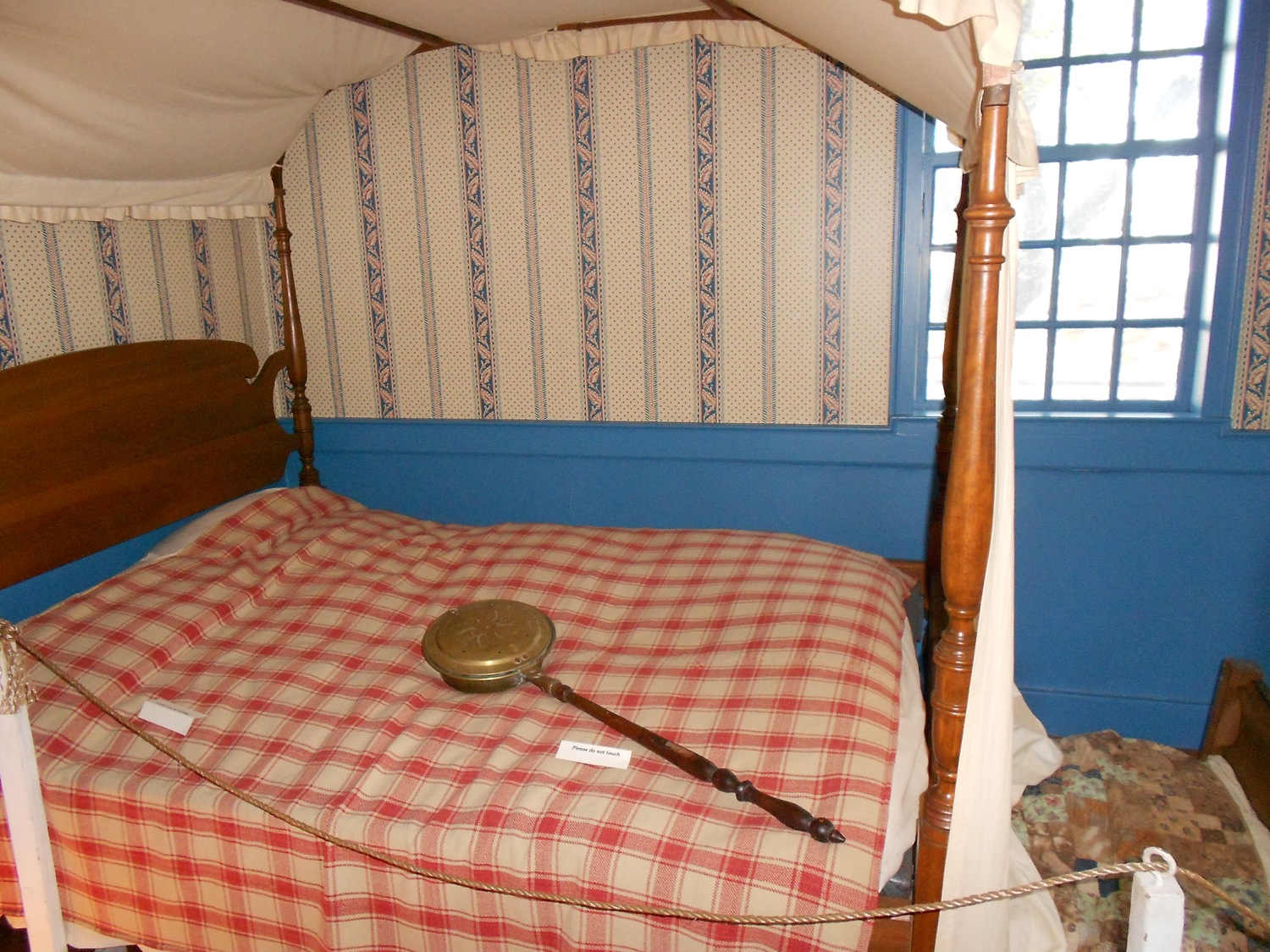
“President John Adams so dreaded the bleak New England winter and the ill-warmed houses that he longed to sleep like a dormouse every year, from autumn to spring. In the Southern colonies, during the fewer cold days of the winter months, the temperature was not so low, but the houses were more open and lightly built than in the North. They were without cellars and had fewer fireplaces; hence the discomfort from the cold was as great.
The first chilling entrance into the ice-cold bed of a winter bedroom was sometimes mitigated by heating the inner sheets with a warming pan. This usually hung by the side of the kitchen fireplace, and when used was filled with hot coals, thrust within the bed, and constantly and rapidly moved back and forth to keep from scorching the bed linen.
The warming pan was a circular metal pan about a foot in diameter, four or five inches deep, with a long wooden handle and a perforated metal cover, usually of copper or brass, which was kept highly polished and formed, as it hung on the wall, one of the cheerful kitchen discs to reflect light of the glowing fire.”
Colonial American homes were often cozy—that is, quite small. Beds took up considerable space. One solution was the “press bed,” which stood on its end during the day, and was pulled down for sleeping at night. Quite clever!

My favorite story of Colonial beds comes from my 97-year-old mother, who recently recalled visiting our ancestors’ farm in Massachusetts when she was very young. She remembered two things from her visit: It was the first time she had ever tasted blueberries, and it was the first time she had ever slept on a feather-filled mattress. She said it enveloped her with a softness unlike any other. It was such a sweet memory for her—and a sweet conversation for me to treasure as I watch her reminiscences begin to fade into history.
