Announcements

10 Year Anniverary & New Releases Winners: Carrie Fancett Pagels' Butterfly Cottage - Melanie B, Dogwood Plantation - Patty H R, Janet Grunst's winner is Connie S., Denise Weimer's Winner is Kay M., Naomi Musch's winner is Chappy Debbie, Angela Couch - Kathleen Maher, Pegg Thomas Beverly D. M. & Gracie Y., Christy Distler - Kailey B., Shannon McNear - Marilyn R.
Showing posts with label Baptists. Show all posts

Monday, November 18, 2019

New Light Baptists (and other denominations of the colonial era)

Some time ago, while reading The Carolina Backcountry on the Eve of the Revolution, featuring the journal and sermons of traveling Anglican minister Charles Woodmason, I came across the term "New Light Baptist" and was curious to know more. Woodmason speaks of them in scathing terms, as he does of every other denomination and most people groups in general, but being raised in a Baptist church myself, I was curious to know.


Wikipedia (which tends to be better sourced these days than it once was) offers a good discussion on the subject, but I also found this snapshot of the religious landscape of the colonial era:

Early New Englanders generally practiced congregationalism, though by the 18th century they seldom thought of themselves as the spearhead of the Reformation. A wave of revivals known as the Great Awakening swept New England beginning in the 1720s, dividing churchgoers into New Light (evangelical Calvinists) and Old Light (more moderate) wings. An increasing minority were calling themselves Baptists.

Nearly all Europeans in these colonies were Protestants, but individual denominations were very different. There were Presbyterians, Lutherans, Baptists, Anglicans, Dutch Reformed, Mennonites and Quakers. While the Church of England was the established church (the official, government-supported church) in the Chesapeake colonies, German and Scottish non-Anglicans were migrating south from the middle colonies, and Baptists were making their first southern converts. Although most Chesapeake slaves were American-born by the late 18th century, they practiced what they remembered of African religions, while some became Christians in 18th-century revivals. [from New Light Schism]

The terms "Old Light" and "New Light" have been applied over the years to several denominational splits, but during the Great Awakening, the debate raged between those who argued that Christianity was more about right doctrine and theology and those who emphasized personal transformation as a result of one's theology. Old Lights were criticized for only caring about one's beliefs, while disregarding behavior such as drunkenness and greed; and New Lights were criticized for their focus on experience and emotion. What began as a split between Presbyterians and Congregationalists birthed the movement called New Light Baptists, when a group of folks influenced by George Whitefield's preaching decided they could find no evidence in Scripture of infant baptism.

John Smyth
But this was not the first time people dissented with such widely accepted theology. There is debate over whether the Baptist church finds its roots in the Anabaptist movement (many say not), or can trace its roots all the way back to the time of Christ, but many say that the movement which led to the modern Baptist church had its beginnings in 1609 Amsterdam, with a man named John Smyth, an English Separatist. These roots, then, cling to the history of the Puritans and Pilgrims, and led to a division between "General" and "Particular" Baptists, who argued whether Christ's atonement applied to all people, or just to God's elect. (Similar debates went on in the Presbyterian Church, famed for following the teachings of John Calvin.) Smyth was eventually imprisoned for his dissent with the Anglican church.

Another Baptist of note was Roger Williams, who founded the very first Baptist congregation in the American colonies (1638, Rhode Island). Not until the First Great Awakening, however, did the term "New Light" become associated with Baptists, when many of them broke away from their Calvinist leanings and it was not held as a complimentary term by those of more established denominations.

Woodhouse rails against New Lights as unlearned, unstable, overly emotional, given to fleshly impulse and vice. He bemoans their lack of Scriptural grounding, their quibbling over liturgical service elements while indulging in public indecency, and their exercise of spiritual gifts as a cloak for sinful indulgence. Doesn't sound so different from criticism between churches today, does it? His accounts tell of shenanigans ranging from a sensuality to rival any modern tabloid, to the cultish and downright criminal. Just the reading of it is enough to make one question one's entire upbringing.

It just goes to show that even the most august structures can have less than auspicious beginnings ... and human nature has certainly never changed, when left to itself.

Despite all that, the Baptist church as a whole found a home in the Carolinas, put down roots, spread across the colonies and into the frontier, becoming a solid, established expression of early American faith alongside more settled and staid denominations.

~*~*~*~

Additional sources:
New Lights (from NCpedia)
Old and New Light (from Wikipedia)
Baptists (from Wikipedia)



Monday, December 10, 2018

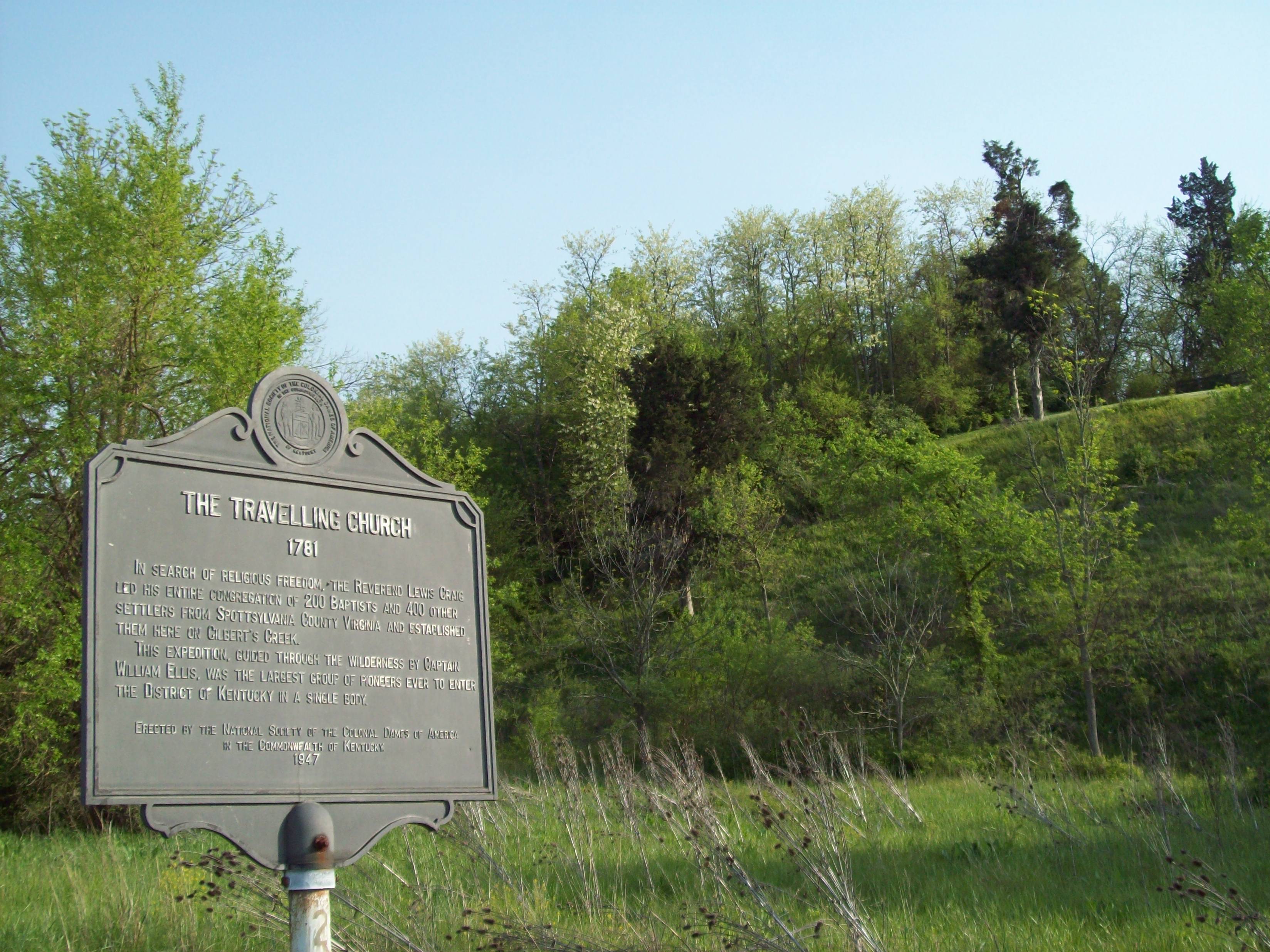
The Travelling Church

Kentucky State Marker #25
From Kentucky State historical marker #25:

In search of religious freedom, the Reverend Lewis Craig led his entire congregation of 200 Baptists and 400 other settlers from Spottsylvania County, Virginia, and established them here on Gilbert's Creek. This expedition, guided through the wilderness by Captain William Ellis, was the largest group of pioneers ever to enter the District of Kentucky in a single body.

So we remember “The Travelling Church,” which set out from Virginia in 1781 for the purpose of exploring the “Canaan” of Kentucky while furthering their missionary endeavors. In October 1781, they arrived in Fort Chiswell in southwestern Virginia with a considerable-sized wagon train, only to find that a hundred miles further, the road would become impassable to anything but horse and foot traffic. They then sold or traded off their wagons and larger household goods, packed things up, and set on down the road. Robert L. Kincaid gives this colorful description in The Wilderness Road:

It was a crushing blow for Craig and his people to give up their wagons so early in their journey. The women and the children hated to leave the luxury of wheels for a hard and uncertain horseback ride. But it could not be helped. Huge baskets and bundles of clothing, bed furnishing and household articles were prepared and lashed upon packhorses. Children were crowded on top, or rode in front and behind their mothers and relatives. The men and older boys who did not have mounts trudged along on foot. Thus accoutered, the company strung out on the road to the dark wilderness with its unknown terrors.

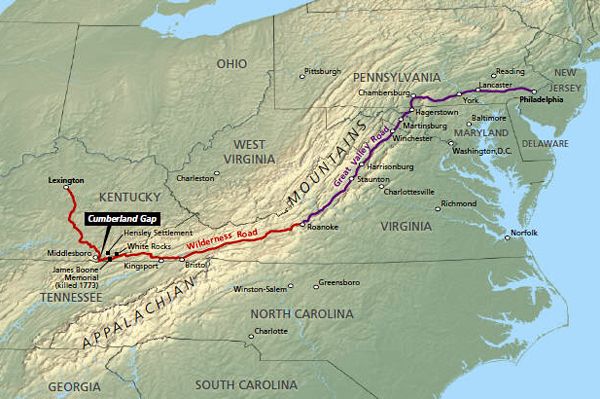
The Great Road (purple) and the Wilderness Road (red)
The group met with delays because of unrest with the Cherokee, wet weather that turned into cold and ice as winter approached. They learned of Cornwallis’s surrender while still in eastern Tennessee and rejoiced greatly over the news. Then, through eastern Tennessee, up over Cumberland Gap and down into southeastern Kentucky, they forded icy rivers and slogged through knee-deep mud in sloughs and canebrakes. Finally the weather eased a bit as they approached Crab Orchard, Kentucky, and at Gilbert’s Creek, in December 1781, they chose a spot for their new church home. This would be the third Baptist church in Kentucky, as two others had been founded earlier the same year.

So why would they do this? Why would almost an entire church leave home and possibly family behind? Obviously the party was comprised of far more than church members—some just wanted the material opportunities Kentucky had to offer—but the biggest reason, for the church itself, was religious persecution. During the colonial era, any church besides the one established by Mother England often came under serious heat from Anglicans. The leader of this particular congregation saw the western frontier as their best solution to this.

Is it possible there could have been a calling from God involved, as well?

~*~*~*~

Filed under the category of historical tidbits I didn’t manage to shoehorn into my recent release The Cumberland Bride. Thanks to Kincaid for his excellent if sometimes embellished work on the Wilderness Road, and to Wikipedia, which has gotten far more reliable over the past few years. :-)

Wednesday, August 21, 2013

Sarah Returns


Dear friends, thank you for your gracious return. Do please accept my apologies for cutting our time short last month. I fear my emotions overwhelmed me. My dear Nathaniel—he’s my husband, for you new friends—encouraged me to try again. He says I have much to offer, for he tells me that in the last days many will undergo what my family had and much worse. The strength I found, he tells me, may help those who suffer the same.
            Please bear with me as I take my time and try to also share the joy. For what are memories if you cannot find joy in them?
            I was quite young when we left Wales for the land claimed by the Massachusetts Bay Colony. I remember little of the place except once passing beneath the window of our town’s mayor. Some men from the king visited him, seeking the names of the families leaving for America. The mayor was a tall man with a fierce face and a pointed beard. His very presence frightened me. I cannot remember why I should have ventured beneath his window, but I did.
            “…condemned wretches, poor gentleman, libertines, those fitter to spoil Wales and England than to help raise the commonwealth…” he had sputtered.
            At first I did not understand, but when my father’s name was mentioned, I scurried away confused that he should be listed with such men. My father, the youngest son of a lawyer, had become a vicar. However, he had discovered the truth of salvation by grace alone. ‘Twas then he had attached himself to those of the dissenting Puritans. Rather unusual in Wales, ‘tis true. He soon lost his vicarage and ‘twas shortly after this that he attached himself to Dr. John Clarke. When Dr. Clarke decided to cross the Atlantic with other Puritans, my father and my mother determined they should follow. Baptists were still feeling the sting of their brother, Edward Wightman, who died at the hands of the monarch in 1611 for stating, “That the baptizing of infants is an abominable custom; that the Lord’s Supper and baptism are not to be celebrated as they are now practiced in the church of England, and that Christianity is not wholly professed and preached in the Church of England, but only in part.”[i]
            If my memory serves me correctly, Dr. Clarke was a member of a Baptist church in Bedfordshire, England. Yes, a great distance from Wales, but not when one finds brethren of like-faith. Though Dr. Clarke associated with other Pedobaptists, he stood on the side of freedom of conscience. He was a gracious man, and like so many who came to New England, he sought the freedom to worship God according to his conscience.
            ‘Twas the banishment of Rev. Whellwright and Mrs. Ann Hutchinson that led to the separation between Dr. Clarke and my father. Dr. Clark chose to help the Hutchinsons, while my father chose to step aside and let justice take its course. Perhaps, when the leaders of the colony of Massachusetts claimed their country to be infested with no less then eighty-two heretical opinions, my father decided to speak out his beliefs.
            On First Days (I believe you call them Sundays), Father began to raise questions regarding the rules by which the Puritans expected all to live. One such First Day a traveler passed through our village. No one would open his door to the man at sunset. Our First Day began at sunset on what is Saturday, but my father welcomed him. A great lover of music, my father entertained this stranger until the constable banged upon our door and threatened to arrest him. Father questioned the law, but at that time did not press the situation and excused the customs of our village to the stranger, who graciously accepted the invitation to retire early without further noise.
            Soon Father’s acts of rebellion became noised about by gossips and those who felt it their duty to correct his poor behavior. If he spoke in town, he would be countered by another who claimed offense to his words.
            I too began to notice the children refusing to play with me, the girls drifting away or turning their backs, and any act of kindness my sweet mother attempted to perform was met with sour faces.
            One day, I asked my mother how she kept her cheery disposition. Her answer, “We are buried with him by baptism into death: that like as Christ was dead by the glory of the Father, even so we also should walk in newness of life.”[ii] She sighed at the confused look upon my face and continued. “If I have died with Christ, what offense can one bring me? My life is not here but with Christ Who resides in Heaven. They can do me no harm with their words or actions, because I do not live in this world, though my body be present here. I live with Christ in Heaven. ‘But God, who is rich in mercy, for his great love wherewith he loved us, even when we were dead in sins, hath quickened us together with Christ, (by grace ye are saved;) and hath raised us up together, and made us sit together in heavenly places in Christ Jesus.’”[iii]
            While I understood her words, I did not fully grasp her meaning until the day I stood before those who sought to have me whipped.
            Alas, I see our time is running out. Forgive me dear friends, for leaving you again, but you see Nathaniel returns today from Virginia and I promised to stand at the shore in Newport to meet him.
            Godspeed, one and all.
______________________________________________________
Sarah speaks the truth when she said the mayors and others sought to reassure the king that the populating of America would not weaken the Commonwealth by stating only those of little value were going.
England was in the midst of much change, a reformation and the beginnings of discontent that would lead to a civil war. I believe to understand those who came to America in the 1600’s you must also understand England at that time. The colonists brought with them the values and attitudes of their home country.


[i] Hammet, Doug. The History of Baptists, Challenge Press, Emmaus, PA 2004, p. 200.
[ii] Romans 6:4
[iii] Ephesians 2:4-7

Wednesday, June 19, 2013

Nathaniel Griffith's Perspective of the "City upon a Hill"

Trouble brewed in the Massachusetts Bay Colony in 1649. But before I give you the next of my memoirs, please take this seat beside me overlooking my wife's garden. I, Nathaniel Griffith, would not have the pleasure of this great garden view (which overlooks the Narragansett Bay) had it not been for the grace of God.

Let me first be charitable to my father and those Puritans who first came to this land. Their intentions were good, desiring to establish a model community in and around the Boston area. Zealous for pure living among all church members (especially of the clergy) and for the church of England to be completely pure of Catholic influence, John Winthrop led a group of men to America. His was a tumultuous life--though I suppose any leader experiences such--but he served his people well and with the best of intentions.

I was a young man when John Winthrop died in 1649. My father insisted I should learn these words from this great man:

"...we shall be as a City upon a Hill. The eyes of all people are upon us."

And indeed, the world did watch to see if these Puritans would succeed. Those who crossed the Atlantic with John Winthrop believed they entered into a covenant with God.

Yea, I am shaking my head. Woe unto us who dare to think we have power to influence God by our right living, for righteous we are not. Nay, they learned through strife that one cannot be the conscience of another and not easily fall into sin oneself. Perhaps not the sin of the man they judge, but a sin even greater in believing they could act in God's stead.

After much labor one day, I rested against the stone fence my father insisted I build. You see, we had two horses which loved to wander. We kept them near on a picket line. What is that you asked? 'Tis a rope we strung about chest level between trees. We tied our horses to this line. We also used a high line, which is simply a picket line hung above the horses' heads. The high lines allowed the horses to graze and not get tangled in their lead. But I digress.

Behind my fence, three men walked. They spoke of those burned at the stake in England for beliefs contrary to the clergy, and then they spoke of those dissenters infecting the churches here in New England. Roger Williams was banished in 1635, Anne Hutchinson was banished, taking with her a number of other colonists to settle Portsmouth, Rhode Island. John Wheelwright was also banished then founded the town of Exeter, New Hampshire. And the list continues. Trouble brewed in England as well and the English Civil Wars began, leading to the beheading of King Charles I.

As I listened, I quaked with fear for Sarah Brown, the woman I loved. Her father had stood with Roger Williams against some of the teachings of the Puritans. Her father also stood in support of Anne Hutchinson and considered leaving with her when she was banished. Instead he stayed, his quiet manner seeming to appease those who opposed the teachings of salvation by grace alone and clung to the necessity of infant baptism. But he soon died and left Sarah. My father then took her in as a maid for my sister. A charitable act driven by a sense of guilt, for he was not without fault for the death of Goodman Brown.

These men that passed my fence determined to purify the Massachusetts Bay Colony of any and all who did not hold to their tenements. As the year progressed, they would seek out any who held a meeting outside of the church and arrest them. Indeed, in the years following some believe those who were tried for witchcraft were not witches, but those who claimed the Holy Spirit communicated with their spirit. And perhaps the most shaking of revelation to these staunch Puritans was the dissension of Henry Dunster in 1653. And one mustn't forget the hanging of Mary Dyer, a Quaker, in 1660, Boston.

I knew I needed to do something to keep Sarah from having the same fate of Anne Hutchinson and others who spoke freely of beliefs contrary to that of the religious leaders of the time. I thought perhaps if I could marry her, I could protect her, but my father would never let me marry beneath my station. Nor did I believe Sarah would have me, a wretched sinner.

Alas, the sun is setting. Perhaps Sarah will share with you next month. And thank you for listening to me ramble on about those days. I fear I lacked great courage and faith, but God would work despite me.
______________________________________________

Here is the timeline of the events Nathaniel mentions:

1630 John Winthrop writes the sermon "A Model of Christian Charity," which includes the section known as "The City upon a Hill." Winthrop then sails to New England

1631 Roger Williams arrives in Massachusetts

1635 William and Anne Hutchinson follow John Cotton to the New World

1635 Roger Williams is banished

1636 Harvard College is established

1637 Rev. John Wheelwright preaches a controversial sermon

1637 Anne Hutchinson and her followers are tried and banished

1638 John Wheelwright is banished

1642 English Civil Wars begin

1649 King Charles I is executed

1649 John Winthrop dies

1651 John Clarke, Obadiah Holmes, and John Crandall arrested for conducting an illegal worship service

1653/54 Henry Dunster, first president of Harvard College, abandons the Puritan view of infant baptism

1654/55 Henry Dunster exiles himself

1659 William Robinson and Maramaduke Stevenson were hung in Boston for returning to the Massachusetts Bay Colony after banishment (they were Quakers)

1660 Mary Dyer is hung in Boston

1660 Parliament asks Charles II to assume the throne thus restoring the monarchy in England.

1661 Executions of Quakers halted by Charles II

This is a very small list of acts the men, whom Nathaniel overheard, had seen and would see in the years to come. It is a quick overview of the struggle those early colonists went through, growing pains of the freedom we now enjoy. Many look at this list and become angry with Christians, but I don't think that is an accurate reaction. Without the Bible to guide our forefathers in an understanding of what true freedom of conscience is, we would never have seen the constitution we have today. I believe the colonists needed to go through these struggles before they could gain an understanding of what America was to become. Without experiencing the trials some of these men endured, they would not have known the importance of their own discovery of true freedom. These men did not look at their current situation, but at the future in which their children would live. They fought for a better place and a better life for those who would live after them.

In my opinion, I think we need to tread carefully before we pass judgment on those in this era. These people were mere men seeking to accomplish something greater than themselves, not realizing they couldn't do it without God's grace.


Sunday, January 13, 2013

The Proof of Your Faith Is found in the Revelation of God's Hand

"God had so appointed it, to stop their fierce proceedings against me for a lie, which they sought to take me in." Thomas Goold quoted by Nathan Eusebius, The History of the First Baptist Church of Boston (1665-1899), p. 44.

"And when Peter was come to himself, he said, Now I know of a surety, that the Lord hath sent his angel, and hath delivered me out of the hand of Herod, and from all the expectation of the people of the Jews." Acts 12:11

Thomas Goold, a leading property owner in 17th century Charlestown, Massachusetts and a wagon maker by trade, created quite a stir. He, the writer of the Confession of Faith for the Charlestown Church began to openly espouse Anabaptist doctrines. Along with Mr. And Mrs Osborn, he caused such concern that the leaders were compelled to write the first records of discipline in the First Parish Church of Charlestown, April 6, 1658.
"...it was consented to by the brethren that his wife [Mrs. Osborn], leavened with principles of Anabaptisme and Quakerisme, should receive an admonition for her notorious neglect of the publique worship of God, denying our churches to be true churches, and denying her membership with us,..."
The end result: excommunication.

These people would be removed from the care and protection of the community. For taking a stand, Thomas Goold would lose not only his social standing but eventually be fined on many occasions, and when he refused to pay the fines, imprisoned.

But Mr. Goold did not focus on the bad. He saw God's hand. When messengers of the church came to argue that he had lied regarding a date for baptism of his child, he recognized God's protection. A friend, who had borrowed his breeches, found the letter confirming Goold's words in the pocket. He also recognized God's protection in having his friend there at the time of this confrontation.

Based on what I have read, I wonder if Mr. Goold still waivered in his convictions at this early date of his trials. I wonder if God saw fit to use this time of testing to help Mr. Goold see God's protection so that he would trust God in future events.

When Peter was arrested, James the brother of John had already been killed by Herod. No doubt Peter feared he'd meet the same end. Yet God spared him. Did that mean Peter would never again face dangers? Not at all. History tells us he was crucified upside down. But between this arrest and his death, Peter would have much work to do for the Lord and would require great faith and trust in God.

As a chapel speaker at a children's camp, I'd listen to girls tell stories of how they hid their Bible under their beds so as not to provoke the anger of their mothers. Or tell of threats by other children in their school yard because they profess the name of Jesus. They, even as young children, stood by their conviction of faith and endured.

Today we see many Christian businessmen and women facing a financial noose. Like Thomas Goold, because of their convictions they may lose all they have gained via fines, and others will suffer because of the stand they take. I wonder if they, like Thomas Goold  and Peter, see God's hand and are encouraged to persevere.

While I read through the documents of our past and rejoice at the battles for freedom fought and won, I marvel at how quickly we are giving up those freedoms. Can you not see the similarities between what Mr. Goold experienced and what those Christian businessmen today who are taking a stand on their convictions are enduring? Even if you do not agree, surely you can see how we are going backward instead of forward in freedom.

We must pray. We can pray for the troubles to be removed, but we must also recognize that God may have a plan higher and greater than our own. The persecution the church in Jerusalem experienced caused them to run to other locations. The apostles had been given a commission:
"But ye shall receive power, after that the Holy Ghost is come upon you: and ye shall be witnesses unto me both in Jerusalem, and in all Judaea, and in Samaria, and unto the uttermost part of the earth." Acts 1:8
 They had not yet gone to the uttermost part of the earth. Comfortable, enjoying the fellowship of others and the growth of the church, they stayed in Jerusalem until God scattered them by using persecution as a catalyst.

Every trial comes for a purpose. Whatever we endure can stand as a testimony of God's work in us and through us, if we chose to look for His hand. Thomas Goold, admonished and put away from the church, could well have been left alone, but God had another plan.
"Now after this, considering with myself what the Lord would have me to do;  not likely to join with any of the churches of New England any more, and so to be without the ordinances of Christ; in the meantime God sent out of Old England some who were Baptists;..."
Thomas Goold, quoted by Nathan Eusebius Wood, The History of the First Baptist Church of Boston (1665-1899) p. 50.
Again Goold saw God's hand. He gave God the glory for the relief and encouragement he received.

What about you? Is your faith proven by your ability to see God's hand in your circumstance? Does seeing His hand in your situation strengthen your resolve to stand by your convictions?

I am praying for our country and for those men and women who courageously remain resolute against those who seek to take away their freedom. I also pray that when the testing of my faith comes, I will be counted among the faithful and found to be without compromise.
"My breathren, count it all joy when ye fall into divers tempations;
Knowing this, that the trying of your faith worketh patience...
Blessed is the man that endureth temptation: for when he is tried, he shall receive the crown of life, which the Lord hath promised to them that love him."

James 1:3-4,12