Announcements

10 Year Anniverary & New Releases Winners: Carrie Fancett Pagels' Butterfly Cottage - Melanie B, Dogwood Plantation - Patty H R, Janet Grunst's winner is Connie S., Denise Weimer's Winner is Kay M., Naomi Musch's winner is Chappy Debbie, Angela Couch - Kathleen Maher, Pegg Thomas Beverly D. M. & Gracie Y., Christy Distler - Kailey B., Shannon McNear - Marilyn R.
Showing posts with label 1500s. Show all posts

Monday, December 13, 2021

Colonial History in the Caribbean: St. Croix Part 3 (another unexpected connection!)

by Shannon McNear

~*~*~

Some things are just too strange to be coincidence.

So this past summer, my husband's Air Guard unit took part in a joint exercise using St. Croix, part of the United States Virgin Islands, as its base. Someone came up with the idea of inviting spouses and/or family along, and thus I found myself flying out of country for the first time ever to a little island I didn't know I needed to visit.

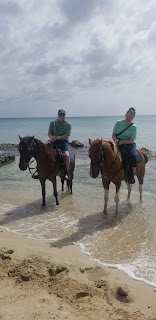
I'll admit, I don't really have a formal bucket list. But if I did, traveling out of country and then horseback riding on the beach would be two items on that list--and I was blessed to get to do both on this trip.
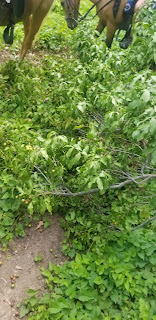
I've already covered two aspects of interesting colonial history associated with St. Croix, one connected with Denmark and one with our own Hamilton, but the one which got me most excited, and felt the most personal, was something I noticed while on that ride through the tropical forest on the island's west side.

It was my first chance to go trail riding in years, and I was already geeking out over getting to be on horseback on a Caribbean island. Then, at a bend in the trail, I looked down and saw these little green apple-like fruits, growing on a small tree that had fallen alongside the trail.

A memory tickled, of an incident I'd read in John White's account of the Roanoke Colony's passage through the Caribbean.

And why were they passing through the Caribbean, you might wonder? I'm glad you asked. It's because during the Age of Exploration, seafaring men knew it was better to take advantage of ocean currents that swirl in a great, clockwise motion from the coast of Europe, southward past Spain and Africa, sweeping around to the Caribbean, and then northward again along the coast of the New World.

Ships often stopped at the various islands for provisioning. And so John White reports an incident that I allude to in my recently released novel Elinor:

The 22 [of June] we came to an anchor at an Island called Santa Cruz, where all the planters were set on land, staying there till the 25 of the same month. At our first landing on this Island, some of our women, and men, by eating a small fruit like green Apples, were fearfully troubled with a sudden burning in their mouths, and swelling of their tongues so big, that some of them could not speak. Also a child by sucking one of those women's breasts, had at that instant his mouth set on such a burning, that it was strange to see how the infant was tormented for the time: but after 24 hours it ware away of it self.

... In this Island we found no watering place, but a standing pond, the water whereof was so evil, that many of our company fell sick with drinking thereof: and as many as did but wash their faces with water, in the morning before the sun had drawn away the corruption, their faces did so burn and swell, that their eyes were shut up, and could see in five or six days, or longer. [They did later find a spring high on a rocky hill.]
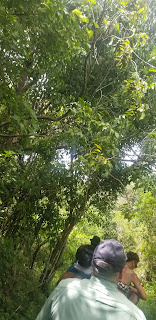
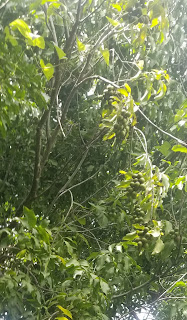
A small fruit like green apples ... ? I piped up and asked the girl leading our ride what the fruits were, and she said, "Oh, that's manchineel, and they're poisonous!"


(Interestingly enough, the experience reported in this article mirrors John White's!)

Our guide went on to chat at little bit about this fruit you definitely want to avoid, and then went on to tell us that there was something else called a "ganip" that looked a bit like a small lime but was absolutely delicious. And before long, we ran across some.


At our guide's urging, we all collected a few. I hesitated--here I was, an adult of somewhat older persuasion and uncertain digestive sensitivity; would sampling this out in the wild be a mistake? But then I decided to take the risk. The skin was tender and popped easily when I bit the tiny fruit--about the size of a Scuppernong grape--and when I squeezed the juicy pulp into my mouth, it reminded me in texture and taste of something between a mango and a peach. There wasn't a lot of pulp surrounding the pit, but our guide was right about how good they tasted. I had several.

And fortunately, I never suffered any digestive distress, either.

A few articles about ganips:

https://en.wikipedia.org/wiki/Melicoccus_bijugatus

https://www.vinow.com/blog/nature/local-fruit-genips/

https://www.plantsandhealers.org/tropical-fruits-of-the-caribbean/

I wonder whether the English colonists thought they were getting ganips when they tried the manchineel?

But here was the thing. I'd completely forgotten whether John White had specified on which island this particular misadventure took place. But do you see it--Santa Cruz? That's the older name for St. Croix, the Spanish version of the name--and the people of the island still call themselves "Cruzan" after that name.

How cool to find that I'd walked shores where my Lost Colonists might have walked, ridden through a forest where they might have wandered.


Monday, July 12, 2021

The Bible of the Colonial Era

Tyndale Bible,
Gospel of John 

That really should read, the Bibles of the Colonial Era.

When discussing this topic, we actually have to go back to just before the Colonial Era to what is known as the Age of Exploration. Because, really, where did colonialism begin? Was it with the English, or the Spanish before them? In truth it's a concept far older than even the Spanish, but they seemed to perfect it with an efficiency both ruthless and shameless, appropriating new lands, the people inhabiting them, and any available natural resources. English colonial efforts didn't take off until the reign of Queen Elizabeth I.

Elizabeth also formalized the Anglican Church, or Church of England, after her father King Henry VIII's split with the Catholic Church. Even so, "Protestant" didn't just apply to Anglicanism, however, but to other groups popping up--followers of Jan Hus, Martin Luther, John Calvin, John Knox, and others. In the middle of all that was the growing push to make the Holy Scriptures available to the common people in their own tongue--not just in Latin, which only those schooled in classical languages could read and understand. This exclusivity had been maintained for far too long by the clergy (Catholic and otherwise) as a way to keep the congregation in line.

John Wycliffe

John Wycliffe, 14th century priest and reformer, is credited with the first complete English version of the Bible. Nearly 200 years later, William Tyndale followed, providing the first English translation directly from Hebrew and Greek manuscripts, but before he could finish, was martyred by Henry VIII. Ironically enough, Henry commissioned a translation shortly thereafter, based largely on Tyndale's unfinished work. Supposing that the colony at Roanoke Island might have had a copy, I used this translation, referred to as the Great Bible, for scripture references in my upcoming Elinor. 

And here, for more information on the subject of Bible translations, I will pause and refer you to two excellent articles previously posted here at Colonial Quills:

Christendom in the American Colonies During 17th Century by Lynn Squire (Aug 15, 2012)

Bibles in Colonial America by Tamera Lynn Kraft (Nov 18, 2016)


For more reading on the history and issues of Bible translations:

Bible Translations Into English at Wikipedia

Textus Receptus Bibles (insight into why there's so much debate over the King James Version)


Monday, February 8, 2021

Researching the 16th Century: Roanoke Island Festival Park

 Another photo-heavy post, so be patient as they load ...


The morning of our second day on North Carolina's Outer Banks, on my quest for on-site research for my upcoming Lost Colony novel Elinor, my daughters and I visited the Roanoke Island Festival Park. Despite the indoor museum areas being closed due to COVID-19 restrictions, I found the open areas extremely interesting and helpful. A walking path leads visitors through a reconstructed indigenous Algonquin village, complete with a ton of informational placards and recordings of words spoken in the native language and native folk stories. I wanted to linger, of course, much longer than the time we actually had.

One of the things that made this so fun is having studied the work of John White, an English artist of some renown for having accompanied three of the first expeditions to the New World, whose illustrations and portraits of native life and people provide the only visual window we have of this time. They've done an amazing job of bringing White's watercolors to life, showing details such as how fish were broiled above large, open fires, to reproduction longhouses and various furnishings.

(And yes, this is the same John White who was later appointed Governor of the new colony, whose granddaughter was the first English child born on American shores.)


Above, my youngest daughter gets into the spirit of reenacting historical trade between Algonquins and the English, beckoning us into the longhouse while reading from one of the signs discussing the importance and details of trade. :-)

Below, I snapped probably a dozen photos of the inside of a longhouse and the details of its construction, but this will give you a good idea of what it looks like.


Sidetracking from the native town area, we walked down to the waterfront, where a beautiful 16th century reproduction ship lay at the dock. My attention was, predictably, torn between the ship and the scenery stretching on both sides.


A few shots of the Elizabeth II, which we enjoyed getting to explore as much as they would allow, again, given pandemic restrictions. (Better photos of the entire ship are are the park website and Facebook page.)


An intriguing little sign I found hanging inside the ship ... good advice for anyone!


We then returned to the Indian town, where my girls were intrigued by the model of a dugout canoe ...
 

A model of one of the fishing weirs commonly used by the Algonquin peoples out in the bay to trap and catch fish ...
And again my youngest literally gets into the fun by pretending to paddle away in the canoe. :-)

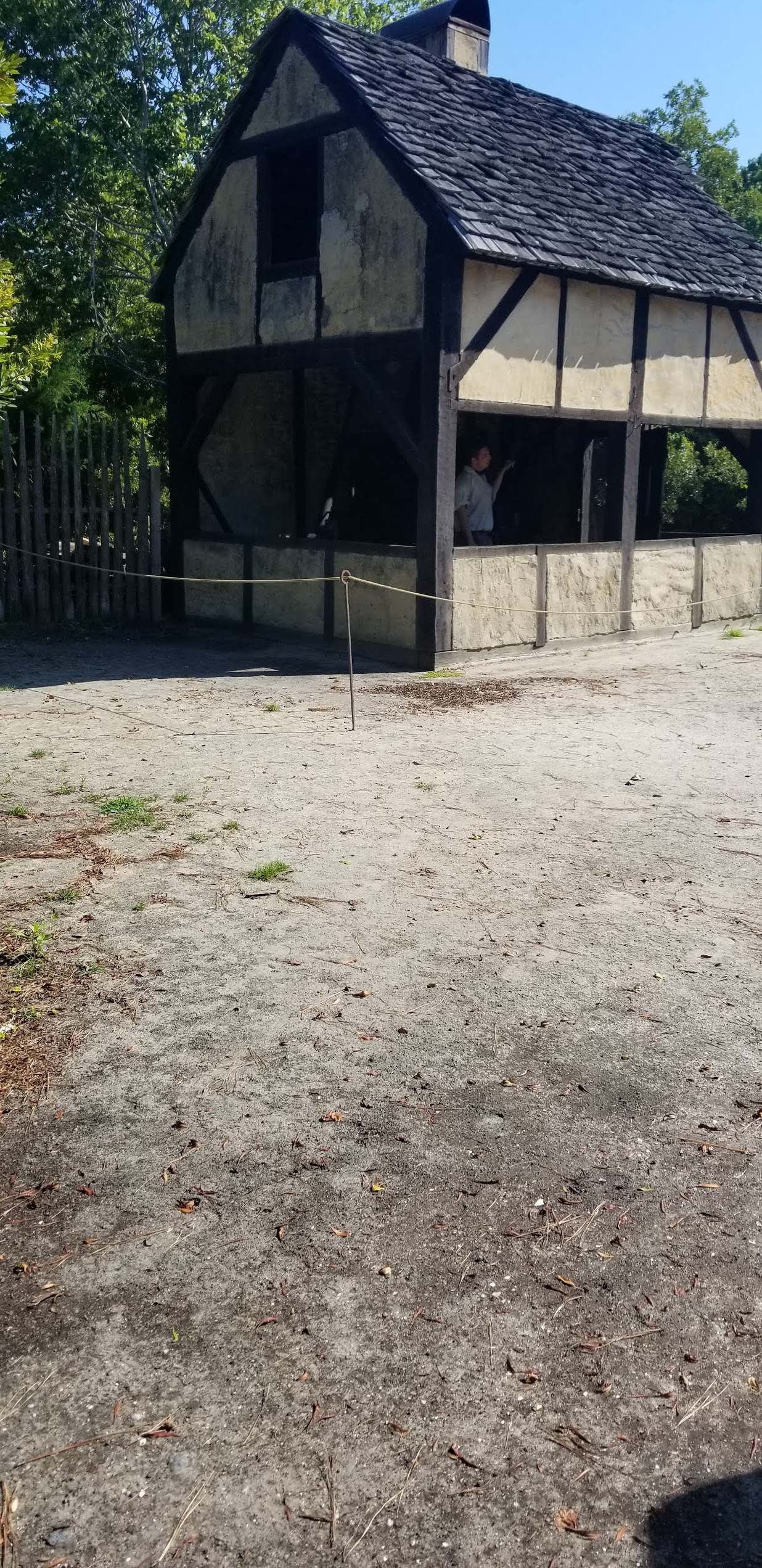
After that, we entered the English settlement area, where among other items of interest, we found a winsome young blacksmith plying his trade. I always find this sort of thing far too fascinating, but with a family meeting to make in another part of the state, we had to say our goodbyes and move on.


The display of a native garden and nearby platform was also interesting. The Algonquin would employ young boys to sit and keep watch over the garden, to make sure deer, raccoon, bears, and other critters wouldn't steal their livelihood. Cultivated crops included the usual corn, peas or beans, and squash, with parsnips, persimmons, strawberries, mulberries, grapes, prickly pear fruit, chestnuts, and acorns also gathered from the wild. Their diet was far more varied than one might expect!

This is definitely a site I'd like to return to when I have more time. In the meantime, they have a lot of interesting reading at both the main website and Facebook page, and it proved an extremely helpful resource, even on a very rushed research trip!


Monday, January 11, 2021

Researching the 16th Century: Fort Raleigh National Historic Site

In a year full of uncertainty and isolation, I was blessed to not only sign another book contract, but also do onsite research for the story. Daughters of the Lost Colony: Elinor is scheduled for a December 2021 release. This was not a story I expected to get to tell--but I am so excited to present it to y'all!

After writing already about the Lost Colony and where recent research indicates they went after leaving Roanoke Island, I'll be sharing more bits and pieces of the story: key players in the Lost Colony saga and maybe even some of the political aspects of the era.

But first, the setting itself.

An important part of research for me is to walk the ground where my characters walked, when possible. To get a taste of what a particular area might have looked, smelled, and felt like, especially in a historical context. So after my niece's wedding in July, near Boston, my daughters and I headed to the Outer Banks of North Carolina. My journey took me in reverse order from history, with Buxton on Hatteras Island being our first stop, but Fort Raleigh National Historic Site is properly the first location to be covered chronologically. It's where Ralph Lane of the disastrous 1585-86 expedition built an earthenworks fort, and where the 1587 expedition landed, originally just to check on the 15-some men left to hold an English presence in the New World but then temporarily settling there after being informed their navigator would take them no further. The actual site of the resulting village and its palisade fort is unknown, but archaeological research found the location of Lane's fort, and a reconstruction was commissioned in the 1950's.

Informational plackards at the site explain that it's obvious the fort would have been too small to shelter an entire settlement. The exact site of the village Lane and his men built then abandoned, and the 15 occupied for however long, is unknown, but that would be where the Lost Colony first took up residence, so I had fun imagining what this area might have looked like with a cluster of English cottages nearby. 


The ampitheater belonging to the modern-day Lost Colony drama production is also located here, so we poked about there as well. It provides a lovely view of the ocean, and the currently unused Elizabethan-inspired buildings added to the atmosphere of historical mystery. And of course the ever-gorgeous maritime forest of pine and oak possess a charm all their own!


Outside the entrance to the ampitheater lies the beginning of a walking trail, with paths leading down to the beach. We didn't have time for the whole route, but a side path led us to a spot where I wanted to linger and linger, overlooking Albemarle Sound. You can bet my imagination ran wild here!


It isn't hard to envision what those first English explorers might have seen when first setting foot here, how enchanted they must have been with the fragrance of the pines and the tallness of the trees, and how strange and yet a part of the forest the native people might have appeared . . .

And how those same people might have felt, seeing their first Europeans, with their equally strange clothing and armor . . .

To be continued!

Monday, July 20, 2020

In the Name of Religious Freedom

French Florida
Or, America's Earliest Colonial History, Part 2.

Right after my last post, a friend messaged me:
I saw your Colonial Quill post. You know how every time one thinks one has history down and then another obscure fact crops up that changes everything? Yeah, that. The first interest in colonizing America wasn't fueled by Queen Elizabeth, who was hoping to stop Spanish expansion. Before that, Jean Ribault landed on the shores of Florida hoping to set up a colony. For Huguenots, I believe.

https://jeanribault.org/
Take a peek at this beautiful website. You're welcome. Makes me long to write a story about this man and the people he sought to defend--although now, alas, I am under contract for a story featuring another, but maybe not so different, group.

That group would be the famed Lost Colonists of Roanoke Island.

These days, even the word "colonial" has a bad name. I've written about this before.

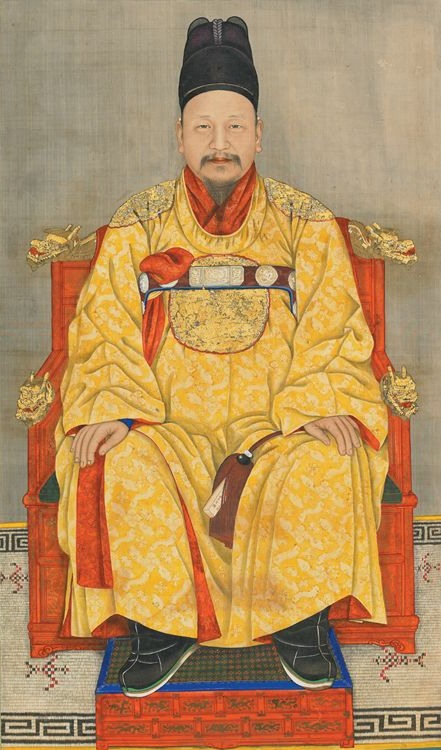
Emperor Gojong of Joseon (Korea)
Truth is, every empire down through history has sought to grow their holdings and increase their wealth by annexing other lands and peoples. I was recently reminded of this while watching, of all things, a Korean drama with my youngest girl, set during the early 1900's, a particularly turbulent time of Korean history. Joseon (Korea) was just beginning to open up to Western ways, just beginning to not immediately put Christians to death, and struggling to find her place between China, Russia, America, and Japan. The latter, that tiny but ridiculously ambitious island nation, made no secret of its desire to make Korea a colony of Japan. Ruthlessness and political maneuvering were the standard of the day, and corruption abounded.

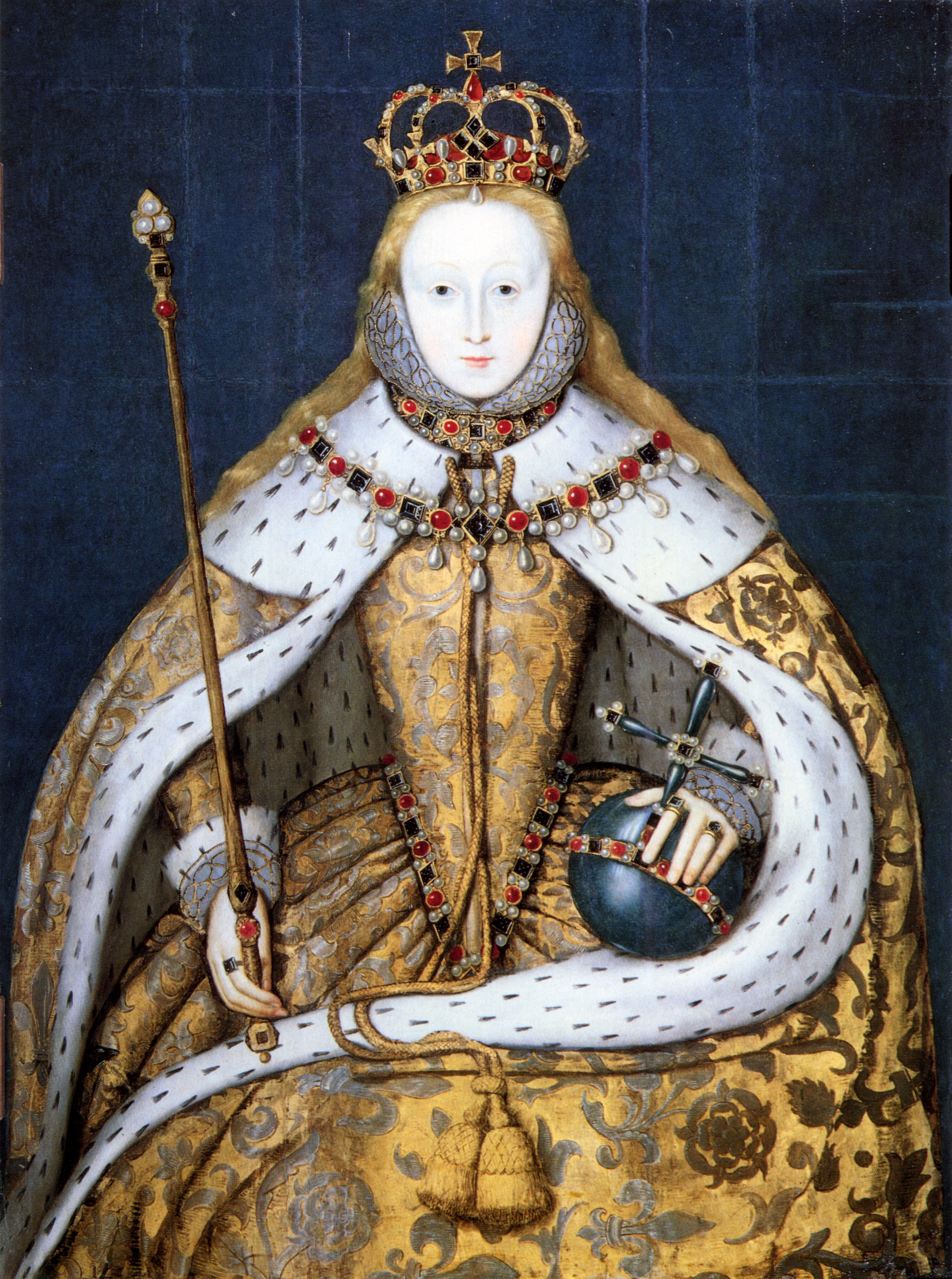
Good Queen Bess at her coronation
Not so very different from the time of Queen Elizabeth. "Good Queen Bess" furthered her father's move in breaking away from the Church of Rome by establishing the Church of England. Bloodshed between Catholics and Protestants abounded, and religious views were the standard by which political views were judged. Ireland suffered a harsh and bloody takeover by England, for reasons which I will not get into here, but doubtless that set the precedent for what later happened on American shores. When Elizabeth granted Sir Walter Raleigh his charter for a colony in the New World, however, she was very clear that it was at least in part for the purpose of furthering the Gospel to unreached peoples, but plenty of folk in England were unhappy enough with the way things were going in the newborn Anglican Church that they wished to either purify the Church (thus, Puritans) or create their own group entirely (Separatists).

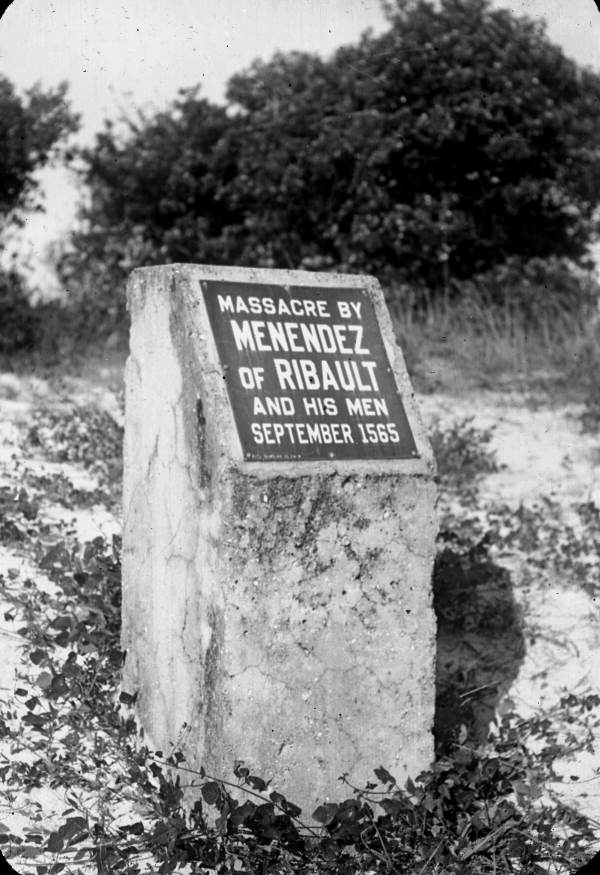
Most feared, however, were the Spanish. Spain already had holdings across South America, and their treasure galleons were the most coveted prize of English privateers. Staunchly Catholic to the point of meting out torture and death to those who disagreed (the Spanish Inquisition, anyone?), they were equally ruthless on the sea. The English were by far not the only ones to suffer at Spanish hands. As outlined in the website I shared above, French Huguenots sought refuge on what is now the Florida and South Carolina coast, but were seen as a threat to Spain's supremacy in the New World and met with death once their Protestant leanings were made known.

Marker at Fort Matanzas National Park
Lee Miller theorizes in her book Roanoke: Solving the Mystery of the Lost Colony that the group which set sail in 1587 under Governor John White, seeking to establish the first permanent English settlement in the New World, were Separatists. If so, the fate of French Huguenots would have been fairly fresh, and avoiding the Spanish at all costs would have been uppermost on their minds. Brandon Fullam makes the case in The Lost Colony of Roanoke: New Perspectives that this would have been a good reason why they settled on Roanoke Island rather than going north to the Chesapeake as originally planned. Maybe it's just my own firm Christian faith, but I find the Separatist theory quite compelling. It certainly wouldn't be the first time that a people group migrated in search of religious freedom, would it?