Announcements

10 Year Anniverary & New Releases Winners: Carrie Fancett Pagels' Butterfly Cottage - Melanie B, Dogwood Plantation - Patty H R, Janet Grunst's winner is Connie S., Denise Weimer's Winner is Kay M., Naomi Musch's winner is Chappy Debbie, Angela Couch - Kathleen Maher, Pegg Thomas Beverly D. M. & Gracie Y., Christy Distler - Kailey B., Shannon McNear - Marilyn R.
Showing posts with label Michigan. Show all posts

Friday, March 22, 2019

Point Iroquois Lighthouse and the Massacre of 1662

Isn't that a beautiful lighthouse? Point Iroquois Lighthouse is at the foot of Whitefish Bay (made famous around the country by Gordon Lightfoot's song, "The Wreck of the Edmund Fitzgerald") on Lake Superior. It was built in 1870, replacing the first wooden structures that had served there since 1857. It operated as a functioning lighthouse until 1962, when it was replaced by an automated light across the shipping channel near Gros Cap, Ontario. The building was placed on the list of National Register of Historic Places in 1975.

Why is this significant? My husband and I are in the process of applying to be the volunteer lighthouse keepers for a year in 2022. The volunteer keepers live in the larger side of the lighthouse duplex - to the right in this photo - while the smaller side and the tower are open to the public from mid-May to early-October every year. Our duties would include keeping the grounds, greeting guests, working in the little bookstore (yes! it has a bookstore!), and performing the general maintenance.

If this all works out, I can only imagine sitting in this historic building, looking out over majestic Lake Superior, and writing down the stories they want me to tell.

Why talk about this on Colonial Quills? Because this area was very busy during the Colonial period. The first white men to come were the French explorers Brule and Grenoble. Point Iroquois became a familiar landmark for the French explorers, fur traders, and missionaries who followed.

The name of the place, Point Iroquois, comes from an Indian massacre that happened here in 1662. The local natives were Ojibwe who fished and hunted the area. In 1662, an Iroquois war party invaded in an attempt to control more of the fur trade. The Ojibwe defeated the Iroquois on the shores where the lighthouse stands today. The Ojibwe called this place "Nau-do-we-e-gun-ing," which means "Place of Iroquois Bones."

While our history books fixate on only the greed and expansion of the Europeans in this country, it's good to remember that people are people no matter the color of their skin. The desire for a better life - however one defines that - is not and never was limited to one sector of the human race. The Ojibwe slaughtered the Iroquois in 1662 to stop their westward expansion and protect their own interests. In the years that followed, they'd fight many more battles with other tribes as well as the Europeans who came with their metal pots, woven cloth, whiskey, and guns. But they couldn't stop progress any more than we can today. Yesterday's metal pots are today's cell phones. Can you imagine going back to a time before we had them?


Pegg Thomas writes "History with a Touch of Humor."

Friday, July 27, 2018

Great Lakes Lighthouses

What does The Great Lakes Lighthouse Brides Collection have to do with Colonial America? Nothing. But ...

Founding CQ author, Carrie Fancett Pagels and I are both authors in this upcoming collection that releases in November. 

Carrie and I both love the Great Lakes and there is a lot of Colonial history here. However, the first Great Lakes lighthouse was not erected until 1825 in what would become the state of Michigan at Fort Gratiot.

Faster, cheaper, and free from attacks by Natives, shipping on the Great Lakes was the answer to moving a lot of people and materials in and out of the northern Great Plains. But it wasn't necessarily safer. Rocks, shoals, islands, and other obstacles - many of them difficult or impossible to see in the dark or during bad weather -  ripped open the hulls of unsuspecting ships.

Lighthouses were the answer, and they popped up along the shorelines of the Great Lakes in amazing numbers from 1850 - 1860. Construction slowed during the Civil War, only to increase with even more lighthouses build between 1870 - 1925. 

Along the shorelines, on riverbanks, and on islands that dot our great inland seas, many of these lighthouses still stand tall and strong and still guide vessels along their way. New technology has replaced the lonely lighthouse keepers, but many of the buildings are open to tourists and include an intriguing glimpse into the past.

If you're roaming around the Great Lakes, take time to visit one of these lighthouses. You won't regret it!


Pegg Thomas
Writing History with a Touch of Humor

Friday, June 22, 2018

Celebrating 350 years of Sault Ste. Marie, Michigan


The waterways along the Great Lakes aren't given the respect that they deserve for America's Colonial Era. People tend to focus on Boston, New York, and Philadelphia. But here are some interesting facts to point out for the 350th Anniversary of Sault Ste. Marie, Michigan:

  • In 1623, Étienne Brûlé visited what is now Sault Ste. Marie, Michigan, and named it "Sault de Gaston" in honor of Gaston, the brother of King Louis XIII of France. (Sault meant either waterfall or rapids.)
  • The Dutch started the first settlement in New Netherland (New York) in 1624.
  • The Puritans did start not arriving in Boston until 1630.
  • In 1668 the French Jesuits missionaries started the first settlement where Étienne Brûlé had visited and named it "Saults de Sainte-Marie, meaning St. Mary's Falls.
  • Pennsylvania didn't get its charter until 1681
  • The War of 1812 touched Sault Ste. Marie with the American burning and looting of the British Northwest Company's fur trader post there.

The area was first under the control of the native Ojibwe, Sauk, and Ottawa tribes who migrated north in the summer months when the whitefish were plentiful.

The French came and traded with the native tribes, they introduced things like metal knives, pots, woven cloth, guns, and gunpowder. The tribesmen traded beaver and other hides which were much in fashion in Europe as well as food. The French claim on the area spanned from 1623 - 1763.

The Brittish drove out the French and alienated the natives. Their tenure in the area was relatively short, from 1763 - 1814.

The Americans claimed the area in 1814 at the conclusion of the War of 1812. Aside from the fortune in furs, the area proved to be rich in other natural resources like iron, copper, fish, and lumber.
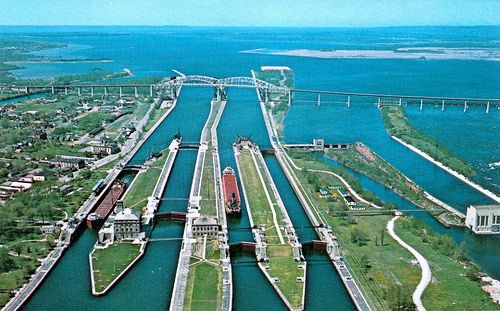
Related image
Today, Sault Ste Marie operates the only lock system that allows freighters to move between Lake Superior and Lake Huron. Millions of tons of cargo and raw materials - many vital to our national interests and security - pass through the Soo Locks each year. 


Pegg Thomas is a native Michigander and avid Upper Peninsula fan. She and husband Michael plan to return to "Da Soo" (Sault Ste. Marie) when he retires in a few years. Both attended Lake Superior State University - back when it was Lake Superior State College - and look forward to moving back "home."

PeggThomas.com

Wednesday, October 18, 2017

Historic Mill Creek Discovery Park -- Mackinaw City Michigan by Carrie Fancett Pagels

The Mill House at Old Mill Creek in Mackinaw City Michigan

If you're planning your next visit to a place this is not only historic, but beautiful, and you love 18th century destinations, add Historic Mill Creek Discovery Park in Mackinaw City. This is part of the Michigan State Parks, specifically the Historic Mackinac Parks. We purchased a summer pass this past summer so that we'd have admission to multiple locations for research (and enjoyment!) If you've got kids with you, or adventurous adults, they even have zip lines here and hiking trails.

As indicated on the sign above, Robert Campbell built the first sawmill in Michigan here near the Straits of Mackinac and aided the British in supplying lumber to build Fort Mackinac on Mackinac Island. There is also a house on the site, representative of the miller's home during this time frame and beyond (look for a future post).

When you arrive at the park, you'll enter via the store. I'd been bringing my heroine Maude around to visit various and sundry places in the area while I was up North all of July. Above is a picture of the fun employees at the store who posed for a picture with her -- wink wink! (The cover of My Heart Belongs on Mackinac Island: Maude's Mooring.)

You'll want to find out when their historian will be speaking and take a bench to hear his fascinating discussion of Mill Creek.


After the initial presentation you'll go inside the Mill House. Again, the historian will tell you more history but also demonstrate how the saw works. The blade is really huge, see below!


Below is a brief video clip. Since my great-grandfather and other family members were some of the lumberjacks who cut down some of the great white pines, I cringed a little during this part of his speech!


You'll be instructed to go outside to see how the wheel works. It makes a beautiful sound. 


Also on the property are many plaques which explain types of sawmills and the engineering behind them. Allow plenty of time to read these, and observe the demonstrations at the Water Power Station.
This area of the park explains about the types of wheels and how they work to generate energy to power the sawmills. Below is one of the displays.
Question: Have you visited Historic Mill Creek Discovery Park -- Mackinaw City Michigan? Would you like to? Were you surprised that the miss was operational as early as 1760?


Carrie Fancett Pagels, Ph.D. is the Administrator of the Colonial Quills blog and author of RT Book Reviews Top Pick My Heart Belongs on Mackinac Island: Maude's Mooring. She enjoys history, research, and travel which comes in handy for coming up with her own pictures for many of her blog posts on Colonial Quills. 

Friday, September 1, 2017

The Laundress's Life at Fort Michilimackinac by Carrie Fancett Pagels


Laundress Reenactor at Fort Michilimackinac in Mackinaw City, Michigan

This summer I had the privilege of promoting my new release My Heart Belongs on Mackinac Island: Maude's Mooring up North, staying in Mackinaw City for a month! And we rented a cottage only a half mile from Colonial Michilimackinac, one of the Michigan State Historical Parks in the area.  So a beautiful walk along the Lake Huron shoreline away, we were able to enjoy programming at the fort! 
One of the wonderful presentations was about the role of the laundress at colonial forts. I was surprised to hear that the wife of a soldier could earn well more than her husband, by taking in laundry! I've read so many things about camp followers fulfilling these roles but I'd not thought about the many enlisted men's wives who might do so.  

The married enlisted men lived in homes inside the fort such as this one depicted below. So if the soldier's wife was a laundress, he'd enjoy a much more comfortable home because her funds could help purchase more goods.

Once previously we had a post about laundry day, by Lori Benton, (Click here to read).

One of the challenges a colonial-era laundress faced in the forts was in getting out stains in white shirts. A lot of scrubbing happened, and the sun helped, but if you want to know more about how laundresses worked their magic, we suggest you plan a trip to beautiful Colonial Michilimackinac in Mackinaw City!

Check out the huge pots of hot water and the way the garments are "hung" up. The depiction shown is during the time of British occupation of Fort Michilimackinac. The fort was originally made by the French, later was taken over by the British, was moved to Mackinac Island, and eventually the Americans took possession (before the Brits grabbed it again for a while!)

Have you heard? NINE of our Colonial Quills authors are part of the Backcountry Brides collection, from Barbour Publishing, which releases this spring in May! My novella, "Shenandoah Hearts" is set right before the onset of the French-Indian War and includes some forted drama. You can pre-order at Christian Book Distributors.


I will be one of the guests at the Virginia ACFW Facebook party on Friday, September 1st, with the 5:00 PM spot. Come by and visit with us for a chance to win a giveaway (click here). And my colonial-era novel Saving the Marquise's Granddaughter is part of this Celebrate Lit giveaway (click here.)

Giveaway:  Choice of RT Book Reviews' Top Pick Carrie's Mackinac Island-set novel or any of her books, including this upcoming release. Answer this question to enter the giveaway: Can you imagine living inside a colonial-era fort?


Monday, December 26, 2016

Rendezvous in the Sault! Sault Ste. Marie, Michigan Colonial Event


Are you planning your summer ahead, like I am? If you're heading up to Northern Michigan or Michigan's beautiful Upper Peninsula, you might want to plan to attend Rendezvous in the Soo. This colonial event happens in late July. In 2016 my family and I were blessed to be able to attend! The photo above is one of the encampments of reenactors. Below is another vignette!

Soldiers were everywhere, especially the French, because this entire region was settled by the French in the 1600s. Not only were there forts, but the fur trade was prominent in the area. The French Colonial Heritage Society directs and supervises the event.


There is a reason they keep the tomahawks behind a rope!

While you are at the Rendezvous in the Soo, be sure to participate in the Tomahawk Throw event! That's my son, above, and he did a fantastic job with throwing the tomahawk! But be sure to stand behind the rope, and follow all the rules. The primary Native American tribes in the area were Odawa, Ojibway, and Chippewa.

There were so many wonderful reenactors at the event. This kind lady was weaving rope from cornstalks! She explained that in colonial times people had to use what they had on hand to weave ropes. She even gave me a sample, which I still have! I found it interesting that some of what she had learned was through being a Boy Scout Leader!

This year, Rendezvous in the Sault will take place July 29th and 30th in Sault Ste. Marie, Michigan. What historic events do you hope to attend this summer?

Bio: Carrie Fancett Pagels is the author of over a dozen historical romance books and is the administrator of the Colonial Quills Blog. In her upcoming release, My Heart Belongs on Mackinac Island: Maude's Mooring, part of her heroine's backstory is that her colonial ancestor was a little French girl from Mackinac Island, whose "parents" lived in mid-1700s Sault Ste. Marie! 

Monday, August 31, 2015

The Original Fort Michilimackinac - Fort DeBuade in St. Ignace, Michigan, by Carrie Fancett Pagels


Above is a close up and enhanced image of the 1696 Coronelli Map of the Great Lakes, touted as being the most accurate map of the Great Lakes found in the 17th Century. Obviously, as we know today, it was sadly lacking in accuracy. One thing that is easy to see however, is that whoever controled the Straits of Mackinac wielded military might at that time. The straits are that close area between the Lower and Upper Peninsulas of Michigan. The French were the first colonial presence in this area.

The original Fort Michilimackinac, one of three forts bearing the name, was constructed by the French and built in St. Ignace, Michigan. The fort also went by the name Fort DeBuade. St. Ignace is located in Michigan's beautiful Upper Peninsula. Situated on land that juts out into the straits of Mackinac, St. Ignace is bordered by two bays and two of the Great Lakes - Lake Huron and Lake Michigan.  Located at a strategic juncture for the fur trade, the French built the fort centrally, with two tribes also encamped on either side.  We don't really know what Fort DeBuade looked like but it make have been a stockaded wooden fort such as one can find displayed in Mackinaw City at the Michigan State Parks Fort Michilimackinac. (Wiki gives several references, that look good, for their notes on Fort DeBuade.)

Native American life, around colonial forts, isn't always considered at many museum sites. The Fort DeBuade museum, in St. Ignace, houses many Ojibway artifacts and is located at the site of one of the villages that surrounded the fort. Native American goods and history are the focus.

The French had a different approach to interacting with the Native Americans than the British died when they came to the straits (their ill treatment later contributing to Pontiac's Rebellion.)

In my recent releases, Books 2 and 3 in the Christy Lumber Camps Series, The Lumberjacks' Ball and Lilacs for Juliana, the stories are set near St. Ignace, in the early 1890s. 

Although they are after Fort DeBuade's day, the residents of the area (I grew up not far from there) were no doubt affected by the history of the fort.  Having different tribes encamped on either side of a French fort had to have been an interesting situation--there was a balance to be had. Yet when the English came in, it is well documented that they failed to treat the tribes with respect and immediately began to engender their hostility.
The later built Fort Michilimackinac in Mackinaw City was ultimately dismantled and moved to Mackinac Island. Seated high on the bluff, the final fort built had an excellent vantage point!

In the time of my series, Fort Mackinac, as it is now called, was winding down. There was no longer a need for a fort in the straits of Mackinac.

Question: Does it seem strange to you that over time the main French fort moved three times in the Straits of Mackinac?

Bio: Former “Yooper” Carrie Fancett Pagels writes Christian historical romances about overcoming. She grew up in Upper Peninsula of Michigan, where many of her stories are set. Possessed with an overactive imagination, that wasn't "cured" by twenty-five years as a psychologist, she loves bringing characters to life. Carrie and her family reside in Virginia’s Historic Triangle, which is perfect for her fascination with history. Carrie enjoys reading, traveling, baking, and beading—but not all at the same time!  

Wednesday, October 15, 2014

Fort Michilimackinac by Carrie Fancett Pagels


Firing Demonstration Fort Michilimackinac

I have previously posted here on Colonial Quills about Fort Michilimackinac, located in Mackinaw City, Michigan. You can visit the reconstructed site which is maintained by the Michigan park system. My current story “The Fruitcake Challenge” is set outside of Mackinac City in a lumber camp in 1890.  This area is strategic to the Great Lakes because the Straits of Mackinac converge as at this point. In between the Lower and Upper Peninsulas of Michigan, Mackinac Island was a location of special spiritual importance to the tribes who lived in the area of Upper Michigan, Wisconsin, and Minnesota. Although it may seem like a long distance to travel, various tribes did travel extensively through the region, typically by canoe, during this time.
French Voyageur Reenactor - Fort Michilimackinac

The French occupied this area from the 1600’s on, including Fort Michilimackinac in Mackinaw City. They enjoyed good relationships with the natives. Some of the soldiers intermarried. This was also the time of the French voyageurs and trade was brisk. Many of the names of towns, and many of current residents today, are of French origin. The region was predominantly Catholic and many famous priests, including Father Marquette, came on missions from Europe. But that changed after the French-Indian War. The French surrendered the fort to the British after the war. And of course the British weren’t Roman Catholic, so that changed things as well. A priest was part of post life for the French. Not so for the British.
House and garden at Fort Michilimackinac

The transition was anything but smooth. The native tribes were unhappy with the British military’s high-handed behavior and their failure to treat them with the respect they received from the French. Instead of a happy intermarriage they now were basically under the rule of the British. Pontiac’s Rebellion later resulted, with devastation visited upon Fort Michilimackinac. A new stasis was achieved afterwards, however, between the natives and the English. Within a generation, though, war again commenced, with the American Revolution.
Fort Mackinac on the bluffs, formerly Fort Michilimackinac in Mackinaw City

When it became clear that Fort Michilimackinac could not easily be defended, the British garrison was moved to Mackinac Island. The fort was basically dismantled and transported across the convergence of Lakes Huron and Michigan to the island and reassembled high above the bluffs, overlooking the harbor. What wasn’t taken was basically burned so it wouldn’t fall into enemy hands.

He who controlled the straits basically controlled the brisk fur trade, which had brought wealth to the French and was now controlled by the British. After the American Revolution, the island was surrendered to the Americans and hence so was the fort. Growing up in Michigan’s Upper Peninsula, and living so close to the straits, I was blessed to be brought up hearing about the influence of the French, the Native Americans, and Americans and I’ll be honest—less was stressed about the British. They occupied the area for only a relatively short period of time and weren’t particularly “nice” about it.

***
Thank you to the volunteers and employees of the Michigan State Parks in Mackinaw City, at historic Fort Michilimackinac for allowing me to get these photographs.
***


Giveaway: Copy of Carrie's bestselling novella "The Fruitcake Challenge" (set in Emmet County Michigan) to one commenter.


Question: When you think about what today is America do you ever consider who lived on the land during the colonial time period?