Announcements

10 Year Anniverary & New Releases Winners: Carrie Fancett Pagels' Butterfly Cottage - Melanie B, Dogwood Plantation - Patty H R, Janet Grunst's winner is Connie S., Denise Weimer's Winner is Kay M., Naomi Musch's winner is Chappy Debbie, Angela Couch - Kathleen Maher, Pegg Thomas Beverly D. M. & Gracie Y., Christy Distler - Kailey B., Shannon McNear - Marilyn R.
Showing posts with label Guest Authors. Show all posts

Friday, February 12, 2016

High Tea in Winchester Virginia -- Guest Post by Kay Moorhouse


High Tea in Winchester Virginia 
Guest Post
By Kay Moorhouse

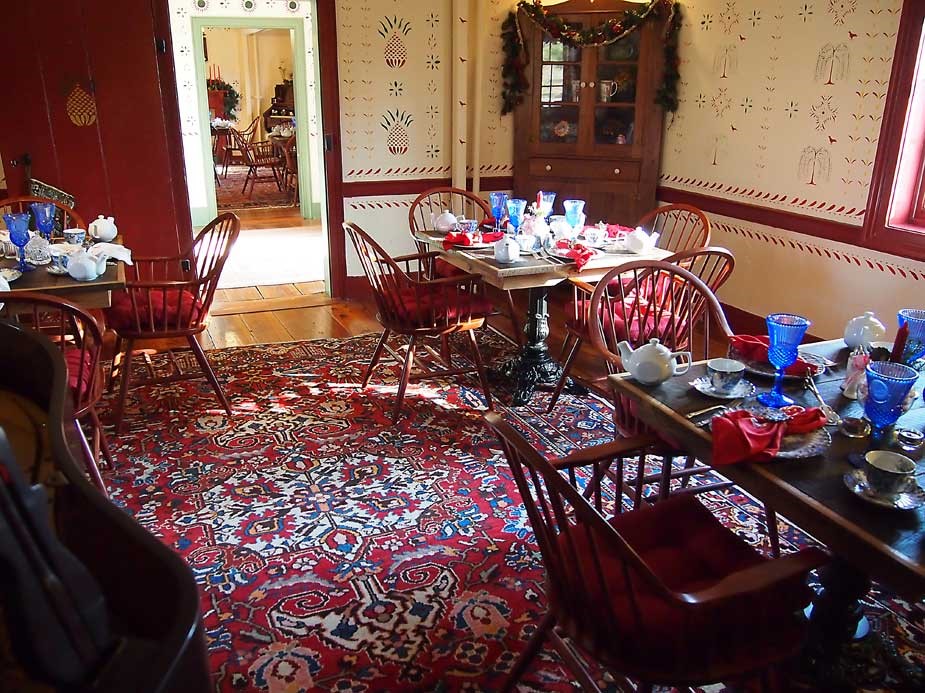
The Coach and Horses Tea Room serves a lovely high tea in a 1790’s house in Winchester, Virginia. Since, I was there during the holiday season, the rooms in the establishment were embellished with greenery, ribbons, and other Christmas decorations, including a charming, Dickens village atop the baby grand piano. A low hum of chatter filled the rooms as groups of women enjoyed the food and companionship. A quiet background of Christmas music floated through the air adding an additional, festive note to the high tea.


High tea might mean a different tradition to different people. There is much speculation and legend concerning the history of tea times in Great Britain. There is also some confusion about the term “high tea,” which originated with the working class and was a name for the evening meal, sometimes called “meat tea.” Today, the high tea experience in American tea rooms is comparable to the English full afternoon tea. It generally includes varieties of hot tea, scones, sweets and savories.


At The Coach and Horses Tea Room, where I went with my daughter and granddaughter for their high tea, we each had our own teapot—outfitted in a teapot cozy. Our first decision was to each chose a tea from a long list of tea selections. I chose Berkshire Apple Fig; my daughter chose French Vanilla Bean; and my granddaughter chose a seasonal Pumpkin Caramel Spice. It was fun to try the different flavors. My daughter and I traded teapots, as I preferred the one she ordered and she preferred mine. My 12-year-old granddaughter was very pleased with her choice, to which she added milk and sugar.

The first course was a choice of either Artisan Greens served with various fruits and berries along with a pomegranate dressing or a bowl of Asparagus Leek Soup. Both were excellent and generous servings. The salad ingredients were exceptionally fresh. The creamy soup included chunks of potato.

The second course was Cranberry Eggnog Scones served with clotted cream and preserves. The scones were exceptional--flakey and tender. These were the best I’ve ever tasted. I didn’t try the preserves, but the clotted cream was a decadent addition to these special scones. When the owner was at our table, I asked him about the scones and he explained their painstaking preparation, which includes grating the frozen butter, keeping the dough very cold, and using White Lily flour.


Finally, the 3-tiered serving tray, was brought to our table. It was laden with a myriad of eye-catching delicacies. According to the menu, the selection always includes dainty tea sandwiches with homemade fillings, mini savories, fresh fruit, sweet delicacies and desserts. The offerings on the bottom tier of our tray were mostly savories, as were the hot miniatures on an additional plate. We decided to start with those and work our way up. There were three of every tiny treat—one for each of us. We all enjoyed the delicious, beef pastry. There was a hot, chicken pastry and another that included asparagus. All were very tasty. Little sandwiches, served cold, included a pimento cheese on a dark, soft roll; and a wonderful cucumber pesto, open-faced sandwich on dark bread.

The sweets on the tray were appropriately decadent. Miniature mincemeat pies were served hot from the oven in tiny soufflé cups. The custard, fruit tarts are delicious with a thick layer of custard topped with a variety of large, fresh berries. Fresh pineapple and kiwi were added to the mix. Altogether, I am guessing there were 20-24 different dainties on the 3-tiered tray and the additional plate.

High tea is always a fun experience. High tea at The Coach and Horses Tea Room is an experience I will long remember.


 Our Guest contributor, Kay Mooorhouse, is an avid reader of Christian fiction. She is a reader and reviewer for many Christian authors.  Thanks, Kay, for sharing with us!!!

Friday, April 10, 2015

Lori Benton's The Wood's Edge - Guest Review

The Wood's Edge by Lori Benton
Regina Fujitani's Guest Review of The Wood's Edge by Lori Benton (Waterbrook, May, 2015)

Lori Benton has written a riveting tale of two families, the Oneida and the British. Two families-two cultures that will be impacted by a decision that will change their lives. A young woman is caught between two worlds. A young man is destined to help both families, and to be reunited with his twin brother.

A British colonel loses his baby in childbirth. A young mother with twins that are different in color, one white and one brown. The baby that died has been switched with the white twin. A father that loves his wife, is desperate to save her from another loss.

As the story begins, the Indians and French are fighting an English fort. Two women give birth, one baby dies, the other gives birth to twins.. As the father is evacuating the fort with his wife and the baby she believes is hers. As they are retreating they are attacked by Indians. A fight for their survival becomes imminent.

Colonel Aubrey's adopted daughter, Anna, finds herself friends with Two Hawks. Two Hawks is William's brother. As the story unfolds and the truth comes out, will the two fathers find forgiveness? Or, will there be a war?

I loved how Lori told this story. I felt like I was there during the Indian raid, with Anna, Two Hawks, and William. I felt like I was right there in The Wood's Edge. From the first page to the very last, Lori will keep you drawn into the pages. This beautiful story is worth your time!

I give this book five stars! I cannot wait to read the next book!

Regina Fujitani is a reader, reviewer, and Beta reader for Christian authors. She lives in the Dakotas with her family and is about to become mother-of-the-bride!

Giveaway: A signed copy of Lori's new release!  Leave a comment on Regina's review!

Monday, July 7, 2014

Review of Circle of Spies by Roseanna M. White

Circle of Spies

by Roseanna M. White

As the Civil War stretched on,
the Culper Ring must draw an unwilling agent 
into the family legacy of espionage...

Guest review by Dorcas Perkins 


5 Stars aren't earned easily. But this book deserves every one of them.

It isn't often I read a book and say "I wouldn't change a thing." There's always SOMETHING that just doesn't quite "scratch the itch." So I was amazed that when I at last put this book down I didn't have one negative thing to say about it. It was perfect.

The characters are flawed and REAL. The heroine is a coquette and drawn in many directions by her desires; she makes some bad choices in her life which eventually cause her to rethink where she is heading. At heart she is a good person. She's also fascinating, in that she has perfect recall. She only has to glance at something (or see something or hear something), and it is forever and indelibly inscribed on her memory. This is both a blessing and a curse. But it's interesting how it all pans out and is put to use.

The hero is very likable. A bit of a rogue who has turned his wayward life around (on the inside), but as a Pinkerton detective he assumes the role of his traitorous dead twin brother to infiltrate the KCG.

And the villain...he's a perfect villain. I liked that he didn't hide his "villain-ness" till the last page. He was a villain from the very first chapter, which made it all the more spooky. But don't get the idea that he's somehow comical. He is an abusive control freak who will stop at absolutely nothing to posses his deceased brother's wife (the heroine). He's positively smooth at the start of the book but becomes increasingly unhinged as he loses the devotion of his intended.

I just loved this book. You need to read it. Even the secondary characters were well formed and living. Such a well developed story. Did I say I loved it??

Many thanks to NetGalley for my free ecopy to review


Dorcas Perkins reviews at
 http://dorcasbooks.blogspot.com/ 
and Goodreads.

GIVEAWAY

One copy of Circle of Spies or any Culper Ring book
(U.S. mailing addresses only--
international winner eligible for ebook)

a Rafflecopter giveaway

Monday, June 30, 2014

Guest Post Interview with Allison Pataki

Author Allison Pataki
Colonial Quills welcomes debut author Allison Pataki as guest. Allison has a new colonial release out, The Traitor’s Wife. Thank you to CQ member, Pat Iacuzzi, who suggested Allison visit with us.

Allison, what got you interested in the colonial time period?
Growing up in the Hudson River Valley, right across the Hudson from West Point definitely played a huge part. Our area was referred to as “the cockpit of the American Revolution,” and George Washington dubbed West Point “the key to the continent,” so my hometown area is steeped in the history of the period. You can’t drive more than half a mile in any given direction without passing a historical marker. And, being the history nerds that we are in my family, we always stopped to read them.

What inspired your latest colonial work?
A couple of years ago my mother and I were walking our dogs near our home near West Point. We paused to read a historical marker, which described “Arnold’s Flight,” on the walking trail we hiked. The marker described the three main characters of Benedict Arnold’s conspiracy to sell West Point: Benedict Arnold, John AndrĂ©, and Peggy Shippen Arnold.
I was intrigued. I knew Benedict Arnold, the notorious American turncoat, and that he had lived right near where I had grown up. Funnily enough – I played in Benedict Arnold’s backyard as a child! I also knew John AndrĂ©, the British spy with whom Arnold had conspired. His was the second biography on this historical marker.
What I had not known, however, was whose face belonged to the portrait of the beautiful young woman beside Benedict Arnold.  Her name was Peggy Shippen Arnold. I read on, learning from this historical marker about how Peggy was courted first by John AndrĂ© before she married the patriotic officer, Benedict Arnold. Peggy was a beautiful young society belle, a favorite of George Washington’s. And, most surprisingly of all, Peggy was a loyalist to the British cause.
What business did Peggy have liaising first with the British spy John AndrĂ© and then marrying Benedict Arnold who, at that time, was a trusted colonial hero? Reading this, I thought to myself: how do I not know this twist in the plot? It seemed like pretty juicy stuff!
As I continued my walk, I could not stop thinking about Peggy Shippen Arnold. What must her life have been like? What role, if any, must she have played in this most infamous act of treason? I asked myself, was Peggy a central figure in orchestrating the plot? If so, why don’t we know more about her?
I could not wait to dig into the history to uncover these answers. Once I began the research, and continued to uncover the salacious details of the whole plot, the idea for the novel took off.

Do you have a favorite colonial place you like to visit and why?
There are so many, I don’t know how to pick one. Well, any of the forts and historic homes in the Hudson Highlands would be up there. West Point does a great job of honoring and preserving its history. Philadelphia does too. I love walking around the old neighborhoods of that city.
I love visiting Mount Vernon and trying to imagine that George Washington will stride through the front door at any minute. And I absolutely love Colonial Williamsburg. I first went there at about age 10 and I was enthralled. History really comes to life there, and if you’re a young kid with an over-active imagination, it doesn’t take much to imagine yourself slipping back in time.

If you care to say, you can tell readers where you live and what colonial places you have in your state or your home state if different.
I live in Chicago currently, so our history picks up a little bit later than the eastern seaboard states in terms of when Illinois joined the Union. But the history of the Prairie State is equally fascinating. You can still see some of the homes and places where Abraham Lincoln frequented. And Chicago is chock-full of history. One period that is fun to study from Chicago history is the World’s Fair of 1894. That was when Chicago really came into its own as a world-class city.

Do you have a favorite colonial recipe you enjoy and would like to share with readers?
I have to go with an old favorite: Shepherd’s Pie. Such comfort food. I got this recipe from Colonial Williamsburg.

Ingredients:
4 tablespoons unsalted butter
2 pounds lean, organic, hormone-free ground beef
1/2 pound turnips, peeled and diced
1/2 pound carrots, peeled and diced
3 celery stalks. trimmed and sliced
1 medium onion, peeled and diced
1 teaspoon fresh thyme leaves
1/2 cup all-purpose flour
2 cups vegetable stock or water
1/3 cup tomato paste
Salt and freshly ground black pepper to taste
2 pounds white or red boiling potatoes, peeled and cut into 1-inch cubes
1/4 pound (1 stick) unsalted butter
1 egg
1 egg yolk
Salt and pepper to taste

Instructions:
-Melt butter in large pan. Add meat and brown on all sides. Remove meat and set it to the side.
-Add turnips, carrots, celery and onion to pan, and saute for 3 minutes, stirring frequently, or until the onions are translucent. Return the meat to the pan along with the thyme, and sprinkle the flour over the beef and vegetables.
-Cook over low heat for 3 minutes, stirring frequently, to cook the flour.
-Add the cold stock or water, raise the heat to medium high, and bring to a boil. Stir in the tomato paste, and season with salt and pepper. Cook the beef mixture covered over low heat for 40 to 55 minutes, or until meat is tender.
-Place the potatoes in salted cold water and bring to a boil over high heat. Boil potatoes until tender, about 15 minutes. Drain, and then mash the potatoes, adding in the butter, egg, yolk, salt and pepper.
-Place the meat into large baking dish or individual dishes, and spread potato mixture on top. Cook in oven until potatoes are golden brown. 

The Traitor’s Wife Book Synopsis:
A riveting historical novel about Peggy Shippen Arnold, the cunning wife of Benedict Arnold and mastermind behind America’s most infamous act of treason . . . 

Everyone knows Benedict Arnold—the Revolutionary War general who betrayed America and fled to the British—as history’s most notorious turncoat. Many know Arnold’s co-conspirator, Major John AndrĂ©, who was apprehended with Arnold’s documents in his boots and hanged at the orders of General George Washington. But few know of the integral third character in the plot: a charming young woman who not only contributed to the betrayal but orchestrated it.

Socialite Peggy Shippen is half Benedict Arnold’s age when she seduces the war hero during his stint as military commander of Philadelphia. Blinded by his young bride’s beauty and wit, Arnold does not realize that she harbors a secret: loyalty to the British. Nor does he know that she hides a past romance with the handsome British spy John AndrĂ©. Peggy watches as her husband, crippled from battle wounds and in debt from years of service to the colonies, grows ever more disillusioned with his hero, Washington, and the American cause. Together with her former love and her disaffected husband, Peggy hatches the plot to deliver West Point to the British and, in exchange, win fame and fortune for herself and Arnold.

Told from the perspective of Peggy’s maid, whose faith in the new nation inspires her to intervene in her mistress’s affairs even when it could cost her everything, The Traitor’s Wifebrings these infamous figures to life, illuminating the sordid details and the love triangle that nearly destroyed the American fight for freedom.

Author Bio:
Allison Pataki is the author of the New York Times bestselling historical novel, The Traitor’s Wife. She graduated Cum Laude from Yale University with a major in English and spent several years writing for TV and online news outlets. The daughter of former New York State Governor George E. Pataki, Allison is currently working on her second novel, The Accidental Empress, a historical fiction inspired by the life of Empress Elisabeth of Austria, to be published in February 2015.  To learn more and connect with Allison visit AllisonPataki.com. 


Connect with Allison Pataki:


Saturday, June 21, 2014

Colonial Chidren's Games - Guest Post by 12-Year-Old Yorktown Victory Center Volunteer


Playing Shut the Box at Yorktown Victory Center

Guest Post by 12-year-old Yorktown Victory Center Volunteer

Colonial Games

In the summer of 2013, I  began playing certain colonial games because I went through training at Yorktown Victory Center boot camp for volunteers. The training is where volunteers come in for three days and on the third day there are two shifts, one at 10:00 and one at 11:30.  Now I will describe the games that I might play as a volunteer to entertain visitors.

Fox and Geese: The game of Fox and Geese was a very popular colonial board game with marbles in which the geese would try to trap the fox and the fox tried to eat all the geese. Goal of the game, which is a two player game, is either to trap the fox (red or brown marble) or eat all the geese (white marbles.)  To trap the fox you have to corner it by penning it in with geese. Or you can surround it with the geese.  Here is a link to a Wiki page http://en.wikipedia.org/wiki/Fox_games

Shut the Box (Clark now owns a nice version of this game, purchased from the museum store-see picture above): Originally “Shut the Box” was a Norman game played by sailors. We were taught this game, also, which colonial children enjoyed and it is a game for all ages.  The game has two dice which are rolled, there is a box frame with 9 wooden pieces that flip on a dowel. The point of the game is to have the least points or numbers because that means the closer you are to shutting the box.  Here is a link to a Wiki page about the game http://en.wikipedia.org/wiki/Shut_the_Box
Please note there are different versions of the game.

Mancala is another popular game.
Mancala game


Outdoor games

Rolling the hoop: You have a stick and a hoop and you try to hit the hoop as many times as you can to move the hoop. The object is to make it roll. And making it roll fast is helpful because it makes the hoop go straighter, faster, and easier to control. 
9 Pins colonial game

Nine pins: You try to knock down all the pins but the middle pin.  The ball is fairly small, made of wood, and you roll it from as far back as you think necessary.  It is possibly a co-ed sport but more likely a boy sport.

Here’s a nice link to more Colonial Children’s Games http://www.pencaderheritage.org/main/teachtool/games.pdf

Bio: Our guest is a middle school student who loves history. He just obtained his second perfect 600 score in History on this SOL exams at school!  This is his first guest post on CQ!  He lives in the historic triangle of Virginia and his mother thinks he is totally awesome. He is a youth volunteer at the Yorktown Victory Center which is under major construction to become the AMERICAN REVOLUTION MUSEUM AT YORKTOWN.


Friday, June 13, 2014

Historic Fallsington Part 2 by Guest, Christy Distler

Stagecoach Tavern in Fallsington


We are continuing Christy Distler's original post about Fallsington from earlier in the week.
Cattycorner in Meetinghouse Square, Stagecoach Tavern was built about 1793. It was originally the private home of John Merrick, a shoemaker and cordwainer. In 1799, it was licensed as a tavern and offered food and lodging to those traveling through Fallsington on their way to and from Philadelphia. It later became a lodge hall and then a hardware store, with additions added, but it was restored to its original state after HFI acquired it in 1960.


Stagecoach Tavern with Beehive at the left and cistern on the righ
Stagecoach Tavern's beehive oven (left of the door) and cistern (on the right side of the porch). The door next to the oven leads into the tavern's kitchen with its massive hearth, and the remainder of the first floor is made up of common rooms and private rooms for dining and visiting. Sleeping quarters were upstairs, with separate rooms for traveling families, men, and women. Men traveling alone were often boarded four to a room, all sleeping crossways on one bed. No, thank you.


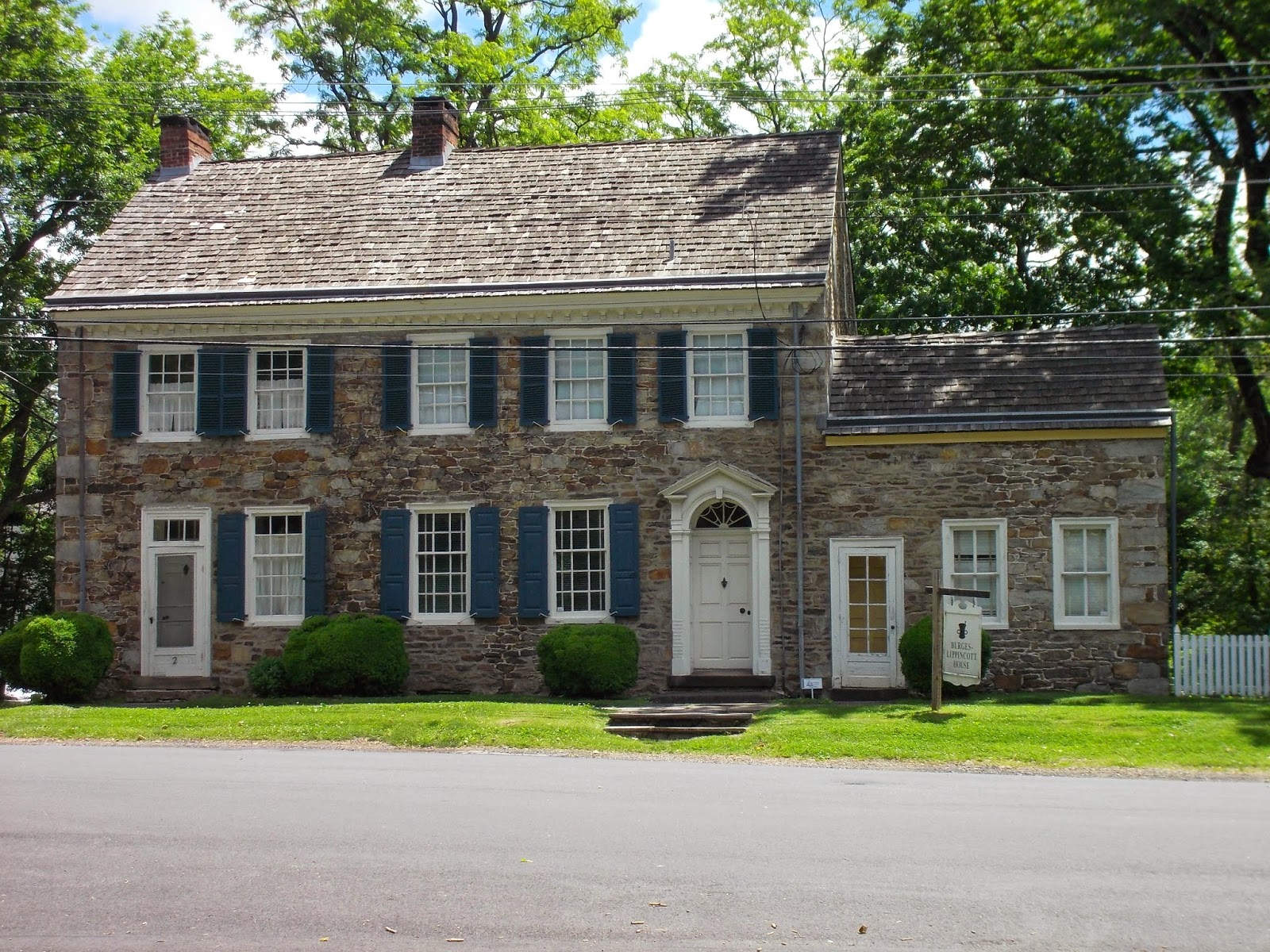
The Burges-Lippincott home sits across Meetinghouse Square. The original house (the center section from the rightmost chimney to the start of the one-story addition) was built in 1808 by saddler Allen Lippincott, and the two additions were built over the fifteen years following. The one-story addition on the right side was used as a physician's office by Lippincott's son, Dr. Henry Lippincott, and now houses a collection of period medical books and instruments. The large-bore syringes and bone drill are particularly cringe worthy.

Moon-Williamson Log House

Up Yardley Avenue from Stagecoach Tavern and the Burges-Lippincott House is the Moon-Williamson Log Home. The mortar-chinked, dovetailed-log section was built in the 1760s by cabinetmaker Samuel Moon, and the fieldstone section to the right was added a few years later. The front steps lead into a room with a large hearth and an enclosed stair to the loft, where the family's children slept. The window to the left of the front door looks into the original "master bedroom," with its own corner fireplace (an indicator of wealth). Inside, the log and mortar outside walls are whitewashed, and a stained pine wall separates the bedroom from the room with the hearth. The addition was added a few years later, providing a brick-floored kitchen on the lower level and a larger bedroom for Moon and his wife above it. A narrow stair of about six steps, with incredibly low head clearance, leads down to the kitchen, and a few stairs along the back wall lead to the newer bedroom. I found the dimness inside the house, especially the kitchen/bedroom addition, particularly remarkable. Even though the morning sun shone brightly outside, the small windows let in precious little light and it appeared more like dusk inside. My guide pointed out that when cooking in a pot over in the hearth, the woman of the house could barely see the food she was preparing. 
Bride and Groom Trees to the right

Directly in front of the Moon-Williamson House are two massive Sycamore trees. According to local legend, these "bride and groom trees" were planted by Moon and his wife on their wedding day, soon after the house was built. The house has changed owners many times over the years, and frame additions were added, completely obscuring the original home. In 1967, HFI acquired the house, removed the additions, and restored the building to its original state.


Historic Fallsington offers tours year-round (by appointment mid-October through mid-May). The tour includes information on the Quaker settlers as well as visits to three of the village's buildings: Stagecoach Tavern, the Burges-Lippincott House, and the Moon-Williamson Log House. An unguided walking street tour, which includes around ninety historic homes, is also available. Many thanks to my guide, Eileen, for answering my questions with a wealth of information, and for dedicating herself to keeping the history of Fallsington alive for generations to come.

Thank you to Christy for generously sharing this post with CQ!

BIO: Christy Distler is a fiction writer and freelance editor. She recently finished a contemporary novel and is now writing a historical romance involving some of her ancestors.