Announcements

10 Year Anniverary & New Releases Winners: Carrie Fancett Pagels' Butterfly Cottage - Melanie B, Dogwood Plantation - Patty H R, Janet Grunst's winner is Connie S., Denise Weimer's Winner is Kay M., Naomi Musch's winner is Chappy Debbie, Angela Couch - Kathleen Maher, Pegg Thomas Beverly D. M. & Gracie Y., Christy Distler - Kailey B., Shannon McNear - Marilyn R.
Showing posts with label Culper Ring. Show all posts

Wednesday, November 21, 2018

Women Soldiers, Combatants, and Spies in the American Revolution

When I began writing my American Patriot Series, I realized that the storyline I envisioned would require my heroine, Elizabeth Howard, to do many things one doesn’t usually associate with 18th century women at the time of the American Revolution. I wanted the story to be as authentic as possible—no modern-day women in historical clothing! When I started doing research, I discovered that, in fact, women were involved in a whole lot of activities during the Revolutionary War that most of us have never heard about. So here are a few brief accounts of some of the ways women became directly involved in fighting for our independence.

Sybil Ludington Statue
On April 26, 1777, two years and eight days after Paul Revere made his famous ride, Sybil Ludington, the daughter of Col. Henry Ludington, a New York militia officer and later an aide to General George Washington, did essentially the same thing. Except that she was 16, a girl, and she rode more than twice the distance Revere did. Not to mention that her route was a whole lot more daunting, and much of the way it rained hard. Learning that Governor William Tryon’s troops were marching on Danbury, Connecticut, 15 miles away, to carry off the militia’s munitions and stores, Sybil immediately jumped on her horse and took a 40-mile jaunt to rouse the countryside, while her father mobilized the locals. She left her home at Fredericksburgh, NY, at 9:00 p.m. and arrived back home at dawn. By then almost the whole regiment of 400 soldiers had mustered due to her warning. They were on the march within a couple of hours and engaged the British at the Battle of Ridgefield. Although they arrived too late to stop the sack of Danbury, they drove Tryon’s forces back to Long Island. After the war, in 1784, then twenty-three year-old Sybil married Edmund Ogden, a farmer and innkeeper. They had six children and in 1792 settled in Catskill, NY, where they lived until Sybil’s death on February 26, 1839, at the age of 77. She is buried near her father in the Patterson Presbyterian Cemetery in Patterson, NY.

Frontispiece of The Female Review: Life of Deborah
Sampson, the Female Soldier in the War of Revolution
There’s no way to know how many women actually served as soldiers during the war by disguising themselves as men, but we do know about 4 who did. Probably the most well-known is Deborah Sampson. Born in 1760, in Plympton, Massachusetts, she enlisted in Captain George Webb’s Company of the 4th Massachusetts in 1782, calling herself Robert Shurtleff. By all accounts she performed her duties admirably and  achieved the rank of corporal. During her first battle, on July 3, 1782, outside Tarrytown, NY, she took two musket balls in her thigh and suffered a cut on her forehead. She managed to avoid detection then, but later was discovered to be a woman. Honorably discharged, she was later granted a pension for her services. The Massachusetts legislature issued a declaration stating that she “exhibited an extraordinary instance of female heroism by discharging the duties of a faithful, gallant soldier.” Sampson later talked about her experiences in the war as a lecturer, saying that she enlisted because of the unjust deaths of colonists at the hands of British soldiers.

Detail of Battle of Germantown by Christian Schussele
Anna Maria Lane probably married her husband, John, before he enlisted in the Connecticut line in 1776 under General Israel Putnam. It isn’t clear if she also disguised herself as a man or just accompanied him as a camp follower. We do know that by the Battle of Germantown she was wearing men’s clothing, though that may have been for convenience. The records of Virginia’s General Assembly state that she “with the courage of a soldier, performed extraordinary military services, and received a severe wound at the battle of Germantown.” Following the war, the Lanes moved to Virginia, and both drew pensions for their service.

Two other women are known to have fought in the Revolution. Sally St. Clare was a Creole girl who lost her life in the war. Another known only as “Samuel Gay,” was discovered to be a woman and discharged. It’s likely others also served in the army as men but were never detected.

Molly Pitcher at the Battle of Monmouth,
engraving by J.C. Armytage, c. 1859
Still other women became combatants when need arose. You’ve undoubtedly heard the name “Molly Pitcher,” which was attached to a woman who stepped in to service her husband cannon after he fell. There’s some evidence that at least two women performed such duties. Mary Ludwig Hays McCauley accompanied her husband, John, who served with the Seventh Pennsylvania Regiment. During the Battle of Monmouth, New Jersey, on June 28, 1778—which will be portrayed in book 6 of my series, Refiner’s Fire—she was hauling water to her husband’s cannon for the sponger to swab out the barrel, when John collapsed, either because of a wound or the day’s extreme heat. Mary immediately stepped up and took his place, assisting the gun crew for the rest of the battle.

Corbin Memorial, West Point Cemetery,
United States Military Academy
Margaret Cochran Corbin was married to John Corbin, another artilleryman, who was killed in the Battle of Fort Washington in November 1776. She also filled her husband’s place at the cannon, assisting in sponging and loading, and received grape shot wounds in the arm and chest. Disabled for the rest of her life, she was an original member of the Invalid Regiment that Congress created in 1777 to care for disabled soldiers. In 1779 Corbin was granted a stipend of $30 and a lifelong pension of half a soldier's pay. She was the first American woman to receive a disabled veteran's pension.

Women also served as spies during the Revolution. A laundress at British headquarters in Philadelphia alerted Washington to British General Henry Clinton’s withdrawal from the city, and many others served in the shadows, like Lydia Darragh. British officers occupying her house in Philadelphia used a large upstairs room for their secret conferences. Lydia would slip into an adjoining closet and take notes on their plans, and after her husband transcribed the intelligence in a form of shorthand on tiny slips of paper, she enclosed them in fabric-covered buttons, which she sewed onto the coat of her fourteen-year-old son, John. When he visited his elder brother, Lieutenant Charles Darragh, serving with the Continental Army outside the city, Charles would snip off the buttons, write out the notes, and send them to his superior. Lydia also supposedly concealed other intelligence in a sewing-needle packet she carried in her purse when passing through British lines.

Major John André
One of the most well-known female spies today was a member of the famous Culper Ring in the New York City area, who was known only by her codename “355,” which stood for “lady” in the Culper code. Her background is unknown, but it’s speculated that she may have come from a prominent Tory family with access to British commanders. She was one of several young, attractive, and intelligent women surrounding dashing British Major John André. When he was arrested by the Americans and executed as a spy in October 1780, Benedict Arnold, one of Washington’s officers who had defected to the British, questioned everyone associated with him. Agent 355 was pregnant at the time and refused to identify the child’s father, arousing Arnold’s suspicions. He had her arrested, and she was held on the infamous prison ship Jersey, moored in the East River. She bore a son there and died shortly thereafter, never identifying the child’s father. But, tellingly, she named him after Robert Townsend, another member of the Culper Ring.

Yet other women followed Washington's army for safety and subsistence. Many provided services such as cooking, washing and mending clothing, and nursing, and consequently received rations and sometimes pay. In my next post, we’ll take a look at the life of camp followers.

How many of these women have you heard of? Which one do you find most interesting or appealing?
~~~
J. M. Hochstetler is the daughter of Mennonite farmers and a lifelong student of history. She is also an author, editor, and publisher. Her American Patriot Series is the only comprehensive historical fiction series on the American Revolution. Book 6, Refiner’s Fire, releases in April 2019. Northkill, Book 1 of the Northkill Amish Series coauthored with Bob Hostetler, won Foreword Magazine’s 2014 Indie Book of the Year Bronze Award for historical fiction. Book 2, The Return, received the 2017 Interviews and Reviews Silver Award for Historical Fiction and was named one of Shelf Unbound’s 2018 Notable Indie Books. One Holy Night, a contemporary retelling of the Christmas story, was the Christian Small Publishers 2009 Book of the Year and a finalist in the Carol Award.

Friday, July 18, 2014

Our First Martyred American Spy

Long before the days of the CIA and Cold War, even before the spies of the Civil War, our nation had a network of spies that rivaled any spy agency of today. The leader of this spy ring, the Culpeper Ring in New York City, was Benjamin Tallmadge, an officer in the Continental Army. One reason Tallmadge may have been so driven to create this spy ring is because his best friend from college, Nathan Hale, was hung as a spy on his first intelligence gathering mission in New York.

Nathan Hale was born in Connecticut in 1755. Before his fourteenth birthday, he and his brother, Enoch, were sent to Yale University to get an education. Nathan's father was a minister and planned for Nathan to follow in his footsteps.

At Yale, Nathan became close friends with Benjamin Tallmadge and William Hull, a man who worked with Tallmadge. Hale's university days created in him a desire to be free from the rule of the British Crown as it did with most of his contemporaries. When he graduated, instead of becoming a minister, he took a job teaching at a private school in East Haddam.

When war broke out, Hale was reluctant to join the army, but at the urging of Tallmadge in a letter, joined up in 1775. For the next year, he saw no action. It disturbed him because he felt he was doing nothing to further the independence of the American Colonies.

In September, Washington was desperate for intelligence about the British troop movements in Manhattan. That information would determine his next move. He asked for volunteers. At that time, most didn't consider spying a respectable occupation, and nobody was willing to volunteer for such a dangerous mission. Nathan Hale, who was eager to do something to help his country, stepped up and said he would do it.

Hale snuck into Manhattan and got the information he needed. Before heading back, he stopped at a tavern where he was recognized by Robert Rogers, commander of Rogers' Rangers. Earlier, Rogers had attempted to get free passage behind enemy lines, telling Washington he was a patriot. His real intentions were to spy for the British. Washington denied his request, but during that time, he had seen Hale in uniform.

Rogers needed proof Hale was a spy and invited him to his home where he informed Hale that he was a patriot. Hale fell into the trap, and was arrested. After admitting he was a spy, he was sentenced to hang by General William Howe.

When Hale was at the gallows, the last sight he probably saw was New York City burning. A fire had started accidently, but knowing it would help the Americans, many patriot civilians started more fires or did things to slow the British in putting out the fires. Many of these patriots were captured and executed. The fire did stop the British from taking up residence in the city.

Hale's last words were immortalized as the sentiment of American Patriots. "I only regret that I have but one life to lose for my country." This quote is reported by Tallmadge and Hull, Hale's friends who were not present at the execution. The quote is probably a condensed quote of what he really said. Hull and Tallmadge were at the site shortly after the execution to facilitate a prisoner exchange and talked to a British officer, John Montresor about what Hale's last words were. Others reported other things Hale may have said, so his speech was longer than the reported quote.

Frederick MacKensie, a British officer, wrote this diary entry for the day, "He behaved with great composure and resolution, saying he thought it the duty of every good Officer, to obey any orders given him by his Commander-in-Chief; and desired the Spectators to be at all times prepared to meet death in whatever shape it might appear."

Whatever the case, at his death, Hale was a patriot and the first American spy executed for his exploits of bravery.

Monday, July 7, 2014

Review of Circle of Spies by Roseanna M. White

Circle of Spies

by Roseanna M. White

As the Civil War stretched on,
the Culper Ring must draw an unwilling agent 
into the family legacy of espionage...

Guest review by Dorcas Perkins 


5 Stars aren't earned easily. But this book deserves every one of them.

It isn't often I read a book and say "I wouldn't change a thing." There's always SOMETHING that just doesn't quite "scratch the itch." So I was amazed that when I at last put this book down I didn't have one negative thing to say about it. It was perfect.

The characters are flawed and REAL. The heroine is a coquette and drawn in many directions by her desires; she makes some bad choices in her life which eventually cause her to rethink where she is heading. At heart she is a good person. She's also fascinating, in that she has perfect recall. She only has to glance at something (or see something or hear something), and it is forever and indelibly inscribed on her memory. This is both a blessing and a curse. But it's interesting how it all pans out and is put to use.

The hero is very likable. A bit of a rogue who has turned his wayward life around (on the inside), but as a Pinkerton detective he assumes the role of his traitorous dead twin brother to infiltrate the KCG.

And the villain...he's a perfect villain. I liked that he didn't hide his "villain-ness" till the last page. He was a villain from the very first chapter, which made it all the more spooky. But don't get the idea that he's somehow comical. He is an abusive control freak who will stop at absolutely nothing to posses his deceased brother's wife (the heroine). He's positively smooth at the start of the book but becomes increasingly unhinged as he loses the devotion of his intended.

I just loved this book. You need to read it. Even the secondary characters were well formed and living. Such a well developed story. Did I say I loved it??

Many thanks to NetGalley for my free ecopy to review


Dorcas Perkins reviews at
 http://dorcasbooks.blogspot.com/ 
and Goodreads.

GIVEAWAY

One copy of Circle of Spies or any Culper Ring book
(U.S. mailing addresses only--
international winner eligible for ebook)

a Rafflecopter giveaway

Wednesday, April 23, 2014

Colonial Spies, Fact and Fiction

by Roseanna M. White

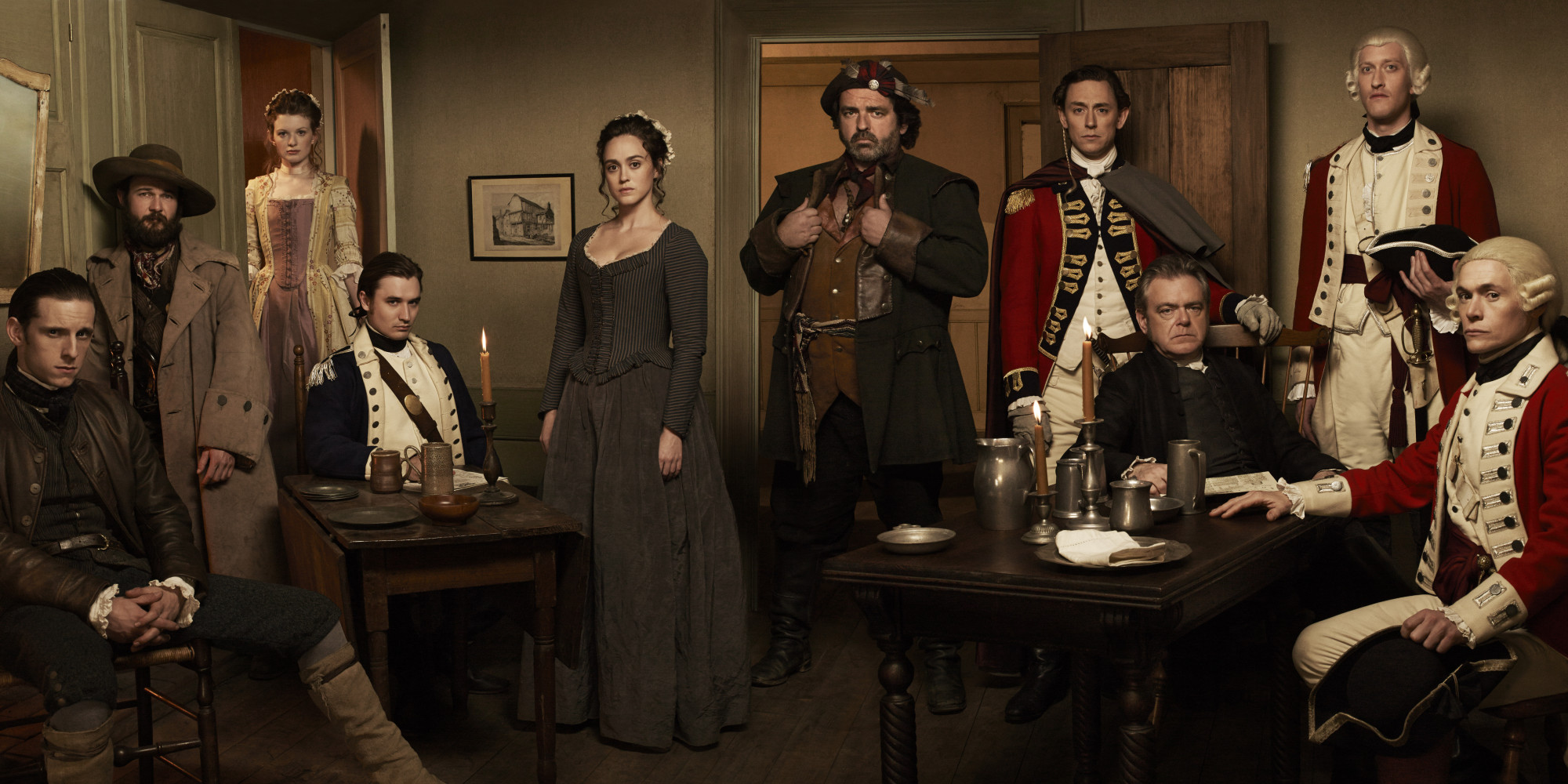
Many of us with a love for Colonial history have been very excited about the premiere of AMC's Turn. Based on the exploits of the Culper Ring as researched and expounded by Alexander Rose in Washington's Spies, Turn (Sunday nights, 9 p.m. on AMC) promised action, drama, adventure, and espionage.

They also deliver violence, which was a bit much for many viewers I've spoken to. I seem to have an immunity to TV violence and honestly scarcely noticed it, so...I'm not the one to talk about that, LOL. Instead, I wanted to touch on some of the fun ways I noticed that Turn has taken fact and heightened it into good fiction.

Because I already researched this history for Ring of Secrets, I was largely familiar with the story they'll be telling. But because it was several years ago, I had to break out my copy of Washington's Spies and do some fact checking--which made me grin, because I'm that kind of geek.
The major players in AMC's Turn

The most important thing to note when viewing this or any other show based on  history, is that facts get bent. And that's good, because in reality the events are dragged out over years, and tension isn't always high. As viewers, we would get bored and soon be flipping to another station. I give the writers of Turn a lot of kudos for putting together major players in the Revolution that didn't (so far as we know) actually meet up, for creating backstory and emotional investment to explain actions and make the characters relatable...and for asking a lot of what ifs.
My version of what ifs are a bit different...but based on the same history

Thus far in Turn, we've been focused largely on Abraham Woodhull, who was the primary operative in the Culper Ring during its first years of operation. He was, in fact, given the code name of Samuel Culper, after whom the whole group of intelligencers was named. In the show, Abraham's father is a judge in Setauket--and loyal to the Crown. By choosing farming above the law, Abraham had introduced strained relations long before the first scene opens. Added to it is the fact that his loyalties are torn.

In reality, Abraham was from a farming family (though he himself became a magistrate and judge after the war!), and he was the primary caretaker of his aging parents on the family farm after his two older brothers are killed in the early days of the war. This, combined with the death of his uncle, who was a Patriot general, are what spurred Abe to take on the role his childhood friend asked him to consider--namely, gathering all the information he could on British movements and passing it along toward Washington.

Also in the show, Abe is married to a lady named Mary but was once engaged to Anna, who's now married to Selah Strong. In reality, Abe wasn't married, and Anna was a neighbor a decade his senior (so no young love there, LOL), who did indeed aid him in his clandestine tasks, and even posed as his wife when he was running information--married couples traveling together were not often halted and searched by the British, but single men always were. It wasn't until 1781 that Abe got engaged to Mary (a relative of Anna's, actually), at which point he more or less resigned from the Culper Ring so he wouldn't risk bringing calamity down on his family.

And according to the history, Abe was never torn in his loyalties. Though he knew how to bite his tongue to keep from drawing the attention of the British, his writings make no secret of his very Patriotic bent...and also make it clear that this quiet young farmer took great pleasure from tricking the British overlords plaguing his town.

As a writer of fiction, I can certainly appreciate how the TV writers have tweaked fact to make a good show. And as a history nut, I always love noting where the differences are.

Wednesday, August 28, 2013

Espionage in Early America

I've blogged about my different discoveries in historical espionage before, but I've never put them all together before for the Colonial Quill. And since this fall I'm teaching a home school class to my local group about the different historical methods of spying, I figure it'll be fun to get a head start here. ;-)

By the time of the Revolution, spying in Europe had reached some rather hilarious levels. It was so common in the different courts that they all knew other countries' men were intercepting their messages and copying them. The "Black Chambers" of these master spies were located nearby the courts. The spies would steal incoming correspondence, make a copy, and slip the original back into the post. Codes had become common too, but these dudes got their jobs by being able to break them, quickly and efficiently. So it was just all one big puzzle that they were playing, knowing well their opponents were evenly matched.
A page from the real Culper Ring's code book

One story I read and loved was of a spy who mistakenly sent along his copy instead of the original message. The recipient knew right away what had happened and sent it back to him, demanding his original in its place--proving that they all knew exactly who was doing what and took very little issue with it after so long.

But in America, espionage was like so many other things--new and experimental. And when the Revolution was in full swing and General Washington found himself in need of reliable intelligence, he had no Black Chamber to rely on. He had only a few trusted men with no background in spying and no training in the covert. They dubbed themselves the Culper Ring and answered to one of Washington's most trusted officers, Benjamin Tallmadge.

My personal experiments with heat-developed inks
Today we look at the cyphers and codes that the Culper Ring developed and shake our heads at how amateur they were. But they did the job, and because of the ingenuity of the brothers Jay and their "sympathetic stain" (invisible ink), the British never even saw the code to crack it. Until then, they had to use heat-developed inks for messages, which anyone with a flame could develop. But this stain required a particular counter agent. This level of security is what kept their secrets throughout the war. And what made my Ring of Secrets a lot of fun to write. ;-)

By the War of 1812, another intelligence tool had made its way to America--the mask, or grille. This was a piece of paper with a shape cut out of it. The writer of a message would put this mask down upon a blank piece of paper, write his true message within the hole, and then remove the mask and fill in the lines around the message so that the real words would be innocuously hidden within innocent sentences. In order to know what the message was, the recipient would have to also have the mask, which would be sent in a separate batch of correspondence.


In the Civil War, codes were the feature of the day, and there were a lot of them. Members of the Knights of the Golden Circle, for instance, would come up with codes for each occasion. Simple phrases to let each other know if a particular outcome had happened as expected or not. Other codes used a key--a book, usually a dictionary, that both sender and receiver had. They would use numbers to indicate words. So you might see something like this: 192.15.26

These numbers stood for page, line, word on line. If they were encoding something like a name that wouldn't be in a dictionary, they would spell it out using a forth number to indicate a letter within the word.

Now my question to you today:

Do you think you could have been a spy in early America?

~*~
Roseanna M. White pens her novels under the Betsy Ross flag hanging above her desk, with her Jane Austen action figure watching over her. When she isn’t homeschooling her small kids and writing fiction, she’s editing it for WhiteFire Publishing or reviewing it for the Christian Review of Books, both of which she co-founded with her husband.

Wednesday, February 27, 2013

Calling All Revolutionary Spies!

Ever wonder how spies get their aliases? Well, I can't speak for modern-day ones, but I happen to know how George Washington and company came by the names for those in the Culper Ring, the first organized American spy ring. And as part of the launch for Ring of Secrets, I thought it would be fun to lay it all out so we can all come up with our own code names!

I'm Evelyn Pitt... Who are you?

How the Culpers came to be the Culpers

George Washington and his intelligencers, when looking to assign code names to their primary agent, started with the initials of the head of intelligence—Charles Scott, C.S. Then they reversed them—S.C. This would be the initials of the primary Culper officer. For the “C,” Washington chose a place he had fond memories of, Culpeper County, Virginia, where he worked as a lad. Then he shortened it to Culper. For the “S,” Tallmadge (the head officer of the ring) decided on “Samuel,” his younger brother’s name, and a good friend of the man who would be adopting the identity. So there we have it! Samuel Culper, the creation that became the bane of the British.


Let's Create Our Name!

  1. Start with a name of a teacher, parent, or boss  

I'm going to pick Patricia Egan, one of my favorite bosses from my college days

2. Take their initials and reverse 'em

So P.E. becomes E.P.


3. Think of a place important to you that starts with the second initial  

I'm going to pick Pittsburgh, because it's the closest major city whose sports teams we like

4. Shorten, lengthen, or otherwise alter the place name into a surname   

So Pittsburgh becomes Pitt. No relation to Brad, ahem. ;-)


5. Think of a family member or friend whose name begins with the first initial
(not the same one you got the name from!)

E, in my family, is for Evelyn.
My great-grandmother's name, and the middle name of my grandmother, mom, and daughter.

So there you have it! Who are you??


~*~

Roseanna M. White pens her novels under the Betsy Ross flag hanging above her desk, with her Jane Austen action figure watching over her. When she isn’t writing fiction, she’s editing it for WhiteFire Publishing or reviewing it for the Christian Review of Books, both of which she co-founded with her husband.