Announcements

10 Year Anniverary & New Releases Winners: Carrie Fancett Pagels' Butterfly Cottage - Melanie B, Dogwood Plantation - Patty H R, Janet Grunst's winner is Connie S., Denise Weimer's Winner is Kay M., Naomi Musch's winner is Chappy Debbie, Angela Couch - Kathleen Maher, Pegg Thomas Beverly D. M. & Gracie Y., Christy Distler - Kailey B., Shannon McNear - Marilyn R.
Showing posts with label Empire in Pine. Show all posts

Friday, August 7, 2020

Old Tools of Lumbering and Homesteading from By-Gone Years

Recently two paper mills owned by the Versa Paper Company were shut down in Wisconsin and Minnesota. One was in my hometown in central Wisconsin. It was a fixture there for decades before I was born (under different names) and the primary employer in the city. The other was in Duluth, not far from where I've lived most of my adult life. Hundreds of people lost their jobs.

TWILIGHT OF VERSA PAPER MILL, WISCONSIN RAPIDS

It's hard for me to imagine such a decades-old industry just closing it's doors. Paper mills have been a part of our nation's economic infrastructure since its inception. In fact, logging's roots in America stretch back to the early 1600s. Begun by the driving need of lumber for shipbuilding, the role of logging expanded with the industrial revolution. The first American paper mill was built in Germantown, Pennsylvania in 1690--although at that time paper was mostly produced from rags and other materials, hence the popularity of stories with the word Ragpicker in the title. That's also the reason my mom, a retired school teacher, used to warn her students against chewing on paper (a bizarre childhood habit of some): "because it might have been someone's dirty underwear." Thanks for that imagery, Mom. I've never forgotten. 😬 

By the mid-1800s the process of making paper from pulp wood was established. (Whew! Go ahead and chew your notebook, if you're so inclined.)

Soon settlers moved westward, and the broad ax became a staple tool of every man, both for carving his farm out of the forests and for cutting the logs he'd use to build his home.

Nowadays, logging is still a hundreds-of-billions of dollars-per-year business, so it sends shock waves through a community when a huge mill closes its doors. Everything has its time and its purpose though. Hopefully some entrepreneur will open the mills again.

All that brings me to a continued look from last month's post about old tools. Today I have some pictures to share of a few old logging tools here on our farm. This first one we bought at an auction when we were first married. Living here in the north woods, in the very land of Lumberjacks and Tall Tales, this tool has, no doubt, seen its share of use. At our house, its merely meant for hanging on the wall for decoration.

BROAD AX
This thing is weighty! It takes a lot of muscle to wield it. This will soon be hanging on the wall behind our wood stove.
PICKAROON

This is an interesting type of pick. Rather than have an ax opposite the pick head like a pickax, it's back end is flat. A pickaroon is used for easier handling of cut logs known as rounds. My husband has been using this to chip away at this giant cedar stump. Every now and then, our grandsons come along and give it a few whacks too. If the stump is ever gone, this little pickaroon is going on the wall with the broad ax.

TWO-MAN CROSSCUT SAW

You might not recognize this man-about-the-farm (my hubby Jeff), but you'll likely recognize the fact he's holding a two-man crosscut saw. Can you imagine the work it took to cut down those big trees back in the day? This item will soon be on our living room wall. (That's a honey-do job, Jeffrey.) The mystery item next to it in the grass is shown closeup below.

MATTOCK (head)

This was a real find! Jeff found this out in woods, beneath a layer of soil, where he happened to be getting firewood. Who knows how many years this mattock head lay buried there? A mattock is pick on one side and adze on the other. It's used for digging, prying, and chopping. A great tool, not only for loggers, but for homesteaders clearing a bit of ground. I'm happily accepting ideas for a cool way to display this piece or re-purpose it. It's heavy!

Like many paper mills these days, these tools are largely retired. You can still purchase modern versions of some that come without the reminisce factor. A couple of other old logging tools I'd like to get a hold of are a cant hook and a peavey. I could've sworn we had a cant hook somewhere, but apparently I imagined that. With slight variations, both are tools that consist of a handle with a swing hook and are used for gripping, moving, and separating logs. In my novel The Green Veil, the hero, Manason Kade, and his crew use these tools for their work, though when it comes to giving some no-good tree-thieves their comeuppance, they depend mostly on their brawn.   


I didn't set out originally to collect logging tools, but it became an interest as I wrote set within the parameters of my state history. Have you ever begun any collections in an unusual way?

Enjoy your summer!
Naomi


Friday, June 5, 2020

A Craft for Your Inner Colonist ~ How to Make a Feather Quill Pen

Today, we're going to have some fun with your inner colonist as we learn to make a quill pen. 

As a kid, didn't you ever want to make a feather quill pen to use? I bet you did. I bet you took apart your Bic, found a big ol' feather somewhere, and stuffed the ink tube from the pen inside to write with. I know I did. If you somehow missed doing that, how about as an adult? Now, of course, you know that stuffing pen parts inside a feather is not authentic. You want a real nibbed quill and an ink bottle on your desk. Seriously, I've found myself researching feather pens on Amazon. I have this one with interchangeable nibs (for style) on my wishlist:


Making Your Own

If you're feeling crafty, though, here's how to make a real feather quill pen. First, you need a likely feather. If you don't have access to someone's farm where you can get a pretty chicken or goose feather,  or you don't have any turkeys roaming around dropping the occasional feather, you can buy some nice turkey feathers online or in a craft store. Note how wing feathers curve. Whether or not you're left or right handed, the way they curve will feel better in one hand or the other. Back in the day, right-handed folks generally chose feathers from the left wing, and vice-versa for left-handed writers. They chose feathers from a bird's right wing. (Note: if you're going to chase down Granny's pet goose to nab a feather, keep this left-hand-right-wing, or right-hand-left-wing info in mind. Haha!)

Once you have your chosen feather, you need to prep it a bit. First clip off any of those soft, fluffy little feathers near the tip, and trim off any of the lower feathers that might get in the way of your holding the shaft. After that, it's time to strip the membrane. This part isn't 100% necessary, but it makes for a nicer "barrel". Just take a paring knife, and scrape the shaft along the barrel. You'll see the membrane coming off.

Good. Now it's time to cut the point on the end. You'll want to trim it at a nice angle, and make sure that you're cutting in the direction you want to be able to hold the quill to write most comfortably. Inside the end of the barrel is the "quick", kind of a like a plug. You'll need to remove that. Then you'll make a second cut to create the point. If you have trouble picturing this, think of the shape of tip on a fountain pen. If you want to make broader strokes, say for calligraphy, then you'll blunt the end a bit squarer. 


You have one more cut to make. After you've fashioned the tip, cut a slit in the middle of it so that the ink can run properly. Again, picture that fountain pen nib.

And that's it! You're ready to write. You'll need ink of course. You can order some, or you can squash up a few berries like some of those colonists would have had to do. I have a character doing that in my WIP, a sequel to Mist O'er the Voyageur. If you live in an area where you have black walnuts, those work good too.


Writing with Your Quill


Dip the tip of your quill in the ink of your choice, and give it a gentle tap to avoid drips. Make slow, easy strokes as you write, realizing that you'll have to re-load your quill every few words. Imagine how long it took Benjamin Franklin, Patrick Henry, Tom Jefferson, and so many of our other founding fathers to pen their lengthy documents! And if you lived in the mountains of North Carolina, there was only a small likelihood that you knew how to write at all. You would probably be just as mesmerized watching someone with that skill as we would be today--watching them write with a quill pen.

Send me a picture if you do this!

In the meantime...what are you reading? I hope you'll add my newly re-released, popular Empire in Pine series to your TBR, Goodreads, and BookBub lists. 

The Green Veil ~ The Red Fury ~ The Black Rose
by Naomi Musch


Here's to History,
Naomi

P.S. As I completed this post, I discovered that this topic has been discussed before, in 2012, here on the CQ blog. If you'd like to see some step-by-step pictures and results from another crafty perspective, you can find that post here: Making Pens from Quills

Friday, May 1, 2020

The “Great Fires” of American History—and the Deadliest of All: Peshtigo

Springtime is notoriously one of the worst times of year for wildfires. Here in places like the one where I live, the snow is gone, but the greening up hasn’t begun in earnest. The ground is covered with dried leaves and brittle pine needles. Branches and other wooded detritus make for tinder that needs only a spark to ignite. Here in Wisconsin, in fact, the Department of Natural Resources has suspended burning permits for the foreseeable future. The concern is that, since more wildfires begin in the spring, eliminating ignition sources on the landscape will reduce the wildfire risk which can lead to more person-to-person contact and possible higher vulnerability to certain populations during the Covid-19 pandemic.

Viruses aside, this got me wondering about the so-called “Great Fires” that raged across the land and our nation’s early history.

There is a lot of study and speculation about whether or not and why those native to the continent may (or may not) have used burning to clear the forests. We do know for sure, however, that when the first European settlers came to this continent, it didn’t take long for fire to begin taking its toll on the colonies.

In January 1608, a devastating fire destroyed most of the colonist's provisions and lodgings. Captain James Smith made a concise assessment of the situation:

"I begin to think that it is safer for me to dwell in the wild Indian country than in this stockade, where fools accidentally discharge their muskets and others burn down their homes at night."

In 1736, Benjamin Franklin—who had a lot of first-hand knowledge of volunteer fire-fighting by this point—founded the Union Fire Company in Philadelphia, which became the standard for volunteer fire company organization in many other places. And firefighting was needed all throughout the colonies.

November 18, 1740, Charleston, South Carolina suffered a horrendous conflagration fueled by turpentine, tar, and rum that moved quickly, swallowing up wharves, commercial buildings, and houses in its path. The wasn’t Charleston’s first licking by fire. Founded in 1689, “Charles Towne” experienced its first blaze in 1698 and lost one-third of its settlement’s buildings. The city went on to suffer other fire catastrophes in 1778, 1788, 1796, 1799, 1810, 1819, and 1826.

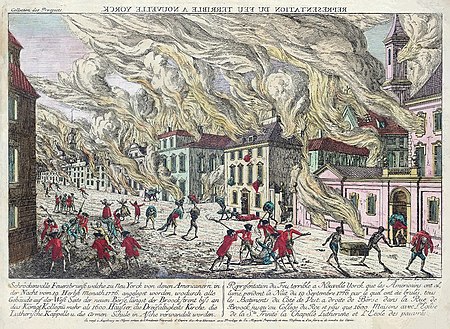
Elsewhere, meanwhile, the night of September 20th, 1776, fire burned New York’s West Side at the southern end of Manhattan Island. This was during British occupation of the island during the Revolutionary War, and there was much debate and blame cast over whether the fire was started by the British or the revolutionaries. 10-25 percent of the buildings in the city were destroyed and other parts were plundered in the chaos.

Artist's Depiction of the Great Fire of New York (1776), Wikipedia Commons

In spring of 1788, fire swept through New Orleans, destroying 856 of its 1100 structures. If that first “Great Fire” wasn’t bad enough, only six years later, another fire roared through the area now known as the French Quarter destroying 212 more structures, including the jail, in what became known as the Great Fire of 1794. The schooner Nuestra Señora del Cármen, anchored off-shore, was rented as a jail for several months following.

The 1800s saw fire’s devastation in many American cities and across its vast countryside. New York, Philadelphia, St. Louis, San Francisco—and who could forget Chicago—saw the massive affects of fire on populations crowded together in wooden structures. In all of these fires, there was some loss of life, making the stories even more tragic.

But of all the fires of our history, none was so destructive and deadly as 
The Great Peshtigo Fire. 

Peshtigo—called the worst wildfire in history—happened when? 
In 1871, on the night of October 8th. 

But isn’t that the night of the Great Chicago Fire, you ask? 
Why, yes, it is. 

But I’ve not heard of this fire, you say. 
That is highly probable, because Chicago was a much bigger city, and resources had been directed from Wisconsin to Chicago to help. 

Meanwhile, tiny little Peshtigo, in the northeast corner of the state near Lake Michigan, not only saw 1.2 million acres go up in flame, but the entire town was turned to ash, and more than 1152 people were killed, compared to Chicago’s loss of life of some 300. Many estimates say that the Peshtigo death toll was likely closer to 2500, and some say 3000. It was difficult to account for the many lumberjacks, railroad men, farm family immigrants, and others who populated the north woods and were itinerant.

"Making for the River", Artist's Depiction of The Great Peshtigo Fire, Wikipedia Commons

Horrifically, the Peshtigo Fire claimed more lives than any other forest fire in US history, before or since. Many of those people lie together in a mass grave. Many others’ bodies dissolved to ash and were never recovered, such was the total annihilation across the landscape.

https://www.amazon.com/gp/product/B087QRZ1CV/


I have always wanted to tell Peshtigo’s tragic story through the eyes of characters in a work of fiction. Using the recorded stories of several actual survivors and other historians, I’ve tried to be true to their accounts, while also sharing a love story. My novel THE RED FURY re-released this week. I hope you’ll visit my website, or check out the book on Amazon to learn more about it.

The characters in The Red Fury are some of my favorite I’ve ever written. When lumberman’s daughter Lainey Kade, and brothers—Civil War veterans—Zane and Kelly Beaumont, stepped into my writer’s heart, I felt as if they were actually there in Peshtigo, in the past.

The Red Fury can be read alone, but it would be better to read The Green Veil first.


Take care now, and God bless,
Naomi
www.naomimusch.com
Amazon author page