Announcements

10 Year Anniverary & New Releases Winners: Carrie Fancett Pagels' Butterfly Cottage - Melanie B, Dogwood Plantation - Patty H R, Janet Grunst's winner is Connie S., Denise Weimer's Winner is Kay M., Naomi Musch's winner is Chappy Debbie, Angela Couch - Kathleen Maher, Pegg Thomas Beverly D. M. & Gracie Y., Christy Distler - Kailey B., Shannon McNear - Marilyn R.
Showing posts with label Culture. Show all posts

Wednesday, November 27, 2013

Colonial Roots Cross Cultures


by Dina Sleiman

My newest novel, Dance from Deep Within, is not Colonial...or even Federalist. So you might wonder why I'm here today. This contemporary style book takes a look at the lives of three young women today: a veiled Muslim, a bi-racial hippie chick of the post modern persuasion, and a blond ballerina. Not exactly the classic colonial subject matter.

But isn't that so typical of America. Even in colonial days we were a melting pot of religions and ethnicities. At some point each of our families began as strangers in a strange land. With Thanksgiving coming, we can't help but remember how the Pilgrims drew from the strengths of the Native Americans to survive in this strange new land.

Gina Welborn, Dina Sleiman, C.J. Chase, Deb Marvin, and Carrie Pagels in Williamsburg
Diversity is a hallmark of American culture. Yet when we think of Colonial Days it is easy to focus on the white, Anglo-Saxon side of the story. Last year when I visited Jamestown with my son's class, they presented a very different portrait. A picture that included American Indians and African slaves as very important parts of the Early-American tapestry. The Europeans never would have survived here on their own. If any of you read my last novel, Love in Three-Quarter Time, you got a glimpse at how these groups all worked together in 1817 Virginia.

But in my new novel, it is Layla Al-Rai, the Muslim-American character, who is still in many ways a stranger in a strange land. Although she was born in America and holds an American passport, she has spent most of her life in a little Muslim bubble in the area of Detroit. She is much more connected to her Lebanese roots and history than to her American roots. Yet she longs to discover the land of her birth and typical American culture.

Part of Layla's journey in the story is learning about the individuality and freedom that are as much a part of the American culture as diversity. Her love interest Mo, a recent convert to Christianity, whisks her away to visit Colonial Williamsburg. There she takes off her veil and lets the breeze flow free through her hair for the first time in many years. Walking its streets alongside horses, carriages, and workers in historical garb, she begins to truly contemplate her American roots. She recalls a novel she read as a child about a young girl, Constance Chambers (roughly inspired by the American Girl novel Felicity), who walked those same streets. She had admired Constance's spirit and her willingness to stand up for a mistreated slave. Suddenly Layla gets it. She wants that sort individuality in her own life. She wants her own relationship with God, not just the religion her parents have dictated. And she wants to stand up for women who are being oppressed by radical Islam.
She wants to experience freedom in the truest sense.

In that moment, a waving flag of red, white, and blue comes to represent everything she is searching for. And later in the story Layla gets to enjoy her first real Thanksgiving among a colorful cast of multi-ethnic characters. It really doesn't get any more American than that.

So if you'd like to explore your American roots through new eyes over this holiday season, check out Dance from Deep Within. And be sure to come back next week for the tea party when we will be celebrating this book at Williamsburg's Shield Tavern.
~~~~~~~~~~~~~~~~~~~~~~~~
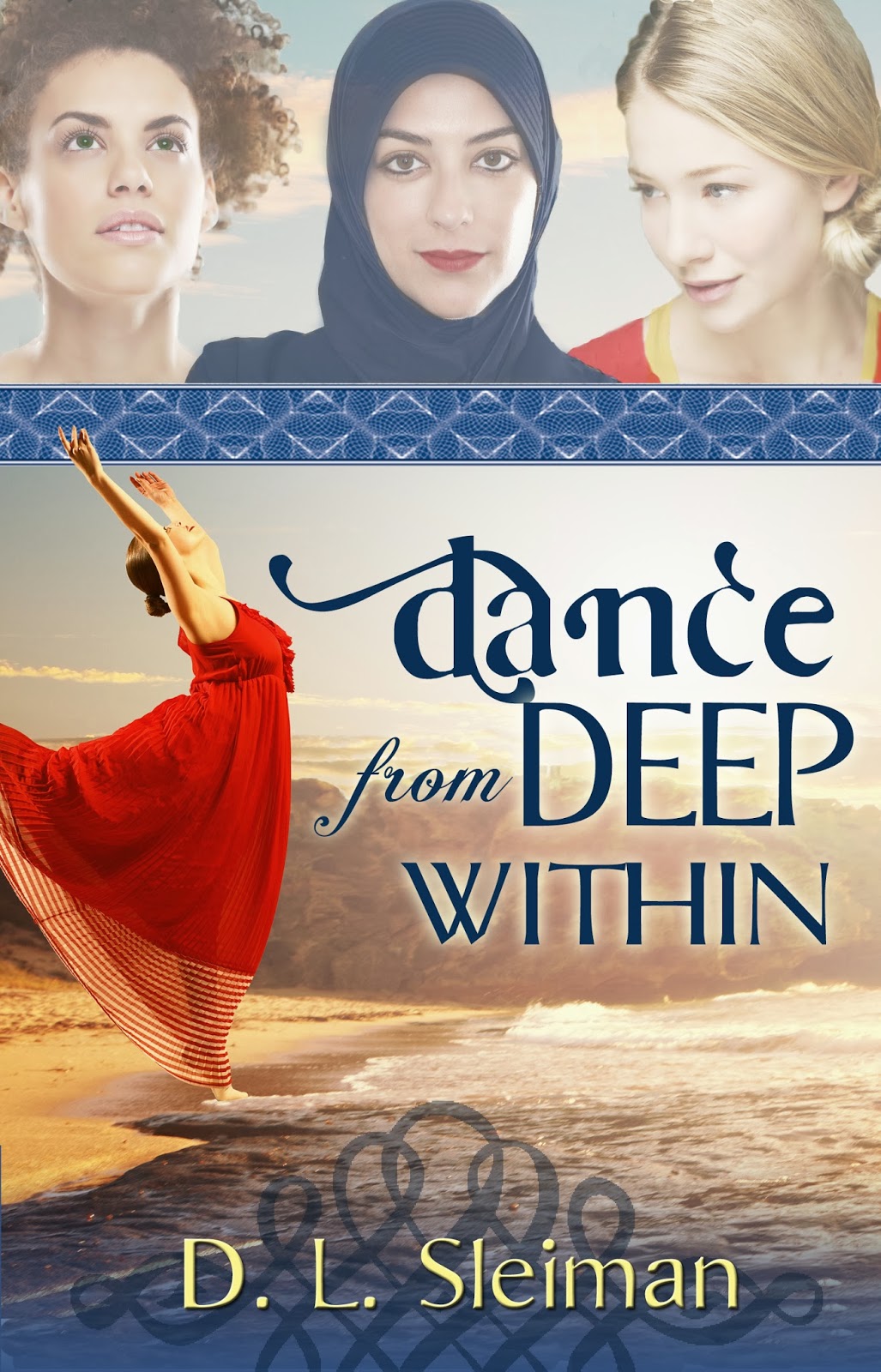
Despite her conservative Muslim heritage, Layla Al-Rai longs for a chance to earn her degree in engineering and perhaps even...dare she dream...to choose her own husband. But young women from her background rarely enjoy such freedoms. When she finally talks her parents into letting her attend college, she is drawn to fellow twenty-something students, Allie and Rain, over a class project. Allie, the blonde ballerina, faces her own struggles as she deals with an ex-fiancé and a church she had hoped to leave behind. Rain, the bi-racial hippie chick, longs for something to believe in, but her questioning could cost her the love of her life. When Layla s childhood sweetheart reenters her world, it seems her dreams might become real. Until everything falls apart. When she meets truth face to face, will she find the courage to accept it even if it requires the ultimate sacrifice? Order here

Wednesday, October 19, 2011

In Ye Olden Days: Hold Your Nose, Put on Your Patience, and Have a Seat in the Colonial Kitchen


This summer I had the joy of visiting Old Bedford Village, a colonial site relatively near my home. They have an entire village set up there, and different reenactors there throughout the week. My favorite was the lady in the Biddle House, who demonstrated spinning and how one would work in a colonial kitchen.

We watched her spin some wool onto a walking wheel (also called a great wheel and a wool wheel). This baby's so big that you have to walk back and forth about six feet as you're spinning--hence the name. The wool ends up on a spool, then you detach it from the big wheel and start spinning it onto the weasel, which puts it into skeins. It takes 150 rotations to equal one skein--and because the ingenius creators of this device knew well no one was going to sit there counting to 150 all day, the weasel pops after 150 revolutions. Sound familiar? Altogether now: "Here we go round the mulberry bush, the monkey chased the weasel . . ." =)

She then enlightened us on dying fabric in a colonial home. The dyes themselves I was well aware of--for instance, to achieve a rich brownish-yellow, you use the black walnut. For a lovely pale blue, indigo is a dream. What I didn't realize was that the dye doesn't just set in the fabric on its own. You have to add something high in ammonia. And what would Colonials have on hand for that?

Yep. The chamber pot. Apparently the urine of young boys was the best for this--they would collect the, er, sample from the chamber pot, cover it, and set the lovely brew in the corner of the fireplace until it was "ripe"--read, very strong-smelling. Then the dye and wool would join it.

After horrifying some of the moderns in my tour group with this, the reenactor moved over into her kitchen to show us how one crafted a meal in the day.

The Biddle House had a unique feature for a house of the time--a huge fire place taking up almost the entire wall of this house, divided into two sections that meet in a very wide V. The right side is a traditional fireplace, complete with a crane to swing a pot back and forth over the flame. But the left side has a stove top supported on the stone--a very thick piece of iron perfectly fitted to this side of the fireplace. On it you could put your pots, or cook food directly on the surface. Managing the fire underneath for the desired temperature, of course.
They had small, moveable ovens to show us too (bottom corner of the picture of the stove). A larger one for cooking meat, which you put onto a spit so you could rotate it within the metal box. The box was then set up against the fire. Not only would the heat cook the meat facing it, it circulated through the box to cook it all around. The lady showed us a smaller version of the same with a shelf inside it--on here they would bake biscuits and cookies. Three at a time, which means that a traditional recipe for about 2.5 dozen cookies took four hours to make.

And here I am, trying my best to avoid meals that take longer than 30 minutes to make!

by Roseanna White

Friday, August 5, 2011

Tools of the Trade: 18th Century Reenactors--Through a Portal in Time

On September 24 and 25 I’m going to be at the Prairie Days at Shawnee Prairie Preserve near Greenville, Ohio. Held annually the last full weekend of September, this event focuses on the prairie way of life in and around 1780–1810 and will feature, crafts, games, and reenactors demonstrating the trades of the time period. This annual free family event attracts around 4,000 people to Shawnee Prairie Preserve each year. If you’re in the area, I hope you’ll come out and join us.

Although I’ve attended a number of reenactment events and visited many historical sites such as Williamsburg over the years, this will be my first foray into the reenactor’s world as more than just a spectator. I decided to go dressed in period-appropriate costume, so I’m in the process of assembling my ensemble—which is a lot of fun in and of itself! I was invited by a young woman who e-mailed a few years ago to tell me how much she enjoyed the American Patriot Series, and we’ve kept in touch. Her parents are reenactors, and her father works at Shawnee Prairie. So this spring she asked if I’d like to participate in the festival. It sounded like a great opportunity to get up close and personal with the reenactor’s world, especially as I was also asked to help judge the pie baking contest. Yum!

All this has reminded me that for students and writers of historical fiction and nonfiction, events like this are wonderful research resources, as are historical sites such as Williamsburg that feature docents in period costume interpreting the lives of actual people of the day. But they’re equally enjoyable and profitable for anyone who is interested in the lives of people from earlier times. Actually walking through restored or recreated sites, handling period objects and seeing demonstrations of how they were used, tasting period dishes, smelling the campfires and the earthy scents of native flora and fauna, and even experiencing the discomforts our ancestors had to deal with gives you a perspective that you can’t get otherwise. It’s truly like stepping through a portal in time.

I guarantee that you don’t live far from fascinating historical sites and parks, many you may never have heard of, that lift history out of the dusty pages of books and bring them to vivid life. Every year all across this country there are events set during a wide range of periods, including American colonial, trappers and traders, French and Indian War, American Revolution, early 1800s, Civil War, and even Medieval and Renaissance. Finding reenactment events/historical sites in your area or around the country is as easy as doing an online search.

One of the best sites for ReWar reenactors is Americanrevolution.org, which lists numerous links to American Revolutionary War reenactor organizations that provide schedules of their events. Reenactor.net has information and links for reenactor organizations from all eras. One interesting site I found is We Make History, an organization that offers both public and private historic balls, reenactments, living history, historical education, support of historic sites and more, according to their website. You’ll find a schedule of their public events on their site. It sounds as if they’re not only educational, but also a ton of fun.

The photos in this post are pictures I took at one such site in my area, Rock Castle, Tennessee, a couple of years ago during the Daniel Smith Frontier Days. If you’ve never attended a reenactment, I hope these will tempt you to step out of modern life and into history for a few hours or days!

Wednesday, July 6, 2011

Faith of Our Fathers


What wonderful fellowship we had at our gathering on Monday! It was a joy to visit with everyone, and the stories recounted started me thinking . . .

Increasingly in these days the idea that our nation was founded on Christian principles is attacked, discounted, and outright denied. The historical evidence overwhelmingly proves the opposite, however. So on this week in which we celebrate our independence as a nation, for our inspiration and encouragement, I thought I’d allow our Founders and other leaders of our great nation to speak for themselves.

The following are quotes from the historical record that appear on the Wallbuilders Web site. Many more complete historical documents can be found there supporting the claim that the United States was founded as a Christian nation based on biblical principles. If you’re unfamiliar with the site, I recommend it highly.


“For the Lord is our Judge, the Lord is our Lawgiver, the Lord is our King; he will save us” (Isaiah 33:22).

—Acknowledged by James Madison as the inspiration for the 3 branches of our government, judicial, legislative, and executive


“I . . . recommend my Soul to that Almighty Being who gave it, and my body I commit to the dust, relying upon the merits of Jesus Christ for a pardon of all my sins.”

—From the will of Samuel Adams, Father of the American Revolution
Signer of the Declaration of Independence


"The general principles on which the fathers achieved independence were the general principles of Christianity. I will avow that I then believed, and now believe, that those general principles of Christianity are as eternal and immutable as the existence and attributes of God.”

—John Adams, signer of the Declaration of Independence, judge; diplomat;
one of two signers of the Bill of Rights; second president of the United States


“I give and recommend my soul into the hands of God that gave it: and my body I recommend to the earth . . . nothing doubting but at the general resurrection I shall receive the same again by the mercy and power of God.”

—From the will of John Hancock, Signer of the Declaration
of Independence


“This is all the inheritance I can give to my dear family. The religion of Christ can give them one which will make them rich indeed.”

—From the will of Patrick Henry, Governor of Virginia, Patriot


“First, I think it proper to express my unshaken opinion of the immortality of my soul or mind; and to dedicate and devote the same to the supreme head of the Universe—to that great and tremendous Jehovah,—Who created the universal frame of nature, worlds, and systems in number infinite . . . To this awfully sublime Being do I resign my spirit with unlimited confidence of His mercy and protection.”

—From the will of Henry Knox, Revolutionary War General and Secretary
of War under President George Washington


“My only hope of salvation is in the infinite, transcendent love of God manifested to the world by the death of His Son upon the cross. Nothing but His blood will wash away my sins. I rely exclusively upon it. Come, Lord Jesus! Come quickly!”

—From The Autobiography of Benjamin Rush, Signer
of the Declaration of Independence


“I entreat you in the most earnest manner to believe in Jesus Christ, for there is no salvation in any other [Acts 4:12]. . . . [I]f you are not reconciled to God through Jesus Christ, if you are not clothed with the spotless robe of His righteousness, you must forever perish.”

—From The Works of John Witherspoon, Signer of the Declaration of Independence; “The Absolute Necessity of Salvation Through Christ,” January 2, 1758


George Washington’s Thanksgiving Day Proclamation, 1789

“A moral Ruler of the universe, the Governor and Controller of all human power, is the only unlimited sovereign acknowledged by the Declaration of Independence; and it claims for the United States of America, when assuming their equal station among the nations of the earth, only the power to do all that may be done of right.”

—From an oration by John Quincy Adams, President of the United States
and son of John Adams, on July 4, 1837


Wednesday, June 15, 2011

Literacy in Colonial America


“No country on the face of the earth can boast of a larger proportion of inhabitants, versed in the rudiments of science, or fewer, who are not able to read and write their names, than the United States of America.”
The Columbian Phenix and Boston Review, 1800

For the past four years I have been employed by an adult literacy organization in my community. According to ProLiteracy America an estimated 90 million adults have low functional literacy. This includes a person’s ability to read and write, use computers, do basic math, and skills to develop fundamental English as a new language. 30 million adults in America function at the lowest level of literacy, unable to accomplish those tasks, while an additional 60 million people function at only a slightly higher level.

It astonishes me that this day in age there are still so many adults with such low levels of literacy when at one time our country boasted of almost universal literacy. Yet contrasting the rate of literacy in the 21st century to that of the 18th century is difficult as measurements vary based on how literacy is defined, and is proportional to the population considered during these time periods.

In New England there was a population of 120,000 (1706), 250,000 (1734),500,000 (1762),1,000,000 (1790). Today the U. S. has a total population of over 310 million people.  But we must keep in mind that in colonial America only the Anglo population was considered in literacy estimates, excluding Indians, African Americans, slaves and indentured servants.In Virginia, an entire 40% of the population who were slaves were disregarded. Slaves were largely illiterate and prohibited from learning to read as a means of social control.

Historical records are incomplete so the information that has been studied on literacy in our country's past is estimated, but educational historians assert that New England in the late 18th century had the highest literacy rate in the world at the time, nearly 100% in Boston.  Literacy was higher in New England and the mid-Atlantic colonies than in the South. Literacy was also higher in cities than in more rural areas. In New England the literacy rate was 60% between 1650-1670, 85% between 1758- 1762, and 90% between 1787 - 1795. In Virginia it was between 54% & 60% in the late 18th century. Literacy in early New York and Pennsylvania was high, owing much to their Dutch and German immigrants. While the average literacy rate was about 70% it was higher than in England, although when taking into account the illiteracy among Indians and African Americans this would place literacy for the total population slightly lower than in England. Immigrants to the American colonies were also more literate than the general population of the countries they left, although Scotland and Wales also had high literacy levels. There were varying levels of literacy among New England women in the eighteenth century - between 45% - 67% during 1731-1800, though some estimates found female literacy to be 90% by the Revolutionary period.


There was a great emphasis on universal literacy in the early colonial era of the 17th century largely based on the puritan belief in the importance of Bible reading. To this end a 1642 New England law stated, "See that all youth under family government be taught to read perfectly in the English tongue..." By 1647 the Massachusetts General Court passed the "Old Deluder Act" calling for the establishment of grammar schools to thwart "one chief project of that old deluder, Satan, to keep men form knowledge of Scriptures." So while we may think of literacy in the most basic terms of having the ability to read and write the English language, literacy in the American Colonies held a primary importance on reading.

Students would master their horn book and then move on to the New England Primer. Boys learned to read, write, and do basic math, went on to become apprentices and perhaps obtain a higher education. Reading and writing were taught as separate skills and writing was not considered necessary for females, so she would learn more practical skills and reinforce her reading as well as embroidery skills by working on a sampler. Both the New England Primer and samplers incorporated moral themes into the text.


18th century New England Primer
18th century Sampler

The ability to read the printed word didn't necessarily result in the ability to read handwriting in any "hand" (writing style). And being able to write one's name or copy phrases did not mean one could compose. Colonists were often expected to put their name to deeds, parish registers, and baptismal records in early America. While some could write, others simply mastered writing their own name, but many signed these documents with their “mark”. Writing in colonial America was predominantly a male skill and tied strongly to class and occupations such as lawyers, clerks, scholars, physicians, clergy and businessmen. But women who could read, write, and do basic arithmetic were better prepared to run their households more efficiently and correspond with friends and family through letter writing. Later in the century women had more opportunity to expand their education.

Literacy has always had the potential to free individuals to be better educated, get better jobs, participate more in their communities, guide morals, and help the next generation to be more literate - both now and in colonial times.


Resources:

Writing the Past: Teaching Reading in Colonial America and the United States 1640-1940

The Instructor, or American Young Man's Best Companion Containing Spelling, Reading, Writing, and Arithmetick, George Fischer, 1786
Published by Isaiah Thomas, Worcester

Every Man Able to Read - Colonial Williamsburg

How to Read 18th Century British-American Writing

Wednesday, June 8, 2011

In Ye Olden Days: Dance in the Colonial Period

By Pat Iacuzzi
Dancing in the eighteenth century, an important social and courting ritual, was a good way to discover if a partner had sound teeth, pleasant breath, good confirmation, and was generally healthy. Dancing also taught poise, grace and balance.

Wealthier women’s additions of panniers (French for basket), a wide dome-like structure that tied around the waist and covered the hips to minimize the size of the waist, caused the petticoats worn over them to flare out, sometimes as wide as an arm’s length on either side. This was considered the woman’s compass, and it took great skill to dance within the restricted area allowed by her clothing—or her partner to dance around it!

For those living in the aristocratic southern colonies of America, balls provided a means of socializing for families who lived on estates separated by long distances.  Guests found pleasure in attending all day and through most of the night, and many celebrations continued three to four days.

A favorite dance called the minuet, first performed as a court dance in France, then in England, became popular with the wealthy after 1700 in the colonies. Dancers followed the French court models using English translations of Feuillet’s Treatise on Dancing, frequently used by dancing masters after 1706.

The minuet called for the highest ranking couple in the room to dance first, holding the floor on their own, (similar to a bride and groom’s first dance at a wedding reception today) then each couple down the social scale presented themselves for a solo performance. Each dancer was carefully scrutinized by the other guests, and the slightest mistake in step patterns was duly noted. Too many errors could mean loss of invitations and banishment of a dancer for the season, thus damaging prestige and social opportunity. After the formalities, the floor was open for contra, or country dances, the more common line and square dances where all could unwind and enjoy themselves.

For those of modest means in the northern and southern colonies, dancers preferred Scottish reels and other country dances. These dances appeared to deftly avoid the code of status by grouping several people together in order to carry them out. During the Commonwealth period (1649-1660 under the rule of Oliver Cromwell), court dances were forbidden. Puritan John Playford’s popular English Dancing Master (1651), published through the eighteenth century, contained almost one thousand country dances.

Attending balls and dances in both north and south was one of the few ways colonists could meet a future husband or wife. Indeed, a pleasant task for most, dancing contributed to courting and marriage—and most likely, avoidance of the Bachelor Tax!

Note from the Federalist/Regency period: Mr. Darcy’s (Pride and Prejudice) refusal to dance did cause a flurry among the guests, but as the wealthiest man there, he’d hardly have to worry about banishment. Not so easily managed by those of lower economic status in the room however, even though they might be born to the peerage.

Another Note: In 1789, the first inaugural ball was held in New York City for George Washington and his wife Martha.

Below is a video of dances favored during colonial times; the first six or seven are country dances (note the simpler homespun clothing). Further along, a minuet is performed by a solo couple. Enjoy!  

Wednesday, June 1, 2011

When the One Church Must Travel


For much of the history of Annapolis, Maryland, it had but one church--St. Anne's Episcopal. The first St. Anne's was built along with the State House and King Williams School in Maryland's capital in 1696. It was the church of Church Circle, one of the two centers of Annapolis life. All Annapolis streets lead from the spokes of a wheel from State Circle or Church Circle (build deliberately to showcase the separation of church and state).

The parish grew along with the city, and the original church was added to, amended, expanded, and . . . thought rather ugly. Writers of the time likened the building to a barn, rather than a church. So in 1775, plans for a new, impressive church were laid out, the old building was razed, building materials were brought in for the second St. Anne's.

And war broke out. Collective sigh from all the Annapolitans. Rather than erecting a new church, all those building supplies were given to the war effort and a fort. Church Circle sat empty. Forsaken. Forlorn.

And worship? Where did that take place?
Well, for a while services were held at King William's School, directly across the street from the State House, but quarters were rather cramped. So the church moved to the old theater on West Street (theater having been outlawed a few years prior), where it met until St. Anne's was finally rebuilt in 1793, after 18 years.

I had the pleasure of visiting the new St. Anne's (dating from 1858) when I went to Annapolis to research Love Finds You in Annapolis, Maryland. Having no clue how old the current building was, my friend and I gazed with awe at the gorgeous stained glass windows (two of which are Tiffany) and the impressive cathedral style. On my way out I grabbed up the brochures they had in the vestibule, and I read them when I got home. You can imagine my surprise when I discovered that my characters in 1783 would have been going to the theater for worship, rather than a church, and that Annapolis in fact had no church at the time!

But as I wove this fun fact into story, I realized that it is fact a wonderful example of the Lord's hand. Sometimes man's best intentions go awry. Sometimes even sound plans that we intend for His glory get sidetracked. Sometimes when we look at the place our dreams should be, we see only emptiness and piles of rubble.

But He always prevails. The faithful will always find a way to worship Him. And though our vision may remain dormant for a time (imagine their feelings after 18 years of transition!), His perfect plan will come to fruition in His perfect time.

Today, St. Anne's is still one of the pillars of Annapolis, and its inspiring history still stands proudly alongside the tales of our founding fathers. And personally, I love imagining the spirit of those good Marylanders who weren't to be deterred by a little thing like no church to meet in. Who surely understood as they fought for our liberty that it was the people who really make a church . . . and a nation.

Wednesday, May 25, 2011

Traveling by Horse in 17th Century New England


Ah, there ye are dear readers. I am blessed to see you visit my Rhode Island farm. God has been very gracious to me. I built it in 1654, nigh ten years ago.

Let me set my horse’s furniture, what ye call a saddle, on this fence rail. Now I can properly introduce myself to you. My name is Nathaniel Griffith.

My good wife and I have just returned from a trip to Lynn in the Massachusetts Bay Colony, nigh a five day ride home, including a ferry ride across the bay.


What is that, ye say? Why so long? Betwixt a narrow trail and many down trees from a storm a fortnight ago, the ride took much longer than anticipated. My wife, she’s a goodly woman and a fine rider, but her stirrup stockings require a broader path than what a single horse needs.

What are stirrup stockings, ye ask? Well, they be similar to my splatterdashes…but I see I have lost you there. These are loose thigh-high leggings to keep my clothes clean. Now stirrup stockings, they be as wide as the length of a large man’s arm. Yea, I agree. They are not very attractive. However, modesty must prevail and these stirrup stockings allow my good wife to ride astride without revealing more than a modest woman should.

Now about the distance. I have good steeds. At an easy trot, they can go six miles in an hour over a clear trail and in fine weather. The day my father took ill, I rode more than sixty miles to fetch Dr. Clarke. Verily, on a journey of several days I desire not to push my animals more than five and twenty miles with a rest every two or three hours. With a carriage, as my father had when we lived in Wales, we would need to travel even slower. However, here in New England we have not the roads for such vehicles.

Now Goodman Blythe and Goodman Coddington, they traveled last summer to Boston. They had but one horse between them. Had they asked, they could have used my black gelding, but that is another story. To spare the horse, they used the ride-and-tie method.

What is that, you ask? An effective method, some say, to spare horse and man. Goodman Blythe rode the first ten miles, and then he’d tie the horse to a tree. Goodman Coddington would walk that distance and by the time he’d reach the horse, the animal would be well rested and ready to go the next distance. Coddington would ride at a trot, passing Goodman Blythe, who was on foot. They’d alternate back and forth like this until they reached Boston.

In my opinion, such a method is an inconvenient form of traveling, and Goodman Holmes agrees. Of course, Goodman Holmes feels one is better just to walk and not fuss over a horse that needs resting. Hitherto, the man owns not a horse and appears to have a fierce dislike for them. That, I believe, is the reasoning behind his opinion.

Now if you will excuse me, I must rub down my animals and turn them loose. ‘Twas a pleasure to meet you, and I wish you Godspeed until we meet again.

Saturday, May 21, 2011

Brides' Cake Recipe


Bride’s Cake


1 1/2 pounds butter
1 1/2 pounds sugar
8 eggs
1 1/2 pounds flour
1 tablespoon ground mace
2 nutmegs
1 cup black molasses
1 cup coffee
1 tablespoon rose extract
2 pounds raisins
3 pounds currants
1 pound chopped almonds
1 pound citron, cut fine

Prepare the fruit and nuts, and dredge with part of the flour. Cream the butter and sugar together and add the well-beaten eggs. Mix and sift the flour and spices and add to the egg mixture. Add the fruit and liquids by degrees.

Line a large baking pan with wax paper, greasing the pan well, and then greasing the paper. Turn in the cake mixture and bake in a preheated slow oven (250º) for about 3 hours. Frost with white boiled icing. Makes about 12 pounds of cake.

Boiled icing is usually a simple concoction of water and confectioner’s sugar. Thickness depends upon your proportions. You can also make the icing this way:

3 egg whites

1 cup powdered granulated sugar (not superfine)

Beat egg whites. Add sugar, beating until smooth and white. Spread icing over slightly warm cake. It will harden very slowly.

— Foods From Our Founding Fathers, Helen Newbury Burke (p. 238)

Contributed by Joan M. Hochstetler:  Colonial Weddings