Announcements

10 Year Anniverary & New Releases Winners: Carrie Fancett Pagels' Butterfly Cottage - Melanie B, Dogwood Plantation - Patty H R, Janet Grunst's winner is Connie S., Denise Weimer's Winner is Kay M., Naomi Musch's winner is Chappy Debbie, Angela Couch - Kathleen Maher, Pegg Thomas Beverly D. M. & Gracie Y., Christy Distler - Kailey B., Shannon McNear - Marilyn R.
Showing posts with label A Tender Siege. Show all posts

Friday, November 1, 2019

The Battle of Bushy Run (Part 2) Ambush and Aftermath

Hey CQ Readers!

Thanks to so many of you for joining us a few nights ago at our Fall New Releases Party. It was a delight seeing so many familiar names and meeting new guests.

Last month, I wrote about The Battle of Bushy Run, and today I'm following up with a conclusion about that wilderness melee. Pontiac's War--and the Battle of Bushy Run in particular--is the incident that kicks off my story A Tender Siege in The Highlanders collection, releasing in only two weeks (Nov. 15th). 

In my previous post about this historic battle, we left off with Colonel Bouquet having marched troops and supplies on 340 pack horses deep into the wilderness. When he was 25 miles from Fort Pitt (about a four-day's march) his troops took a brief respite along a small creek where they could refill their canteens. Colonel Bouquet's intent had been to rest the men, then march them overnight through the high and craggy hills of Turtle Creek, but then the unthinkable happened.

The Ambush

There they were, exhausted, thirsty, sweltering in the heat, when war cries and shots echoed out of the thickly forested hills around them. The Indians rained down upon the army's advanced guard, surprising them with sudden ferocity. As soon as Bouquet drove them back, they reappeared again on another flank. As the entire army fell under attack, this pattern went on for hours in the August heat. Troops split apart into pockets of men, fighting as they could. Others charged in small columns up the slopes, but the natives pressed on. Eventually, by continually reinforcing their attack from first one place and then another, the natives surrounded Bouquet's 500 men and attacked the convoy left in the rear. 

The Indians that ambushed Bouquets troops of Highlanders and Royal Americans were the same Indians that had besieged Fort Pitt, which the army had been marching to relieve. The Indians had earlier discovered that troops were on their way to bring that relief, and withdrew from the fort to surprise the troops. 

Bouquet ordered a retreat to protect his supplies. The men marched backward up the slope of Edge Hill having already suffered a loss of 60 killed and wounded.


My Hero

In A Tender Siege, this is where we meet my hero Lachlan McRea. Having fallen to a bullet wound, Lachlan becomes separated from his troops. With the smoke of gunfire filling the woods, and war cries coming from one place and then another, Lachlan can only lie still enough to try and remain undetected in the bush. His heart is torn though. While part of him would rather keep his scull from being cleaved by a tomahawk's blade, another part begs God to take him to his wife Moira and their child, both dead these five years past.  

Meanwhile on Edge Hill

The battle, which began at one in the afternoon, now silenced with the dusk. The troops arranged their store of flour sacks into a fortification to protect the wounded and then set up their defense positions. With nervous anticipation, they expected the attack to begin again at dawn, which it did.

With the sunrise, the same yelping and shrieks began from 500 yards distant. Like before, the shouts came from areas surrounding the army--first here, then echoing there. Perhaps the Indians hoped to terrify the army with their numbers. It remains unclear as to exactly how many warriors were actually involved in the ambush. Historically, some have thought from as few as 110 to hundreds, while modern historians suggest that there were actually smaller numbers that moved around a lot to appear as more.

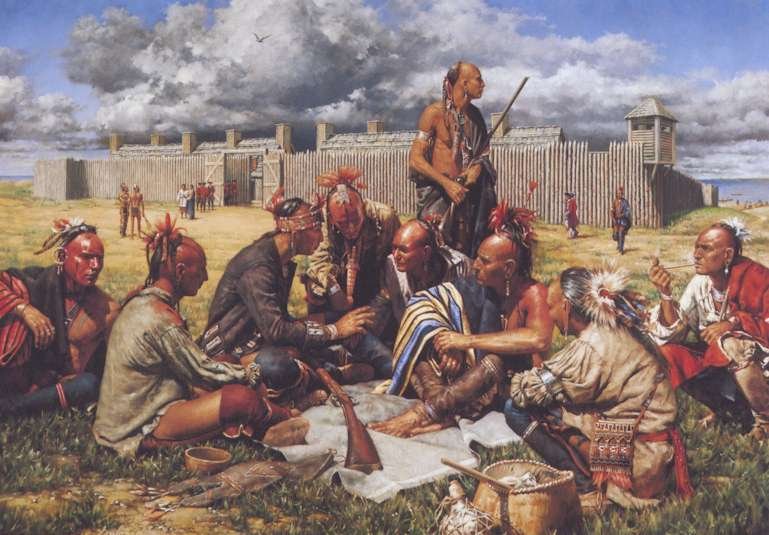
Depiction of Battle of Bushy Run
The Bushy Run battlefield remains the only preserved battlefield from Pontiac's War in the nation.

Reverse Ambush!

When things appeared their bleakest, Bouquet determined to make a move both daring and brilliant. In hoping to force a concentrated attack by the Indians', he then commanded his men to intentionally weaken the southwest side of their position by withdrawing into a feigned retreat. This had the effect of opening that side like a horseshoe, and the attackers came in. 

Bouquet then sent two companies of light infantry undetected to swing around to the east in order to attack the exposed Native American force. The forces, in effect, looped around and turned the whole business inside out, so that the Indians were now being ambushed instead. Bouquet's forces kept up an unrelenting fire, pursuing the enemy until they were dispersed. 

Colonel Bouquet writes, "The left of the savages which had not been attacked were kept in awe by the remains of our troops posted on the hill for that purpose. Nor durst they attempt to support nor assist their right, but being witness to their defeat, followed their example and fled."

The roads now being cleared, the companies of Bouquet's army were able to take the hill to the front. As soon as litters for the wounded could be made and the flour destroyed (burned) for lack of pack horses to carry it, they marched on without further molestation.

In Hindsight

The troops had last seen Pontiac's warriors heading west back toward Fort Pitt, so they didn't know what to expect. But in hindsight, we know that the Battle of Bushy Run ended the siege at Fort Pitt, and actually brought and end to the war itself, as the Native American coalition fragmented with their defeat. The British still had the problem of resupplying and rebuilding Fort Pitt, but the tide of history had definitely turned.

But what about Lachlan?

After the battle, Bouquet counted fifty men killed, sixty wounded, and five missing. I chose Lachlan to become one of those missing men. 

Hanging between life and death, between reality and visions, Lachlan drags himself through the forest. He's afraid to return to the Forbes Road, unsure who has won the battle. Pillars of distant smoke coming from the direction of Bouquet's forces could mean anything. Through a veil of pain, Lachlan turns northward instead. His journey soon reaches its limits however. It is then he is discovered by an unlikely rescuer.


Pontiac's War, August 1763: 

"I beg Ye to take me." Wounded in battle in the Ameridan wilderness, Lachlan McRea of His Majesty's 42nd Highlanders pleads with God, yearning to be reunited with his lost wife and child. As death hovers near, he is discovered by Wenonah, a native widow doing all she can to survive alone while avoiding the attentions of a dangerous Shawnee warrior. In aiding one another, their perils increase, but if Lachlan can let go of the woman he once loved, he might yet find healing for both body and soul.


It's also the final day to get this special deal:
(Expires 8 a.m. Nov. 2)

I hope you'll love all these stories that seek to mine history in light of life as it was back then. Blessings to you, and have a treasured Thanksgiving.

Naomi Musch
https://naomimusch.com/
Friday, October 4, 2019

The Battle of Bushy Run (Part 1) and New Fiction: The Highlanders Romance Collection


In one short month (November 15th to be exact) THE HIGHLANDERS novella collection is due to release, in which each story features a different period of history, and in each one, a heroic Highlander. My story in the collection, titled A TENDER SIEGE, is set on the American Colonial frontier.

You might be wondering what Scottish highlanders would have to do with the American Colonial period. Surprisingly (or not) quite a number of highland regiments fought on the soil of the North American continent. Most of those occurrences took place during the French and Indian Wars. A Tender Siege features such a soldier of His Majesty’s 42nd Highlanders.


The Period

Last May, I wrote a piece called Pontiac and the Conspiracy that Shook an Empire about the Odawa leader who, on the heels of the last French and Indian War, attempted to form a vast confederacy (some said conspiracy) that would renew the fight against the English. Pontiac’s War, as it came to be called, represented the greatest threat of the 18th century against the British colonies here in America. It’s during this uprising that A Tender Siege is set.

The Set-Up

As the story begins, we see highland soldier Lachlan McRae marching through the forest under the command of a professional Swiss soldier, Colonel Henry Bouquet. Since June, highlanders of the 42nd and 77th regiments have been arriving from Staten Island to bolster Bouquet's forces. In the sweltering heat of July, they are finally on their way to relieve the Indians’ siege of Fort Pitt in the Pennsylvania wilderness.

A Little More History

The Indians had been wreaking havoc and fury at forts up and down the frontier. They had already captured Forts Detroit, Sandusky, St. Joseph, Miami, Ouiatenon, Michilimackinac, Venango, LeBoeuf, and Presqu’Isle. They have fired on Fort Ligonier and have massacred both soldiers and settlers. During that same time, the Indians continued plucking away at the small contingent of soldiers and families sheltering inside Fort Pitt. The people there have run out of provisions, and communication lines have broken.

After an initial ten days’ march, Bouquet’s army arrived first at Fort Bedford. There Bouquet recruited scouts and woodsmen to join some of his fiercest highlanders in leading them onward. He also procured what further supplies he could. The army then continued on to Fort Ligonier where it transferred mountainous bags of flour it had been carrying in barrels onto 340 packhorses.

Back to the Story

It is now August 5th, as hot and humid a day as ever there could be, as Bouquet commands his army along a small creek where they might fill their canteens, just five miles east of Bushy Run Station. Surrounded by hills and forests, thirsty and exhausted, the troops plod on both wearily and warily, when the forest comes aliv My hero, Lachlan McRea, is wounded and separated from his troops.


Following is the back cover copy of the story. Next month (November 1st) I’ll tell you what happened next in the Battle of Bushy Run, and I'll share a little more history behind the story of:

A TENDER SIEGE

Pontiac’s War, August 1763:

“I beg Ye to take me.” Wounded in battle in the American wilderness, Lachlan McRea of His Majesty’s 42nd Highlanders pleads with God, yearning to be reunited with his lost wife and child. As death hovers near, he is discovered by Wenonah, a native widow doing all she can to survive alone while avoiding the attentions of a dangerous Shawnee warrior. In aiding one another, their perils increase. If Lachlan can let go of the woman he once loved, he might find healing for both body and soul.

Loving history, loving story,
Naomi Musch

Friday, May 3, 2019

Pontiac and the Conspiracy that Shook an Empire

The French and Indian War, known also in Europe as the Seven-Years-war, was actually the fourth in a series of long and bloody clashes beginning in 1688 between European powers and their native American allies for control of a continent. The period from 1758-1763 we now call the French and Indian War followed King William’s War, Queen Anne’s War, and King George’s War. Collectively, they were known as the French and Indian wars.


In 1756 the most notable of these French and Indian Wars erupted. After six years of vicious fighting, the French abruptly abandoned many of their posts in the interior of the continent along the Ohio Valley and western Great Lakes. The swell of victory lay within England's grasp—except they did not realize that defeating the French did not mean the natives of that country would give up. Many tribes were not willing to hand over yet more of their ancestral lands to the Europeans for settlement and colonization.

Michilimackinac

Then emerged an Odawa leader who had fought alongside the French. His name was Pontiac, called Obwandiyag by the Odawa. He was born on a night of snow and rain, wind and thunder. It is said the elders of his tribe remarked that a great leader was being born. Little is known of his early life, but Pontiac grew to become an important war chief among the Odawa. He was furious when his French allies signed a treaty in 1763 handing over all their lands to the British. Pontiac believed that now the English would flood the country, building towns and pushing the Indians further off their ancestral lands. Pontiac believed the only way to stop this was for all the Indian nations to put aside their past disputes and join together to stop the English. He also hoped that the French would once again join in and help, for they had never shown the intense interest in colonization that the British did.


Indeed, he must have been a great leader and diplomat, for he brought together tribes that had been his peoples’ enemies for countless decades—the Huron, Shawnee, Munsee, Wyandotte, Seneca-Cayuga, Ojibwe, and Lenape—and convinced them that they must stand together against the English. The league of nations he gathered together became known as Pontiac’s Confederacy. In May of 1763, Pontiac’s Rebellion erupted with the siege of Fort Detroit and developed further as he began plucking off the British forts one by one, shaking the foundations of Britain's strength.

Pontiac's Rebellion (also called Pontiac's Conspiracy or Pontiac's War), however, was doomed to failure. In the autumn of 1764, the British military took the offensive, invading the Ohio Valley. Pontiac began to lose some of his followers. The British eventually resorted to negotiating with Pontiac to end hostilities, but the result was the exact opposite of what Pontiac hoped for, because it brought about a greater British military presence in the Ohio Valley and Great Lakes region. Pontiac was eventually assassinated by a Peoria warrior a few years later in the French town of Cahokia. Rumors have long circulated about his death.

I've long been interested in the history surrounding Pontiac's War. This coming November, 2019, will see the release of a new, 4-author, historical romance novella collection in which my story A TENDER SIEGE is set during Pontiac's War. The story follows one particular battle which I'll write about next time. Stay tuned here, and sign up for my newsletter for updates on that release.

You'll also want to stay in touch for a reminder about a FREE book download coming May 23-27 of my novel The Softest Breath, Echoes of the Heart, Book Two. (Book One is only $3.99) It's not a colonial era novel, but I hope you enjoy it. Mark your calendar!


Blessings for your May basket~