Announcements

10 Year Anniverary & New Releases Winners: Carrie Fancett Pagels' Butterfly Cottage - Melanie B, Dogwood Plantation - Patty H R, Janet Grunst's winner is Connie S., Denise Weimer's Winner is Kay M., Naomi Musch's winner is Chappy Debbie, Angela Couch - Kathleen Maher, Pegg Thomas Beverly D. M. & Gracie Y., Christy Distler - Kailey B., Shannon McNear - Marilyn R.
Showing posts with label colonial currency. Show all posts

Monday, June 10, 2019

Colonial Currency

Cash, checks, credit cards, debit cards, and now, cell phones. What do all these have in common?

All, of course, are various methods we have in modern times of buying and selling. But how did people accomplish such a thing back in colonial days?

The monetary system at the time was based on the British pound. The problem was, however, a shortage of actual British money, either paper bills or coins. And like everything else, the Crown grappled for control of the currency standard within the colonies, where various things from wampum, to deerskins, to tobacco were in use as methods of trade. The printing of "notes," the slips of paper that we know as paper money, had also been in use for a long time, but these needed to be backed by something of actual value, whether gold, silver, or--as became popular in Colonial and Federal America--the land itself. There was also the problem of a colonial pound not being valued as highly as a British pound, and of one state not recognizing the value of notes issued by another state. And, of course, counterfeiting was huge, which Benjamin Franklin tried to combat by developing a printing process that involved using actual leaves. (You can see many examples of these at the Wiki link below, on early American currency.) By the end of the American Revolution, it was no wonder the term "not worth a continental" was so commonplace.

The American economy was a bit of a mess in the years after the war, with no standardized method of value and trade. Enter Alexander Hamilton, the first Secretary of the Treasury, who recommended that the country form its first national bank and standardize currency. This led to the passage of the Coinage Act in 1792, which said that American currency be in dollars and units, a decimal system which was easier to keep track of than pounds, shillings, and pence.

The continental dollar was originally based on the Spanish milled dollar, worth about 8 units of Spanish currency, or reales. This standard continued after the Coinage Act, and quarters, dimes, nickels, and cents would eventually follow. For the rest of the 18th century, however, and doubtless several years after 1800, pounds and shillings would still be in use as terms of value. I've found many references in primary sources of both terms, and it was also still very common for folk to trade in skins and tobacco, especially in frontier states such as Kentucky and Tennessee.


For more reading on this complex and fascinating topic, I recommend the following articles:

Wednesday, August 12, 2015

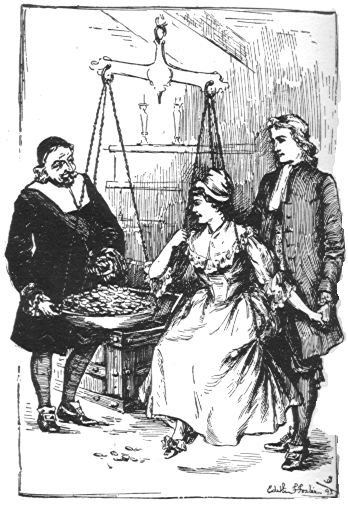
Hannah Hull's Dowry

Her Weight in Gold by Jean Leon Jerome Ferris


There is a charming tale called The Pine-Tree Shilling told by 19th century author, Nathaniel Hawthorne, in The Whole History of Grandfather's Chair (1840). It tells the story of a colonial maiden and how her father ascertained the worth of her dowry.

Miss Hannah Hull was the only daughter of one of the wealthiest men in Boston, Mintmaster John Hull and his wife Judith. In 1652, due to the increase in trade in the Colony, uncertain conditions with England, and to prevent fraudulent money, John Hull, a silversmith, and Robert Sanderson were authorized to erect “a mint for coining shillings, sixpences and three-pences.” Hull guaranteed that each of the Pine-Tree Shillings contained 15 ounces of silver. Massachusetts was the only one of the thirteen colonies that had a mint before the Revolution and it's Pine-Tree shilling circulated up until that time. John Hull’s share in the profits of the mint was fifteen pence of every twenty shillings. He rapidly amassed a fortune.


When twenty-four year old Samuel Sewell came courting and wished to marry Hannah, eighteen, the matter of her dowry came into the picture.


"She saw me when I took my degree and set her affection on me,
though I knew nothing of it until after our marriage, which was Feb 28th. 1675/76."

~ From The Diary of Samuel Sewell

Tradition says that John Hull placed his daughter in one of the scales and heaped in the other with silver, filling it with Pine-Tree shillings until the scales balanced. The wedding present amounted to a dowry of £500. The weight of this amount being 125 pounds may very well have approximated the bride's weight, giving credence to Hawthorne's tale. Samuel received a portion of the dowry seventeen days prior to the marriage nuptials and the remained a fortnight after the wedding. Hannah's marriage to Samuel gave him early wealth, an established merchant business, and a start to his illustrious career in public office. Yet biographers have attested that the marriage was built on mutual happiness and shared love and faith.


"Then the great scales were brought, amid laughter and jest,
And Betsy was called to step in and be weighed;
But a silence fell over each wondering guest
When the mint-master opened a ponderous chest
And a fortune of shillings displayed.
"By handfuls the silver was poured in one side
Till it weighed from the floor blushing Betsy, the bride;
And the mint-master called: 'Prithee, Sewell, my son,
The horses are saddled, the wedding is done;
Behold the bride's portion; and know all your days
Your wife is well worth every shilling she weighs.'"
 ~ Poem by Florence Royce Davis,
Historic Shrines of America, John T. Farris


You may read about the marriage of Hannah Hull and Samuel Sewall online in Puritan Family Life: The Diary of Samuel Sewall by Judith S. Graham.