Announcements

10 Year Anniverary & New Releases Winners: Carrie Fancett Pagels' Butterfly Cottage - Melanie B, Dogwood Plantation - Patty H R, Janet Grunst's winner is Connie S., Denise Weimer's Winner is Kay M., Naomi Musch's winner is Chappy Debbie, Angela Couch - Kathleen Maher, Pegg Thomas Beverly D. M. & Gracie Y., Christy Distler - Kailey B., Shannon McNear - Marilyn R.
Showing posts with label Plymouth Rock. Show all posts

Friday, March 5, 2021

American Colonial History and the Rest of the World in 1620

I've always enjoyed looking back at one aspect or period of history and reminding myself of all the other things happening at that same time. You know...taking a look at the bigger picture going on around the world. 

Take for instance the year 1620, the date which generally marks the beginning of the American colonial period. In that year 102 pilgrims embarked from Plymouth, England on the Mayflower along with 30 crew bound for the new world. Later that same year those pilgrims signed the Mayflower Compact and established Plymouth Colony. We tend to look at most of the world's happenings back then through the lens of what the pilgrims were doing. That's the way we learned it as kids.

Plymouth Rock

When I was a child trying to grasp history, I had the unfounded notion that the pilgrims were the only Europeans in North America at the time. The "New World" was really new! I relegated the Spaniards to explorations in Central America far, far way (another thing I had wrong). The rest of the world ceased turning in light of the colony being established in Massachusetts. 

But in fact, by the time the Pilgrims landed, there had already been a lot of exploration going on just to the north (in Canada), across the Great Lakes, and down the Mississippi to the Gulf. The French had been working at establishing themselves on the North American continent for many years before the pilgrims arrived. In 1620, whilst our intrepid pilgrims were setting sail away from Europe, Henri II, Duc de Montmorency was named Viceroy of New France. With Samuel de Champlain as his lieutenant, he began construction of Fort Saint Louis on the cliffs of Quebec. He then formed a company that was granted an 11-year fur trade monopoly in the New World.

If you remember my earlier posts, you'll recall that fur was the cornerstone on which the entire North American economy was built, so France definitely had the first foothold.

Meanwhile, King James I got it in his mind to commission William Alexander to reclaim New France and Acadia, and the coureur des bois (the free fur traders) founded the trading post called Palace Royal in present-day Montreal. 

All while the Pilgrims were just trying to survive their first year on North American shores.

I mention all this because of of how very important it is to understand our developing nation as a whole. While the arrival of the pilgrims was a huge event that we look to when we consider the colonial period, North America was already being shaped by others, some indigenous, and others as explorers, businessmen, priests, soldiers, and adventurers.   
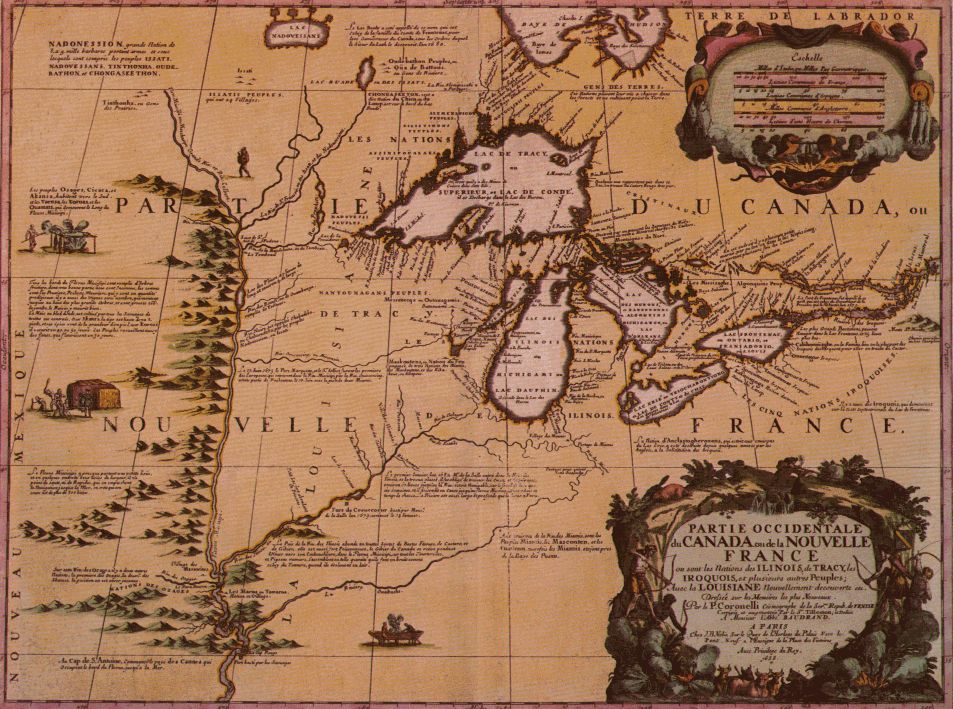

Just for fun and further insight, here are a handful of other important events that took place around the world in 1620:
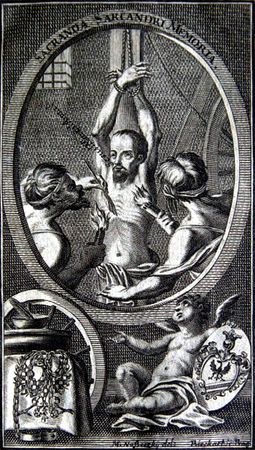
A 1715 etching depicting the torture of John Sarkander

*St. John Sarkander, a Polish-Moravian priest, died of injuries sustained by prolonged torture. It's a long story, connected by ongoing conflicts between Catholics and Protestants in Europe's Thirty Years War, which had begun only two years earlier.*The first merry-go-round was seen at a fair in Turkey.

*The mother of Johannes Kepler, German astronomer, mathematician, and astrologer, was arrested for witchcraft.

*Witch hunts also begin in Scotland.

*The modern violin was developed.

*An navigable undersea boat (type of submarine) was  demonstrated in the Thames River, England.

*A sign alphabet was developed by Juan Pablo Bonet, a teacher of deaf children in Spain.

~~~~~

Are there periods of history or specific historical events that you enjoy studying within the larger context of what was taking place in the world at that time?

Naomi Musch

https://naomimusch.com/


Wednesday, December 17, 2014

Saving Plymouth Rock


Plymouth Rock
With the first day of winter nigh upon us, let's look back upon the first day of winter nearly four hundred years ago, December 21, 1620, when weary voyagers from the Mayflower chose their first permanent dwelling place in North America. Landing on the frigid coast just above Cape Cod, the Pilgrims embarked on the shores of Plymouth, Massachusetts. And stepped onto a huge rock.


"Plymouth Rock" has since become an American icon as a symbol of discovery and liberty. A quest for religious freedom and pursuit of a better life. It cannot be verified that the rock that exists today is actually the rock that the Pilgrims stepped onto, or if they stepped onto such a rock at all. Yet tradition has firmly held through verbal transmission that the large piece of granite provided a steady landing for the sojourners, as sure as their convictions.

One Thomas Faunce was the son of John, who came to Plymouth in the Ann in 1623. John was considered one of the "First Comers"along with the original Mayflower passengers and raised his son, Thomas, contemporaneously with other second generation settlers. From his childhood, Thomas was told by his father and others about coming to America including the report about the rock. Thomas, who became the last elder of the First Church of Plymouth, brought his own children and grandchildren there to continue transmitting the story on each anniversary of the Pilgrim's landing.

Then in 1741 a wharf was to be built over the rock and 95 year old Elder Faunce was taken by chair to see the rock for one last time. At Founder's Day in 1817 a Mrs. White and Deacon Spoon transmitted their testimony that Elder Faunce had publicly proclaimed the history of the consecrated rock with tear filled eyes.


In 1775 inhabitants of the town decided to consecrate the rock as a shrine of liberty. Twenty yoke of oxen attempted to move it only to have it split in two when a team attempted to raise it. The upper portion, however, was placed at the foot of the Liberty Pole as a reminder of the values that first brought the Pilgrims to their beloved country.
Piece of Plymouth Rock taken by Lewis Bradford.
18th and 19th century souvenir hunters have chipped at the rock through the years to take a piece of its legend and legacy. A piece was taken in 1850 by a descendant of Gov. William Bradford and is inscribed "Broken from the Mother Rock by Mr. Lewis Bradford on Tues. 28th of Dec. 1850 4 1/2 o’clock p.m.”. But since 1921, Plymouth Rock has been protected by a monumental enclosure which stands in Massachusetts' Plymouth Rock State Park on the shore of Plymouth harbor. It's current size is believed to be only 1/3 to 1/2 the size of the original piece of granite.


Plymouth Rock in 1867
On the Fourth of July in 1834 the rock was moved to a position in front of Pilgrim Hall where it remained enclosed by a fancy iron fence for forty six years. In 1867 a canopy was errected which sheltered the original piece of the rock. In 1880 the the two fragments were reunited after a separation of over a century. It was that the inscription "1620" was carved into Plymouth Rock.


"We have come to this Rock, to record here our homage for our Pilgrim Fathers; our sympathy in their sufferings; our gratitude for their labours; our admiration of their virtues; our veneration for their piety; and our attachment to those principles of civil and religious liberty, which they encountered the dangers of the ocean, the storms of heaven, the violence of savages, disease, exile, and famine, to enjoy and establish. – And we would leave here, also, for the generations which are rising up rapidly to fill our places, some proof, that we have endeavored to transmit the great inheritance unimpaired; that in our estimate of public principles, and private virtue; in our veneration of religion and piety; in our devotion to civil and religious liberty; in our regard to whatever advances human knowledge, or improves human happiness, we are not altogether unworthy of our origin…"  ~ Daniel Webster, 1820

Plymouth Rock's current enclosure.
  This link will take you to a panoramic view of Plymouth Rock.